49 works in this view — arrow keys or swipe to move between them.
Dance in Art
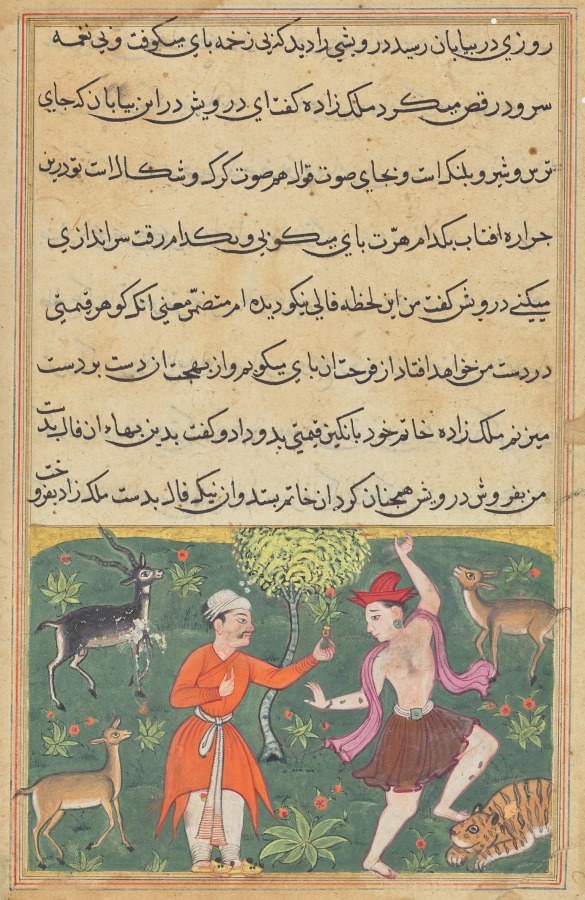
The prince meets a carefree dancing dervish whose good fortune he purchases for his ring, from a Tuti-nama (Tales of a Parrot): Eighteenth Night
Unknown artist
- Medium:
- gum tempera, ink, and gold on paper
- Collection:
- Indian and Southeast Asian Art
- Source:
- Cleveland Museum of Art
- Rights:
- Public domain — free to use, share and adapt.
- Recorded as:
- CC0
This image documents a living sacred dance practice—Sufi dervish movement—as it was understood and valued in 16th-century Mughal courts, rendering visible the spiritual claims made for ecstatic dance and the reverence in which such dancers were held. It also shows how dance functioned as a narrative and moral device in courtly literature: the dervish's movement is not mere entertainment but a sign, readable by the prince, of metaphysical power and fortune. For historians of Sufism and of dance in Islamic culture, this page provides rare visual evidence of how the body in movement was imagined and depicted.
What you are looking at
A prince in an orange tunic and white turban stands in a wilderness garden, facing a bare-chested dervish in a red hat who dances with arms raised in exultation. The dervish's body twists in a dynamic pose, weight shifted, one leg bent as if mid-movement. Around them, the garden teems with wildlife: deer graze unconcerned, a tiger prowls nearby, and birds perch in flowering trees rendered in brilliant greens and golds. The prince extends his hand toward the dervish in a gesture of exchange or blessing. The painting is framed by four margins of Persian calligraphy in black ink on gold-leafed paper, establishing this as a manuscript illustration from a narrative cycle. The color palette is jewel-toned—rich blues, crimsons, and emeralds—with gold leaf catching light throughout the composition. The moment captures the narrative turning point: the prince recognizing divine favor embodied in the dervish's uninhibited joy.
The dancing
The dervish's body is the locus of movement: his torso is upright but uncontained, arms raised and slightly spread, one foot forward in what may be a lifted or pivoting position, the other supporting his weight. His gesture reads as ecstatic and uncontrolled—the movement of a body in trance or joy rather than formal technique. The prince stands in contrast, grounded and still, his posture formal and his gaze fixed on the dervish. The composition opposes restraint (prince) against release (dervish), creating visual and kinetic tension between the two figures.
The dance depicted
This depicts the whirling or ecstatic movement of a Sufi dervish—a sacred dance tradition tied to mystical practice and spiritual attainment. The catalogue notes an irony: in this story, the dervish dances not in pursuit of divine union but from joy at a perceived omen of future wealth. The dervish's raised arms, twisted torso, and free energy are recognizable in Sufi dance iconography, though the painting does not show the sustained spinning associated with formal Mevlevi sema. Instead, it captures a moment of spontaneous, joyful movement—the body's expression of inner ecstasy and hope. The text of the Tuti-nama frames this as a teaching story about fortune and perception.
How it was made
This is a work in gum tempera, ink, and gold on paper—the standard medium for Mughal and Indo-Persian manuscript painting in the 16th century. The technique allowed for jewel-like translucent color, precise line work, and the integration of calligraphy and figuration on a single page. Gold leaf was applied directly to the paper ground and to highlights throughout the composition, creating surfaces that catch and hold light. The fineness of detail—the individual feathers of birds, the veining of leaves, the pattern of the prince's tunic—required brushwork of extraordinary precision. This was court art, produced in a scriptorium for an elite audience, and intended to be viewed at close range, held in hand, and contemplated at leisure.
About this work
This is a page from the Tuti-nama (Tales of a Parrot), a narrative text that circulated widely in Persian, Turkish, and Mughal courts. The Tuti-nama is a frame narrative: a parrot tells stories to a merchant's wife to dissuade her from infidelity, and many of those stories concern fortune, deception, and the hidden workings of fate. This illustration shows the moment when a wandering prince encounters a dervish whose uninhibited dance and apparent contact with divine blessing moves him to exchange his signet ring—and thereby his royal identity—for the dervish's intangible good fortune. The work belongs in a dance history not merely because it depicts movement, but because it records how dance functioned in the Sufi mystical tradition of the Islamic world, and how it could be read as a sign of spiritual or temporal grace. The composition itself teaches through visual contrast: the prince's formal restraint against the dervish's ecstatic freedom.
How to look at it
The viewer should attend to the contrast between the two male bodies: the prince's vertical, enclosed posture and the dervish's opened, spiraling energy. The artist has chosen to freeze the dervish mid-movement, capturing a moment of abandon rather than a static pose—his torso is already in rotation, his arms already lifted. Notice too the role of the animals: they do not flee or attack, but coexist peacefully with the human figures, a visual metaphor for the dervish's spiritual power to harmonize nature and transcend ordinary rules. The gold leaf throughout the painting—particularly in the foliage and in the margins—creates an atmosphere of precious, transcendent space, elevating the scene beyond the merely narrative into the realm of spiritual significance.
The period
The Tuti-nama was composed in Arabic in the 12th century and achieved enormous popularity across the Islamic world, with multiple Persian recensions and Mughal court versions produced in the 16th and 17th centuries. The manuscript tradition flourished under the Mughal emperors, particularly under Akbar (r. 1556–1605), whose court at Agra became a center of artistic production. The integration of Persian literary culture with Indian artistic practice created a distinctive Indo-Persian aesthetic. Sufism was well-established in the Indian subcontinent by this time, and Sufi saints and their spiritual practices, including ecstatic dance and music, held significant cultural and political authority. The dervish depicted here would have been a recognizable figure in Mughal court society—at once exotic, holy, and a subject of fascination and some skepticism. The story's ironic tone (the dervish dances for joy at wealth, not union with God) reflects the courtly skepticism toward mystical claims, even as the image honors the beauty and power of the dervish's movement.
Where it lives
This page is held in the Indian and Southeast Asian Art collection at the Cleveland Museum of Art. It is a leaf from a Mughal-era manuscript of the Tuti-nama, likely produced in the mid-16th century in an imperial or princely court workshop. Such manuscripts were luxury objects, commissioned by the ruling elite and kept in royal libraries; individual pages sometimes entered European and American collections through dispersal during the 19th and 20th centuries.
Dance in this work
Questions about this work
What is a dervish?
A dervish is a follower of a Sufi order, the mystical branch of Islam. Sufi practitioners use practices including music, poetry, dance, and meditation to seek direct experience of the divine. Some dervish orders, most famously the Mevlevi order, incorporated whirling or spinning as a central spiritual practice. In this image, the dervish's ecstatic movement embodies the Sufi ideal of losing the separate self in union with God—though the story humorously subverts this by revealing the dervish's joy is about earthly wealth instead.
What is the Tuti-nama?
The Tuti-nama (Tales of a Parrot) is a narrative frame text originally composed in Arabic in the 12th century. A merchant's wife is seduced by a younger man; her husband leaves on a journey and entrusts a magical parrot to guard her. Each night for 52 nights, the parrot tells her a cautionary tale designed to discourage her infidelity. The stories range from moral fables to picaresque adventures and were enormously popular across the Islamic world. Lavishly illustrated Mughal manuscripts of the Tuti-nama survive from the 16th and 17th centuries.
Why would a prince exchange his ring for a dervish's fortune?
The story concerns the hidden nature of blessing and the permeability of social boundaries. The prince has been exiled by his brother and stripped of royal identity; the dervish appears to possess something more valuable—contact with divine favor, visible in his joy and in nature's harmony around him. By exchanging the ring, the prince recognizes that blessing cannot be inherited or commanded, but must be earned or perceived. The exchange is both a literal transaction and a symbolic recognition that the dervish's spiritual state is worth more than royal insignia.
More dance artwork





