49 works in this view — arrow keys or swipe to move between them.
Dance in Art
Nataraja, Shiva as the Lord of Dance
Unknown artist
- Medium:
- Bronze
- Collection:
- Indian and Southeast Asian Art
- Source:
- Cleveland Museum of Art
- Rights:
- Public domain — free to use, share and adapt.
- Recorded as:
- CC0
This sculpture is a foundational image in art history—the canonical representation of Shiva Nataraja—and it demonstrates that in classical Indian culture, dance was understood as the expression of ultimate reality, not entertainment. For dancers, it reveals how the body can be organized to express abstract philosophical ideas through precise positioning, gesture, and spatial relationship. The work shows that a single figure, arrested in a moment of movement, can contain within its form an entire cosmology.
What you are looking at
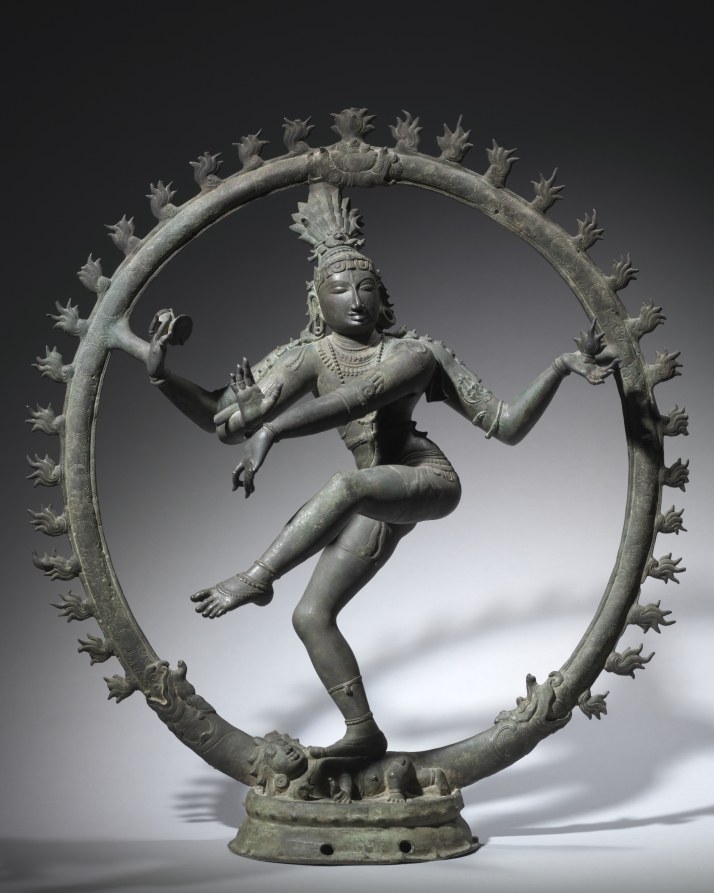
A bronze figure of Shiva emerges from an elaborate flaming aureole, caught mid-leap in a pose of dynamic spiritual power. The dancer's body twists in a contrapposto stance, one leg raised high and bent, the other grounded, creating an illusion of arrested motion—a body suspended between stillness and perpetual motion. The figure wears a tall, intricately carved crown (kirita) and heavy ornamental jewelry: necklaces, bracelets, and an armbands, all rendered with precise detail. The face is serene and composed, with elongated eyes and a subtle smile, the gaze neither directed outward nor inward but existing in a state of divine detachment. In the raised right hand, he holds a small drum (damaru); in the lower left, a hand gesture (mudra) with fingers elegantly arranged; the upper left hand carries a flaming torch or tongue of fire; and the lower right hand is raised in the abhaya mudra (fear-not gesture), palm facing outward. Beneath the dancing feet, a small dwarfish figure—personification of ignorance—is crushed underfoot. The oval flame border (prabha) surrounding the entire composition is densely carved with repeated flame motifs, each flame rising sharply, creating a rhythmic pattern that mirrors the energy of the dancer's movement.
The dancing
A single male figure occupies the composition, modeled in a contrapposto pose of extraordinary complexity and balance. The weight rests on the grounded leg while the other rises, knee bent, toward the torso; the upper body twists independently, creating spiraling lines through the torso and arms. Four arms radiate from the body in different directions and poses, each holding significant ritual objects or making specific hand gestures. The figure's musculature is clearly defined but idealized—the anatomy serves the spiritual narrative rather than naturalistic representation. The movement is not merely captured but choreographed: every limb, every finger, every angle of the body corresponds to specific meaning in classical Indian dance iconography.
The dance depicted
This is Nataraja, Shiva as the Lord of Dance (Nataraja), rendered in the classical bronze form that became canonical across South India from the Chola period onward. The pose represents cosmic dance (tandava)—not entertainment but the rhythmic act of creation, preservation, and destruction that sustains existence itself. The specific iconography—the drum marking time's beat, the flame signifying destruction and transformation, the foot crushing ignorance, the fearless gesture promising liberation—is expressed entirely through the body and its placement. This is sacred gesture made visible, a form of prayer and cosmology executed through the dancer's physical presence. The work belongs to a tradition of devotional sculpture where the image itself is understood as a living embodiment of the divine, meant to be approached, circumambulated, and experienced as a presence rather than merely observed as art.
How it was made
This is a lost-wax bronze casting (the standard technique for this form from the medieval period forward). The complexity of the pose—multiple overhanging limbs, the intricate flame aureole, the small crushed figure beneath the feet—would have required a carefully constructed mold and skilled metalworking. Bronze allowed the sculptor to achieve the slender proportions, the delicate detail of the jewelry and crown, and the precise articulation of the fingers and mudras in a way stone would not have permitted. The surface has developed a dark green patina characteristic of age and oxidation. The material choice—bronze rather than stone—meant the work was likely created for a royal court or wealthy temple, where the expense was justified by the status of the patron and the sacred significance of the subject.
About this work
This is one of the most famous sculptural types in world art: the Nataraja or dancing Shiva, here rendered as an eleventh-century South Indian bronze. The work crystallizes the classical Hindu understanding of dance as a cosmological force—the god's movement embodies the cycles of creation and destruction that sustain all existence. The figure's four-armed pose, complex contrapposto stance, and radiant flame border create an image of concentrated spiritual energy expressed entirely through bodily form and gesture. It is simultaneously sculpture, prayer, and philosophical statement, belonging to a tradition in which the image itself is sacred and the dancer's body a vehicle for divine truth.
For dancers and historians, this work represents an entirely different paradigm of what dance can be: not entertainment, not narrative, but metaphysical principle made visible. The precision of the pose—every mudra, every angle of the limbs—corresponds to specific meanings in classical Indian dance systems like Bharatanatyam and Kathak. To understand this image is to understand how in many cultures, the dancing body has been understood not as a performer but as a vessel for cosmic or sacred forces.
How to look at it
Observe first the pose: note how the figure seems to be in perpetual motion despite being cast in bronze, and how the twisting of the torso and the angle of each limb creates a spiral or rotating effect around the body's center. Look at the relationship between the grounded foot and the raised leg—the balance achieved is not stable but dynamic, suggesting the dancer is captured mid-leap rather than at rest. Study each of the four arms separately and consider what each is doing: the raised hand is a gesture of reassurance, the drum a symbol of time's rhythm, the flame a symbol of destruction, and the fourth hand a gesture of grace. Finally, attend to the face: despite the frenetic activity of the body, the face remains calm and focused, suggesting that all this movement originates from inner stillness and spiritual control, not emotional agitation.
The period
This work dates to around 1000 CE, during the Chola dynasty's rule in South India—a period of extraordinary artistic and cultural flowering. The Cholas were great patrons of temples and commissioned thousands of bronze sculptures, many of which survive today in temple collections and museums. By this period, classical South Indian dance forms had developed sophisticated systems of gesture, posture, and movement (mudra, rasa, bhava), codified in texts like the Natya Shastra. Shiva had long been worshipped as Nataraja (Lord of Dance) in Tamil devotional poetry and philosophy, but the bronze sculptural form became standardized during the Chola period, and this work represents that classical synthesis. In the broader art-historical context, this is a moment when Hindu temple sculpture had reached a sophisticated understanding of how to express complex theological and philosophical ideas through the human body.
Where it lives
This bronze is held in the Indian and Southeast Asian Art collection of the Cleveland Museum of Art, catalogued as a significant example of Chola-period sculpture.
Dance in this work
Questions about this work
What are the four arms doing?
Each arm communicates a different aspect of Shiva's role. The raised right hand holds the damaru (drum), symbolizing the rhythmic beat of creation. The lower right hand is raised in the abhaya mudra (fear-not gesture), offering protection and reassurance to devotees. The upper left hand carries a flame or flaming torch, representing destruction and transformation. The lower left hand points downward or gestures in a dancing pose. Together, the four arms express the totality of Shiva's divine function.
Who is the figure being crushed under the feet?
The small dwarfish figure beneath Shiva's feet represents Apasmara, a demon embodying ignorance and illusion. By dancing on this figure, Shiva symbolically conquers ignorance and liberates his devotees from the cycles of rebirth and suffering. This trampling is not violent destruction but a spiritual act of redemption.
Why is the figure surrounded by flames?
The oval flame border (prabha or mandorla) is a standard element in Hindu and Buddhist sculpture, signifying the spiritual power and divine presence of the figure. The repeated flame motifs create a visual field of energy around the dancer, emphasizing that this is not a human dancer but a cosmic or divine force. The flames also reference one of Shiva's epithets and aspects: the god of destruction and transformation through fire.
Is this sculpture meant to be danced?
No—this is a devotional sculpture meant to be viewed and worshipped, not imitated. However, the form is deeply informed by the classical dance traditions of South India. Dancers trained in Bharatanatyam or Kathak would recognize the mudras (hand gestures) and the sculptural convention of expressing meaning through the body's positioning. The work is a record of how dance was understood and valued in medieval South India.
More dance artwork





