49 works in this view — arrow keys or swipe to move between them.
Dance in Art
Dancing Woman with Arms Spread
Pierre Roche (French, 1855–1922)
- Medium:
- gypsograph
- Collection:
- Prints
- Source:
- Cleveland Museum of Art
- Rights:
- Public domain — free to use, share and adapt.
- Recorded as:
- CC0
This image is among the most significant visual records of Loïe Fuller's movement vocabulary and its revolutionary impact. For dance historians, it offers direct testimony to what Fuller achieved: the transformation of the human body into something abstract, dreamlike, and sculpture-like through the orchestration of costume and motion. For historians of modernism more broadly, it demonstrates how Fuller's innovations in dance catalyzed responses across all the visual arts.
What you are looking at
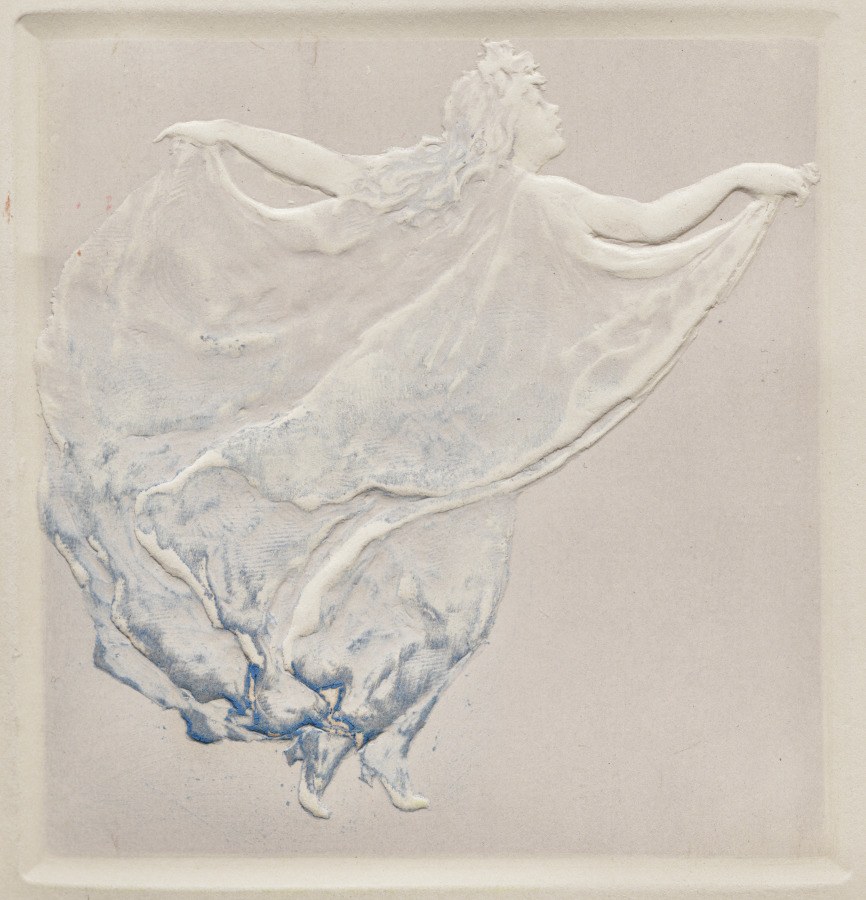
A single female figure emerges from pale, sketchy background in a classicizing relief style. She is captured mid-movement, her body twisted in a dynamic spiral: her head turns sharply to the left in profile, her long curled hair prominent, while her torso and limbs writhe and undulate. Both arms sweep outward and upward in expansive arcs; the upper body leans back and to one side. Her drapery—a flowing, diaphanous garment—billows and swirls around her body, caught in the moment of movement. The fabric dominates the composition, rendered with deep shadows and tonal gradations that suggest volume and weightlessness simultaneously. Her legs are obscured by the drapery, but her stance suggests a tilted, off-balance pose. The relief technique and monochromatic palette (white figure, gray shadows, tan ground) create the impression of a sculptural study rather than a painted scene.
The dancing
A single dancer occupies the composition, her body arched in a pronounced backbend or spiral twist. Both arms are raised and extended outward, creating an open, expansive upper-body frame; the left arm curves upward and to the left, the right sweeps to the right. Her head is turned sharply to profile, looking leftward. The core of her body appears to twist and flex, suggesting active rotation through the torso. The weight appears shifted and mobile—there is no planted stance visible, only the sense of a body in flux. Her bare arms and legs (insofar as they appear beneath drapery) show articulated musculature rendered naturalistically, not idealized.
The dance depicted
This is almost certainly a study of Loïe Fuller, the American modern dancer whose revolutionary serpentine and fabric-based technique mesmerized Paris from 1892 onward. Fuller's signature aesthetic involved large expanses of flowing silk, manipulated by the dancer's movement and often by hidden supports, which created the illusion of a creature of fabric rather than a human in clothing. The image captures the core of her innovation: the body becomes nearly incidental to the dance of the drapery itself. The backbend and spiral twist, combined with the billowing garment rendered in tonal depth, evoke Fuller's dreamlike, often abstract movement vocabulary. Roche, a prolific portraitist of Fuller in multiple media, distilled her essence in this gypsograph—a print technique allowing him to render the soft gradations and sculptural volume necessary to convey the weight and flow of her signature silks.
How it was made
The work is a gypsograph, a relief printing process (sometimes called a type of zincograph or alumigraph) that allowed artists to work with tonal variation and soft gradation rather than the line-based language of traditional engraving or etching. The process involves creating an image on a prepared metal plate (often zinc or aluminum) from which prints are pulled. Unlike lithography, gypsography produces a relief print, allowing for the subtle modeling of light and shadow visible here. The monochromatic palette—achieved through careful gradation of the printing ink—is ideally suited to capturing the play of light across soft fabric and the sculptural volume of a body in motion. The technique was relatively modern in Roche's time and would have allowed wider distribution and multiple impressions than a unique sculpture.
About this work
This is a gypsograph by French sculptor Pierre Roche documenting Loïe Fuller, the pioneer of modern dance who revolutionized theatrical movement in the 1890s through the integration of flowing costume and ethereal lighting. Roche created an extensive series of such prints, part of a larger body of work across multiple media (sculpture, bronze, marble, plaster) devoted to Fuller as subject. The image does not depict a recognizable classical position or ballet vocabulary but rather the essence of Fuller's movement philosophy: a body subsumed within and animated by fabric, creating an abstract, almost otherworldly visual poetry.
The work belongs in a dance archive as a primary record of how one of the twentieth century's most influential dance innovators was perceived and commemorated by her contemporaries. It is also a document of print technique and of the deep intersection between visual art and dance innovation at the turn of the century.
How to look at it
Observe the moment Roche has chosen: not a high point of extension or a planted pose, but a moment of spiraling, off-balance motion. The body is readable only by following the tonal gradations—the figure is not outlined but sculpted by shadow. Notice how the drapery dominates: it is not merely clothing, but the primary subject of the dance. The arm positions are open, expansive, and asymmetrical; there is no geometric balance, only the dynamic tension of a body in flux. The soft, almost painterly quality of the gypsograph medium—the graduated tones and absence of sharp lines—conveys the ephemeral, dreamlike character that observers associated with Fuller's performances.
The artist
Pierre Roche (1855–1922) was a French sculptor and versatile printmaker active during the height of Art Nouveau and early modernism. Though best known for sculpture, he was deeply engaged with experimental printmaking techniques and worked prolifically across media. His extended engagement with Loïe Fuller as a subject—across clay, bronze, marble, plaster, and gypsographs—speaks to Fuller's profound cultural significance in early 1890s Paris and to Roche's conviction that her innovations warranted sustained artistic documentation. The series of gypsographs accompanied an essay by the influential art critic Roger Marx, who framed the publication as 'a precious monument to Loïe Fuller,' indicating the esteem in which both the artist and critic held her achievement.
The period
Loïe Fuller emerged as a performer in Paris in 1892, at a moment when modernist visual art was beginning to fragment traditional representational strategies. Her dancing participated in broader fin-de-siècle interests in abstraction, the synthesis of the arts, and the dissolution of the human form into atmosphere and ornament—concerns shared by Symbolist painters and Art Nouveau designers. The early 1900s (when Roche was creating these prints) represented a high point of Fuller's fame and influence. In dance history, Fuller's work was anomalous: she did not fit neatly into ballet or theatrical dance tradition, instead occupying a liminal space later recognized as prototypical of modern dance. In the visual arts, the period saw intensified experimentation with printmaking techniques and with the representation of movement itself—concerns evident in everything from Futurist painting to photographic studies of locomotion.
Where it lives
The work is held in the Prints collection of the Cleveland Museum of Art (source: cma). It is one of a series of gypsographs illustrating an essay by critic Roger Marx, a publication designed as a comprehensive artistic commemoration of Fuller's achievement.
Dance in this work
Questions about this work
Who was Loïe Fuller and why did artists keep painting her?
Loïe Fuller (1862–1928) was an American dancer who revolutionized theatrical dance in Paris beginning in 1892 through her invention of 'Serpentine' or 'Skirt' dancing—a technique involving large swaths of silk that she manipulated to create abstract, otherworldly visual effects. She was not a classical ballet dancer but a pioneer of what would become modern dance. Artists across all media were captivated by her work because it suggested new possibilities for the relationship between the body, costume, light, and abstraction. Roche, a sculptor, was among the most dedicated visual artists to document her.
What is a gypsograph?
A gypsograph is a relief printing technique that produces soft, tonal imagery rather than the linear marks of traditional engraving. The artist works on a prepared metal plate (zinc or aluminum), and the resulting prints allow for subtle gradations of light and shadow. The technique was modern in Roche's era and suited to representing the play of light and volume—particularly useful for depicting fabric and the sculptural qualities of the body in motion.
Can you see her feet in this image?
No. The dancer's legs and feet are entirely obscured by the flowing drapery, which is intentional and characteristic of how Roche (and other artists) represented Fuller. In her actual performances, Fuller's footwork was often invisible; the dance was understood as the dance of the fabric itself rather than a display of the moving body. The obscuring of the lower body emphasizes this aspect of her innovation.
Is this a sculpture or a print?
This is a print—a gypsograph, a relief print technique. However, gypsographs can achieve sculptural effects through tonal modeling, and the image itself evokes sculpture. Roche worked in both media: he created sculptures of Fuller in clay, bronze, and marble, and also created a series of these gypsographic prints. Both approaches allowed him to capture the abstract, voluptuous quality of her movement.
More dance artwork





