49 works in this view — arrow keys or swipe to move between them.
Dance in Art
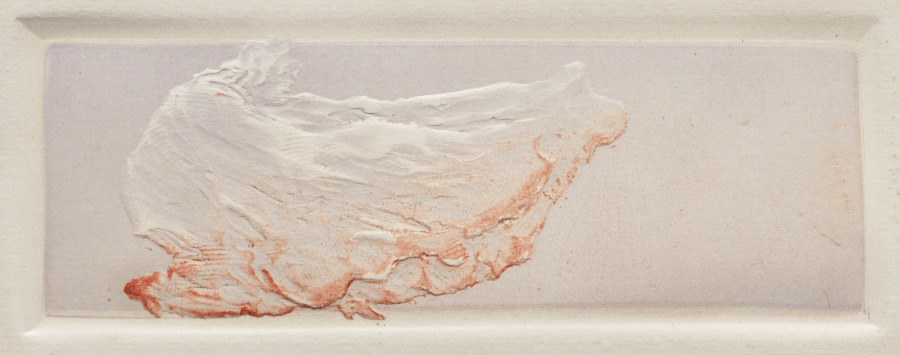
Dancing Woman Slightly Crouched
Pierre Roche (French, 1855–1922)
- Medium:
- gypsograph
- Collection:
- Prints
- Source:
- Cleveland Museum of Art
- Rights:
- Public domain — free to use, share and adapt.
- Recorded as:
- CC0
Loïe Fuller was one of the most celebrated performers of the late 19th and early 20th centuries, credited with inventing modern dance. Her work shifted the focus of dance away from the body as the primary aesthetic object toward the possibilities of costume, lighting, and abstraction—a shift that enabled entire new genres. Roche's multiple studies of Fuller represent one of the few sustained artistic attempts to capture her distinctive technique in motion, making them crucial visual documentation of her innovation at a moment when film technology was still primitive.
What you are looking at
A single female figure is captured in a moment of dynamic movement against a pale lavender ground. She is rendered in soft red-orange chalk or crayon, her body compressed into a forward-leaning crouch with knees deeply bent. Her upper body pitches toward the viewer, arms extended and flowing, the fabric of her garment—a long skirt or robe—sweeping behind and above her in a dramatic arc. The drapery billows with such force and fluidity that it becomes almost independent of the body, creating the sense of rapid motion arrested mid-gesture. The figure appears weightless, suspended between stillness and movement. The composition is intimate and closely framed, focusing entirely on the dancer's silhouette and the sculptural quality of fabric in motion.
The dancing
The dancer's frame is compact and folded, with a profound forward lean that suggests either a deep bow or a moment of propulsive transition. Her center of gravity is clearly forward and low. The arms are extended but not rigid—they appear to flow with the movement rather than frame it formally. The drapery rises and curves above her head and torso in ways that suggest either a shawl or loose overdress caught in motion, or the photographer's capture of the skirt's own momentum. The posture is asymmetrical and organic rather than posed, reading as a genuine frozen instant rather than a choreographed position.
The dance depicted
This is almost certainly a study of Loïe Fuller, the American modern dance pioneer who revolutionized performance through the manipulation of voluminous silk skirts and novel stage lighting. The catalogue record confirms Fuller was Roche's frequent subject. The forward crouch, the sweeping drapery, and the emphasis on fabric movement are hallmarks of Fuller's signature technique: she danced with long silk skirts that she controlled with concealed rods and wires, creating undulating abstract forms. The image captures not a single codified step but rather the moment of sculptural transformation that was Fuller's innovation—the body as a vehicle for drapery and light rather than as the primary visual object. The crouch and lean suggest either an opening gesture or a moment of directional change within one of her famous 'skirt dances.'
How it was made
The work is a gypsograph, a print medium in which an image is drawn or engraved into a surface that is then dampened and printed, allowing for soft, atmospheric effects and rich tonal variation. The red-orange crayon or chalk marks have been applied with clear directional intention—flowing strokes follow the fall of drapery, while the body is more firmly defined. The lavender ground is integral to the composition, not merely background; it creates an ethereal, theatrical space. Gypsography, though less common than lithography or etching, allowed for intimate, sketch-like qualities while still permitting multiple impressions, making it suitable for illustrative essays such as the Roger Marx publication on Fuller.
About this work
This is one of a series of gypsographic studies by the French sculptor and printmaker Pierre Roche, executed around 1904 as part of a visual essay on the dancer Loïe Fuller. The image captures Fuller not as a posed portrait subject but as a moving form—a moment of kinetic energy suspended in print. The work is part of a broader artistic fascination with Fuller's revolutionary practice; many major visual artists of the period (including Toulouse-Lautrec, Raoul Larche, and others) were drawn to her as a subject precisely because she made visible the abstract possibilities of motion, fabric, and light. For a gallery of dance in art, the work documents both a seminal dance innovator and the visual language artists developed to represent modern movement itself.
How to look at it
Attend to the moment the artist has chosen: not a peak or a full extension, but a compressed, transitional instant—the dancer folded forward in a crouch. This was a deliberate choice; a classical artist might have chosen a moment of maximum extension or clarity. Notice how the drapery has its own life and weight, rising and curving independently of any clear anatomical logic. The artist is asking you to see motion as form, not as the arc of a body. The soft medium and the atmospheric background push against the hard edges one might expect from an anatomical study; instead, the work feels dreamlike and sculptural, which is precisely how Fuller's work was experienced.
The artist
Pierre Roche (1855–1922) was a French sculptor and printmaker of considerable versatility. Though best known for three-dimensional work in clay, bronze, plaster, and marble, he was also a prolific experimenter in print media. His sustained interest in Loïe Fuller as a subject—across multiple mediums and over several years—speaks to the profound cultural impact Fuller had on artists of his time. The portfolio of Fuller studies, illustrated Roger Marx's essay, placed Roche within the circle of advanced cultural commentary on modern performance. His practice exemplifies the turn-of-the-century intersection of sculpture, printmaking, and dance documentation.
The period
Loïe Fuller danced in Paris from 1892 onward, and her work sparked an immediate artistic frenzy. By 1904, when Roche made this series, Fuller was already a legend; her skirt dances had been extensively illustrated, collected, and theorized. This was the era of Art Nouveau, when artists were fascinated by motion, metamorphosis, and the aesthetics of fabric and light. In dance itself, Fuller's work was a watershed: it demonstrated that modern dance need not imitate ballet's formal codification, that the body could be de-emphasized, that light and costume could be choreographic elements in their own right. Roche's gypsographic studies sit at the intersection of printmaking innovation and dance history, documenting a moment when visual artists saw dance as worthy of sustained, serious artistic attention.
Where it lives
The work is held in the Prints collection of the Cleveland Museum of Art (cma). It is part of a series of gypsographic studies of Loïe Fuller created to illustrate an essay by the art critic Roger Marx, described as 'a precious monument to Loïe Fuller.' The series represents one of the most sustained artistic attempts to document Fuller's practice.
Dance in this work
Questions about this work
Who was Loïe Fuller?
Loïe Fuller (1862–1928) was an American dancer who revolutionized modern dance beginning in the 1890s. She danced with long, voluminous silk skirts that she manipulated with concealed wires and rods while performing under colored stage lights. Her work was abstract and sculptural rather than narrative; she created what she called 'skirt dances' that transformed the stage into a landscape of flowing fabric and light. She was as much a visual artist and inventor as a dancer, and her work influenced artists, choreographers, and architects across Europe and America.
What is a gypsograph?
A gypsograph is a print technique in which an image is drawn or etched into a prepared surface (often a type of plaster or chalk-based compound), which is then dampened and printed. The technique produces soft, atmospheric marks and rich tonal variation, similar to lithography but with a distinctive tactile quality. Gypsography allowed artists to produce multiple prints from a single drawn or engraved original, making it suitable for illustration and reproduction while retaining a sketch-like, intimate quality.
Why did so many artists paint or draw Loïe Fuller?
Fuller's work was visually revolutionary and philosophically fascinating to artists of her era. She made visible the abstract possibilities of motion, light, and fabric—ideas that aligned with Art Nouveau aesthetics and modernist thinking. Unlike ballet, which was codified and formal, Fuller's work was radically open-ended and experimental. Artists saw in her practice a model for how art itself could move and transform, making her not just a performer to depict but a muse to intellectual and aesthetic innovation.
What moment in the dance does this image capture?
The image captures a compressed, transitional moment—a deep crouch or forward fold. It is not a moment of maximum extension or clarity, but rather a moment of gathered energy or directional change. The choice to freeze this moment rather than a more extended or balanced pose is significant; it emphasizes motion and transformation rather than beauty of line or classical form. The drapery's momentum suggests the dancer has just shifted direction or is about to rise or leap.
More dance artwork





