49 works in this view — arrow keys or swipe to move between them.
Dance in Art
Dancing Woman with Arms Raised
Pierre Roche (French, 1855–1922)
- Medium:
- gypsograph
- Collection:
- Prints
- Source:
- Cleveland Museum of Art
- Rights:
- Public domain — free to use, share and adapt.
- Recorded as:
- CC0
Loïe Fuller was a watershed figure in dance history, and her influence on the visual arts has been underestimated. Roche's series demonstrates that Fuller was not peripheral to art historical discourse but central to it—sculptors, painters, and printmakers treated her as a subject of the same order as classical nymphs or allegorical figures. The gypsograph format, sculptural in its origins, signals that Fuller's dance was understood not as transient performance but as enduring form, worthy of being cast, printed, and preserved in collectors' portfolios.
What you are looking at
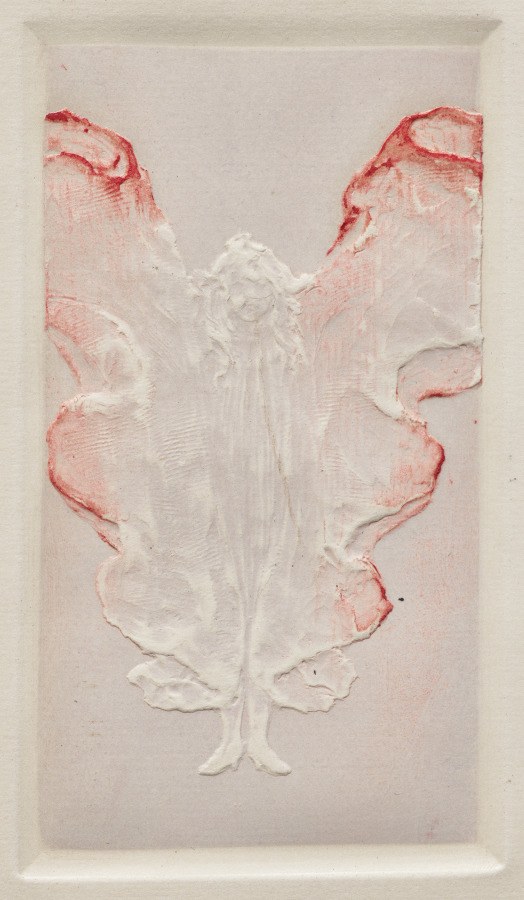
A single female figure dominates a cream-coloured ground, rendered in strong relief through contrasting red outlines and white highlights. She stands with arms raised in a sweeping gesture that curves upward and outward from her torso, creating an expansive silhouette. The figure is modelled with soft, rounded forms built up in white pigment, giving her substantial volume and weight. The red contours define the edges of the raised arms, the upper body, and the folds of what appears to be a flowing garment or robe, while the lower body tapers into a simple vertical line descending from the waist. The composition is severely frontal and symmetrical, with the raised arms creating a lyre or V-shaped frame above the head. There is no indication of setting, floor, or spatial context; the figure exists in an ambiguous shallow space defined only by the paper's edge.
The dancing
The body is presented in a standing position with both arms raised to approximately shoulder height or higher, creating a symmetrical composition. The gesture reads as expansive and buoyant—not a static pose but a moment of upward momentum, as though the figure is rising or floating. The torso is frontal and upright, with the weight appearing centred. The arms sweep outward with curved, graceful lines, and the raised position of the hands suggests a moment of fullness or culmination in movement. There is a single dancer, and the focus is entirely on the quality and extension of the upper body.
The dance depicted
This is recognizable as modern dance, and the catalogue record identifies the subject as Loïe Fuller, the American-born pioneering modern dancer who transformed Paris in the 1890s with her serpentine and skirt-dancing innovations. Fuller's signature was the manipulation of flowing silks and the creation of abstract sculptural forms through movement, posture, and lighting effects. The raised-arm gesture and the emphasis on the flowing fabric and upward extension are consistent with Fuller's vocabulary: a moment of apotheosis or transcendence, where the body and costume merge into an ethereal form. The symmetrical, frontal presentation and the sense of vertical lift align with how Fuller was mythologized and abstracted by sculptors and graphic artists of the period—not as a naturalistic figure, but as a symbol of artistic innovation and the liberation of movement.
How it was made
This is a gypsograph, a relief printing technique using plaster or clay rather than wood or metal. The process allowed the artist to build forms additively in three dimensions and then ink the raised surface, resulting in the crisp, high-contrast effect visible here: white plaster catching and holding the ink, with red lines where the paper receives the impression from the recessed edges. The technique produced a sculptural quality—the figure reads as volumetric and haptic—while remaining reproducible through printing, making it ideal for book or portfolio illustration. The warm cream of the paper ground and the selective use of red accent (rather than full-colour printing) speaks to a refined, limited-edition practice, consistent with Roche's use of the medium for an art-critical essay.
About this work
This gypsograph is one of a series Roche created to accompany art critic Roger Marx's essay on Loïe Fuller, whom Roche had portrayed across multiple media—sculpture, bronze, marble, and plaster—throughout his career. The work freezes a moment of Fuller's characteristic gesture: the upward extension of the arms and the illusion of weightless motion created by the sculptor's manipulation of form and surface. It is not a documentary image but a distillation of Fuller's artistic essence—the sense of transcendence and sculptural abstraction that made her revolutionary. In the context of dance art, the image represents a crucial moment when modern dance, then barely a decade old, was being claimed and canonized by the fine-art establishment through the work of serious sculptors and critics. Fuller's body became not just a dancer's body but a subject worthy of sustained artistic investigation and monumental treatment.
How to look at it
Attend first to the symmetrical composition and the complete absence of narrative or setting. The artist has chosen to present Fuller not in a moment from a dance or within a stage space, but as a pure sculptural form—almost as a monument. The raised arms and the sense of vertical lift read as aspiration or transcendence, not as a step or phrase of actual choreography. The contrast between the soft, white-rendered body and the sharp red contours creates visual tension; the figure seems to emerge from or dissolve into the paper. Notice how the lower body is barely articulated—it is the extension and gesture of the arms and torso that carry all the meaning. This is abstraction in service of capturing something essential about Fuller's contribution: the idea that dance could be pure form, transcendent and timeless.
The artist
Pierre Roche (1855–1922) was a French sculptor of considerable skill and versatility. While best known for large-scale sculptural work, he was a prolific experimenter across media—bronze, marble, plaster, clay, and printmaking. His interest in the gypsograph process and his sustained focus on Loïe Fuller as a subject suggest an artist deeply engaged with modernist abstraction and the expressive possibilities of form. Roche worked in the fin-de-siècle avant-garde milieu, collaborating with important critics like Roger Marx, and his career reflects the period's fascination with merging fine art and performance, sculpture and ephemeral movement.
The period
This work was made in 1904, twelve years after Fuller's Paris debut in 1892 and at the peak of her cultural influence and critical canonization. By 1904, Fuller had transcended the status of music-hall performer; she was a muse and intellectual subject. The period saw intense cross-pollination between dance and visual art: sculptors treated dancers as vehicles for abstraction, and photographers and printmakers developed new techniques to capture movement. Roche's gypsograph series coincides with a moment when modern dance was claiming artistic legitimacy not through imitation of classical ballet but through the embrace of sculpture, form, and the body as pure expressive material. The accompanying essay by Marx—a major critic—anchored Fuller's practice in aesthetic philosophy rather than entertainment.
Where it lives
The work is held in the Prints collection at the Cleveland Museum of Art, acquired from an identified source. It is part of a series of gypsographs commissioned to illustrate an essay on Fuller by critic Roger Marx, which was itself described as 'a precious monument to Loïe Fuller.' The series was meant to circulate among collectors and in art-critical circles rather than as mass-market reproduction.
Dance in this work
Questions about this work
Is this a real sculpture, or just a print?
It is a print made from a relief sculpture. Roche carved or modelled the image in plaster or clay in three dimensions, then inked the raised surfaces to create the gypsograph. You are looking at the printed result, but it records the texture and form of an original sculptural object. The technique allowed Roche to produce multiple impressions for distribution in the Marx essay and collectors' portfolios.
Why are there red lines around the figure?
The red marks the edges where the sculpture meets the paper during printing—the recessed areas of the relief block. The soft white forms are the raised surfaces that held ink. The interplay of red outline and white volume creates the sense of the figure emerging from the ground, and gives the image its striking, almost stained-glass quality.
Is this really Loïe Fuller dancing?
Not exactly. Roche has abstracted and idealized Fuller's characteristic gesture—the raised arms and flowing costume—into a timeless sculptural form. It is not a snapshot of a specific choreography, but rather a distillation of what Fuller stood for: weightlessness, transcendence, and the liberation of the body through movement and fabric. It is artistic interpretation rather than documentation.
Who was Loïe Fuller?
An American dancer who revolutionized modern dance in the 1890s by combining flowing silk costumes, innovative lighting, and abstract gestural movement to create immersive visual experiences. She rejected classical ballet technique and instead developed a vocabulary based on the manipulation of fabric and the interplay of light and shadow. She was celebrated in artistic circles across Europe and influenced painters, sculptors, and photographers.
More dance artwork





