49 works in this view — arrow keys or swipe to move between them.
Dance in Art
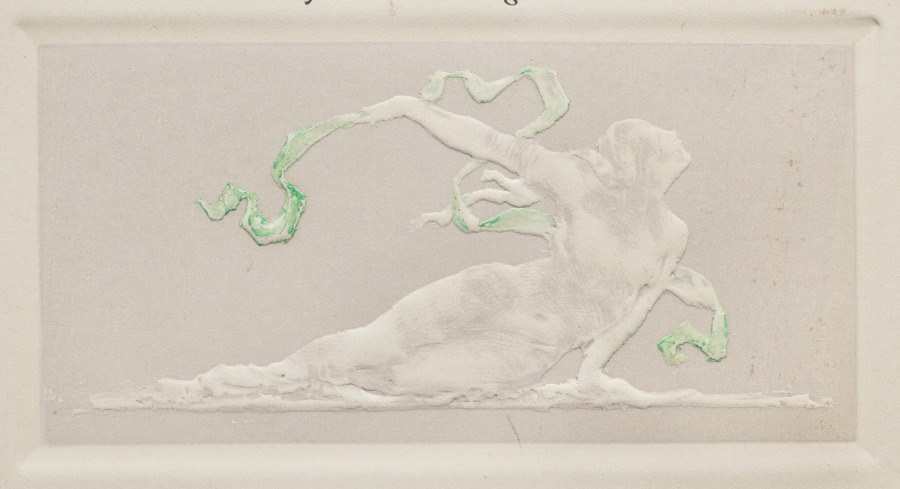
Dancing Woman in Reclining Pose
Pierre Roche (French, 1855–1922)
- Medium:
- gypsograph
- Collection:
- Prints
- Source:
- Cleveland Museum of Art
- Rights:
- Public domain — free to use, share and adapt.
- Recorded as:
- CC0
Loïe Fuller was a foundational figure in modern dance, and Roche's images of her are among the only visual records made by a serious sculptor during her performing lifetime. This print demonstrates how early modern dance was understood and valued by fine artists: not as entertainment but as a new form of human movement worthy of the same sustained visual attention given to classical sculpture. For dancers and historians, these works document a moment when avant-garde performance and visual art were not separate disciplines but deeply intertwined.
What you are looking at
A reclining female figure dominates this composition, rendered in white relief against a pale ground with carefully modeled shadows and highlights. She lies on her back in a languid, contorted pose, her body twisted with one arm extended upward and the other across her torso, her legs bent and intertwined. The figure occupies nearly the full width of the rectangular format. Surrounding her are five green linear forms that read as abstract or stylized serpents or fabric elements—some coiling above and beside her, others trailing across the lower register. The precise white modeling of the figure's musculature, torso, and limbs creates a sculptural quality despite the work's print format, emphasizing the dancer's flexibility and the stretch of every limb.
The dancing
A single female body occupies nearly the entire composition. Her pose is extreme and supple: recumbent with the back arched, one arm reaching upward in an extended line, the torso twisted to allow the other arm to cross the body, legs sharply bent and played. The weight is distributed across the back and hip, suggesting sustained flexibility rather than momentary balance. The figure's total extension—fingertips to toes—and the dramatic hyperextension of the torso suggest either advanced acrobatics or the stylized exaggeration of dance movement common to art nouveau representation.
The dance depicted
This work depicts Loïe Fuller or a figure inspired by her revolutionary modern dance. Fuller pioneered a dance form centered on the manipulation of yards of silk fabric, undulating movement, and dramatic bodily contortion under colored light, which took Paris by storm in 1892. The green linear forms surrounding the figure almost certainly represent her iconic flowing costumes—Fuller's drapery could extend to fifteen feet and was integral to the visual spectacle of her performance. The extreme flexibility and twisted torso align with the serpentine, liquid movement Fuller popularized, though pinpointing a specific style within modern dance remains impossible from the image alone. The work belongs to a moment when avant-garde dance and visual art were in active conversation.
How it was made
A gypsograph is a form of photogravure—a process combining photography with etching to produce a print with photographic tonal range and depth. The technique allows for subtle modeling of form through continuous tone rather than line or crosshatching alone, explaining the sculptural realism of the figure and the soft modeling of flesh and muscle visible here. Gypsographs occupied a middle ground between fine art and mechanical reproduction, offering fine-art quality to wider audiences while maintaining the artist's control over the image. This particular work's soft, almost translucent white figure against pale ground is characteristic of the medium's capacity for extreme tonal subtlety.
About this work
This gypsograph belongs to a series that sculptor and printmaker Pierre Roche created as illustration for an essay on Loïe Fuller by art critic Roger Marx. Fuller's revolutionary modern dance—built on undulating movement, extreme bodily flexibility, and vast swirling silk costumes—captivated Paris from 1892 onward and inspired artists across media. Roche was one of the most devoted visualizers of Fuller's movement; his bronze and marble sculptures of her are among the best-known dance representations of the era.
The work combines Roche's training as a sculptor with the reproductive potential of the gypsograph. The figure's anatomical precision and the modeling of every muscle group reflect Roche's three-dimensional understanding of the body in motion. Yet the introduction of the green serpentine forms—Fuller's signature costume elements—shifts the image from pure anatomical study toward something more theatrical and complete, suggesting how costume, body, and movement unified in her performance. The series of gypsographs was described as 'a precious monument to Loïe Fuller,' capturing both the dancer's revolutionary technique and her iconic visual signature.
How to look at it
Look at the pose as a continuous line from fingertips through the twisted torso to the bent knees: the artist has frozen a moment of extreme extension and flexibility, not of balance but of sustained stretch. The figure is not reaching toward anything; she is held in a condition of extreme opening. Now attend to the green lines: they are not abstract decoration but architectural elements that define the space of performance, the material that transforms a human body into spectacle. The modeling of the white figure—the shadows and highlights that describe every shift in the musculature—reflects the work's origins in sculpture: Roche saw this body three-dimensionally first, then translated that understanding into print.
The artist
Pierre Roche (1855–1922) was a French sculptor, printmaker, and decorative artist working across clay, bronze, marble, plaster, and printmaking processes. Best known as a sculptor, Roche was unusually versatile and prolific, moving fluidly between media and scales. His fascination with Loïe Fuller spanned his entire career; he created sculptures of her in nearly every material available to him, and his series of gypsographs for Roger Marx's essay represent his most sustained engagement with a single subject. Roche's approach to Fuller was reverent and technical rather than satirical—he treated her movement as serious artistic material, worthy of the same formal analysis he would give to classical figures.
The period
This work dates to 1904, twelve years after Loïe Fuller's Paris debut. By this date, Fuller's influence was at its height across European visual and performing culture. The 1890s–1910s saw an intense cross-pollination between modern dance and the visual arts: dancers inspired sculptors and painters, while visual artists collaborated with choreographers on costume, lighting, and spatial design. Roche's series was part of a broader effort by critics and artists to legitimize modern dance as an art form rather than mere spectacle—to capture its movement in materials as durable as marble or in prints that could circulate widely. The gypsograph medium itself—a relatively new photomechanical process—was associated with modernity and artistic innovation.
Where it lives
This gypsograph is part of a series created to illustrate an essay on Loïe Fuller by art critic Roger Marx. The print is held by the Cleveland Museum of Art.
Dance in this work
Questions about this work
Who was Loïe Fuller?
Loïe Fuller (1862–1928) was an American-born dancer who revolutionized modern dance in the 1890s through the use of elaborate silk costumes, undulating movement, and dramatic colored lighting. She debuted in Paris in 1892 and became one of the most celebrated performers of the era, influencing visual artists, composers, and the direction of modern dance itself. Her performances were total artworks combining dance, costume, lighting design, and music into unified spectacles.
What is a gypsograph?
A gypsograph is a fine-art print made using photogravure, a photomechanical process that combines photography with etching. The process allows for photographic tonality and subtlety in a printed image, creating effects impossible with traditional line-based techniques like engraving. Gypsographs occupied a middle ground between unique works of art and mass-reproducible prints, making them valuable for artists who wanted fine-art quality with wider circulation.
Did Roche create other images of Fuller?
Yes. Roche was deeply devoted to Fuller as a subject and created sculptures of her in bronze, marble, plaster, and clay across his entire career. The gypsograph series for Roger Marx's essay is his most sustained printmaking project and was described as 'a precious monument to Loïe Fuller.' His sculptures are in major museum collections including the Musée d'Orsay.
What do the green lines represent?
The green lines almost certainly represent Loïe Fuller's signature costume elements—the vast swirling silks that could extend fifteen feet and were central to her visual impact on stage. They are colored in green to distinguish them from the white figure and to suggest the independent movement of the costume as an integral part of the dance itself.
More dance artwork





