49 works in this view — arrow keys or swipe to move between them.
Dance in Art
Dancing Woman in Running
Pierre Roche (French, 1855–1922)
- Medium:
- gypsograph
- Collection:
- Prints
- Source:
- Cleveland Museum of Art
- Rights:
- Public domain — free to use, share and adapt.
- Recorded as:
- CC0
Loïe Fuller transformed dance from a narrative or formal spectacle into an abstract visual and kinetic art; Roche's sustained effort to translate her moving form into static media documents the profound challenge modern dance posed to representational art. The gypsograph studies reveal how contemporary artists grappled with representing the flowing, weightless, continuous motion that defined early modernism in dance, and they stand as testimony to Fuller's immense cultural impact in the early twentieth century.
What you are looking at
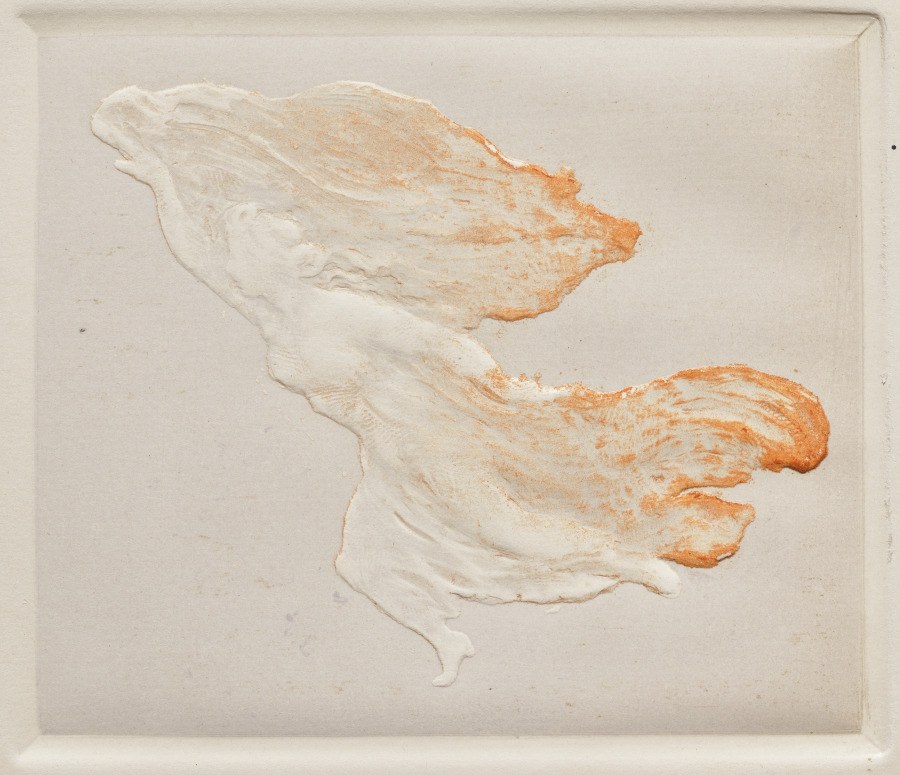
Two studies of a female figure in dynamic motion, rendered in white relief on a cream-colored ground. The upper figure is caught mid-leap or stride, body angled sharply to the left, with drapery streaming behind. The lower figure is more compact, the torso twisted and limbs folded, again with fabric in motion around the form. Both are executed with loose, gestural modeling that emphasizes the moment of action rather than anatomical detail. The figures are rendered in white with warm orange-ochre tones applied to highlight the planes and suggest shadow and volume, creating a sense of luminosity and movement against the neutral ground. The technique—a relief process—makes the figures appear almost to emerge from or press against the surface, intensifying the impression of kinetic energy.
The dancing
Both figures exhibit the extended, flowing silhouette characteristic of early modern interpretive dance. The upper form shows a lunging or leaping gesture, with the body elongated diagonally and limbs extended into the space; the posture suggests sustained momentum rather than a stable stance. The lower figure's twisted torso and bent limbs suggest a gathering or turning moment, the body folded into itself with drapery massing around the frame. In both cases, the artist has prioritized the expressive line of the body's extension and the interplay of fabric; anatomical precision yields to the description of flowing, undulating movement. Neither figure demonstrates the turned-out legs or lifted positions of ballet; instead both show the naturalistic, gravity-engaged stance of modern dance.
The dance depicted
These studies depict Loïe Fuller, the American pioneer of modern interpretive dance whose dramatic innovations in movement, costume, and lighting transformed dance practice after her Paris debut in 1892. Fuller's signature technique involved the manipulation of yards of silk fabric—often yards longer than her own body—which she moved with her entire frame, creating flowing, abstract shapes and creating an optical illusion of weightless, almost otherworldly motion. The relief medium captures the essential gesture of her dance: the asymmetrical, extended reach of her body as it propels the drapery, and the twisted, recessive moments between extensions. These are not studies of steps or formal technique but of the sustained, fluid impulse that animated her work.
How it was made
This is a gypsograph, a relief printing technique in which an image is incised or built up on a plaster or gypsum ground, inked, and printed. The technique was relatively rare and typically associated with fine-art experimentation rather than commercial reproduction. The warm ochre inking visible here, applied selectively to the white relief surface, suggests hand-coloring or partial inking during printing, which would have made each impression unique or semi-unique—a luxury procedure suited to artists' portfolios and art-historical documentation rather than mass circulation. The tactile, sculptural quality of the gypsograph's surface and the artist's ability to model form with light and shadow made it well-suited to capturing the sculptural and ephemeral qualities of Fuller's moving form.
About this work
Pierre Roche was a French sculptor and printmaker who became fascinated by Loïe Fuller's revolutionary dance practice in the 1890s and early 1900s. He documented her movement across multiple media—clay, bronze, marble, plaster, and print—as part of a sustained artistic investigation into how dance could be represented in static form. These two gypsograph studies were produced as illustrations for an essay by the critic Roger Marx and are part of a larger portfolio described as 'a precious monument to Loïe Fuller.' The work sits at the intersection of sculpture, printmaking, and dance documentation, capturing not the literal posture of a single moment but the essential physical and visual identity of a revolutionary performer and the radical art form she created.
How to look at it
Attend to the way the artist has frozen the moment not at a single endpoint but mid-gesture—the upper figure is lunging forward, the lower one twisted and gathering. The drapery is never slack but always active, integral to the silhouette and motion; the warm ochre inking emphasizes the folds and movement of fabric as much as the body itself. Notice that there is no attention to the dancer's face or individual identity; the focus is entirely on the shape and trajectory of the body and the lines of the costume. The relief surface creates a sculptural presence that mirrors Fuller's own use of her body as a three-dimensional form moving through space, and the gentle modeling in light and shadow suggests the interplay of stage lighting that was central to her visual practice.
The artist
Pierre Roche (1855–1922) was a prolific and versatile French sculptor known for his work in clay, stone, and bronze, but also an experimentalist in printmaking and mixed media. His fascination with Loïe Fuller extended across his practice for over a decade and resulted in dozens of sculptures, reliefs, and prints. He was part of the avant-garde milieu in Paris that recognized Fuller's work as a watershed moment in modern art and movement practice. His engagement with gypsography—a technique suited to artists seeking an alternative to commercial lithography—reflects his commitment to fine-art printmaking and the singular impression over mass reproduction.
The period
Loïe Fuller emerged in the 1890s at a moment when dance was undergoing radical transformation: the rigid conventions of classical ballet were being challenged by performers who sought a more expressive, natural, and individually authored form of movement. Fuller's innovation—the manipulation of costume and lighting to create abstract, non-representational visual experiences—aligned with the broader modernist project of abstraction and formal experimentation that was reshaping visual art in the same period. Artists and intellectuals recognized her work as a bridge between visual art and performance; the attention lavished on her by painters, sculptors, and printmakers (including also Henri de Toulouse-Lautrec and Raoul Larche) reflected her status as a key modernist innovator. The early 1900s, when these studies were created, marked the peak of Fuller's cultural influence and the moment when artists were most urgently trying to capture and preserve her achievement in form.
Where it lives
This gypsograph is held in the Prints collection at the Cleveland Museum of Art. It is one of a series of studies illustrating an essay by the critic Roger Marx, which was issued as a portfolio or deluxe publication dedicated to documenting and celebrating Loïe Fuller's artistic achievement.
Dance in this work
Questions about this work
What is a gypsograph?
A gypsograph is a relief printing technique in which an image is carved or modeled into a gypsum or plaster ground, inked, and printed onto paper. Each print is unique or semi-unique because the matrix is fragile and the inking can vary. The technique was favored by fine artists seeking an alternative to lithography and a more sculptural, tactile surface.
Why did Pierre Roche make so many works of Loïe Fuller?
Fuller's dance was revolutionary and utterly unlike anything in the existing vocabulary of movement. She created a new form of theater that combined dance, costume, light, and abstraction in ways that fascinated visual artists. Roche was part of a broader cohort of Paris-based artists who recognized her as central to modernism and attempted to capture and preserve her achievement across multiple media.
What is Loïe Fuller dancing in these studies?
Fuller did not dance literal narratives or follow a set vocabulary of steps. Instead, she created continuous, flowing movement in which the body and yards of silk fabric moved as a unified form, often in response to colored lighting. These studies capture the essential postures and extensions of her practice: the asymmetrical reach, the twisted torso, the sense of fabric as an active part of the body's expression.
How do we know these depict Loïe Fuller?
The catalogue record identifies the work as part of a series illustrating an essay about Fuller by the critic Roger Marx. The compositional choices—the focus on drapery, the abstraction, the emphasis on continuous flowing motion—are consistent with Fuller's signature practice and with other contemporary visual documentation of her work.
More dance artwork





