49 works in this view — arrow keys or swipe to move between them.
Dance in Art
Dancing Woman with Arms Lowered
Pierre Roche (French, 1855–1922)
- Medium:
- gypsograph
- Collection:
- Prints
- Source:
- Cleveland Museum of Art
- Rights:
- Public domain — free to use, share and adapt.
- Recorded as:
- CC0
Loïe Fuller was a revolutionary figure in the history of modern dance, a creator who synthesized movement, costume, and light into a new vocabulary that influenced visual artists across Europe. This image is historically significant because it documents, through the hand and eye of a major sculptor, how Fuller appeared on stage—her costume, carriage, and the visual spectacle she created—at a moment when no film existed to preserve her work. The gypsograph series represents a deliberate artistic project to memorialize a living performer and her aesthetic innovation.
What you are looking at
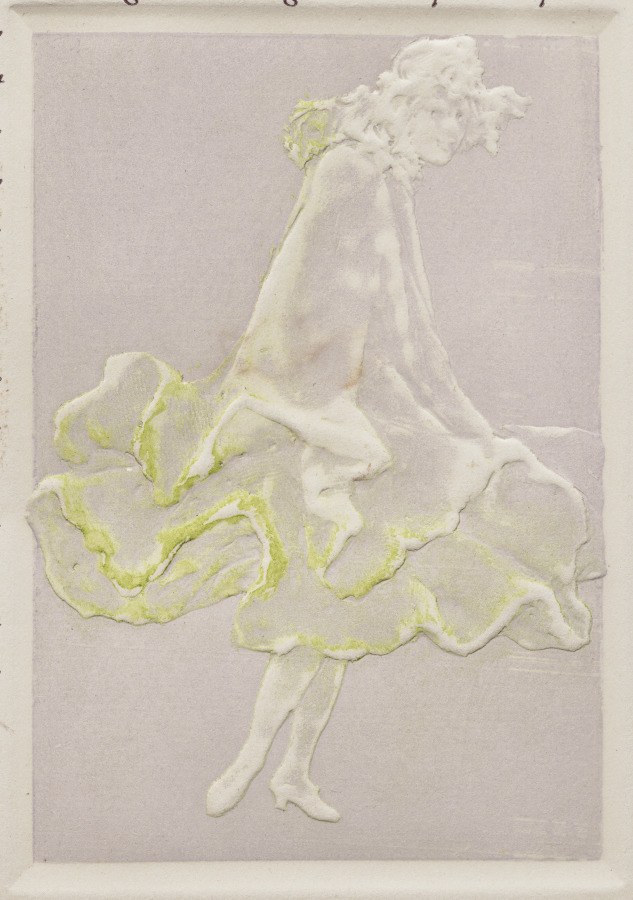
A single female dancer is depicted in a moment of restrained, elegant movement against a neutral lavender-grey background. She wears a pale, high-necked dress with long sleeves and a voluminous skirt articulated with sweeping yellow-green accents that suggest silk or gauze layering and movement. Her posture is upright but not rigid; her arms are lowered to her sides or slightly forward, and her gaze is directed downward in a pose of graceful composure. The image captures a moment of quiet repose rather than dynamic action—the dancer appears almost frozen in a studied attitude. The print technique creates soft gradations of tone that emphasize the three-dimensionality of the figure and the subtle play of light across the drapery.
The dancing
A single standing figure with a refined, contained body position. Her weight appears evenly distributed, her posture upright with shoulders back and neck elongated. Her arms hang loosely, neither extended nor tightly controlled—a natural carriage rather than a formal dance frame. The downward gaze and relaxed arm position suggest introspection or a moment between movements. There is no visible footwork, and the pose does not employ the turned-out legs or lifted carriage typical of formal ballet training visible in the stance.
The dance depicted
This is a portrait study of the pioneer modern dancer Loïe Fuller, the American-born performer who revolutionized dance in Paris beginning in 1892. Fuller was famous for her manipulation of extensive silk scarves and voluminous skirts that she illuminated with colored stage lighting, creating flowing, abstract sculptural forms. This image, part of a series of gypsographs by Roche, documents her distinctive costume and the visual poetry of her movement vocabulary. The downturned gaze and restrained arm position may suggest a moment of preparation or the quiet intervals in her serpentine movement sequences rather than a climactic gesture.
How it was made
This is a gypsograph, a printmaking technique in which an image is drawn directly onto a plaster surface and then printed. The process created a unique quality of soft tonal gradation visible here, with the pale cream and white of the dancer's dress rendered through careful manipulation of light and shadow against the mauve ground. The technique allowed for fine detail in fabric and form while maintaining an ethereal, almost painted quality; each print would be a unique or limited impression rather than an unlimited edition, making these precious objects suited to their purpose as illustrations for Roger Marx's essay—a limited, artisanal publication.
About this work
This gypsograph is one of a series Pierre Roche created of Loïe Fuller, the American modern dance pioneer who captivated Paris in the 1890s with her revolutionary use of flowing silk and colored light. Roche, primarily known as a sculptor, captured Fuller across multiple media—clay, bronze, marble, plaster, and these delicate prints. The series illustrated an essay by the influential critic Roger Marx and became what he called 'a precious monument to Loïe Fuller,' preserving in print the visual essence of a performer whose art was ephemeral, existing only in live performance without film or photograph. This single sheet shows Fuller in a moment of poised stillness, her costume's layered silks articulated with yellow-green highlights that evoke the colored stage lighting for which she was famous.
How to look at it
Observe the articulation of the costume: the pale underdress and the sweeping yellow-green overlay that creates the illusion of layered silk and movement. Note how Roche has rendered the folds and volume not through outlines but through subtle tonal shifts, suggesting how light would play across such fabric in performance. The dancer's posture and downturned gaze invite contemplation of her as a sculptural form—the elongated neck, the elegant fall of her arms, the subtle S-curve of her stance. This is a study in repose, not action; Roche chose a moment that reveals the formal beauty of the body and costume rather than capturing kinetic energy.
The artist
Pierre Roche (1855–1922) was a French sculptor of considerable versatility who worked across media—clay, bronze, marble, plaster, and printmaking. He was part of the Parisian artistic circles of the Belle Époque and was drawn to the same modernist energies that attracted visual artists to Loïe Fuller's performances. His body of work devoted to Fuller suggests both professional admiration and personal fascination; the commitment to rendering her image across multiple techniques implies that her art and presence held significant meaning for him. Roche's practice of translating sculptural form into print, as seen in the gypsograph technique, reflects late 19th-century exploration of how sculpture and drawing might merge.
The period
Loïe Fuller arrived in Paris in 1892 and became a sensation, performing at the Moulin Rouge and other venues from 1893 onward. Her work coincided with Art Nouveau's rise and shared its aesthetic values: organic flowing forms, the integration of light and material, and the dissolution of rigid academic boundaries. The 1890s and early 1900s saw intense visual documentation of her work by photographers and artists, though moving film was still new and rare. Roger Marx, the critic, was a champion of modern art and design; his commissioning of this series of prints by Roche reflects the period's serious critical engagement with Fuller as an artist deserving of permanent, artisanal documentation. The gypsograph technique itself—intimate, hand-drawn, limited in edition—embodied the Arts and Crafts and Art Nouveau values of the moment.
Where it lives
This work is held in the Prints collection of the Cleveland Museum of Art. It is one print from a series of gypsographs that illustrated Roger Marx's essay on Loïe Fuller, a limited, artisanal publication of the early 1900s. The gypsograph technique made each print unique or part of a small edition, placing it among rare works of art documentation rather than mass-produced reproductions.
Dance in this work
Questions about this work
Who was Loïe Fuller?
Loïe Fuller (1862–1928) was an American-born dancer and pioneer of modern dance who revolutionized performance art in Paris beginning in 1892. She created a new vocabulary of movement by manipulating long silk scarves and voluminous skirts combined with colored electric lighting, creating flowing, abstract sculptural forms on stage. She influenced visual artists, Art Nouveau designers, and the direction of modern dance; her work dissolved the boundary between dance and visual spectacle.
What is a gypsograph?
A gypsograph is a printmaking technique in which an image is drawn or incised directly onto a plaster surface, which is then used to print an impression. The process creates fine tonal gradations and an ethereal quality; each print is unique or part of a very limited edition, making it more akin to drawing than to traditional printmaking. The technique was employed by several artists in the late 19th and early 20th centuries but remains relatively rare.
Why did Pierre Roche create so many images of Loïe Fuller?
Roche was evidently fascinated by Fuller as an artist and by the challenge of translating her ephemeral performance into permanent visual form across multiple media. The series of gypsographs were commissioned to illustrate an essay by the influential critic Roger Marx, creating what Marx called 'a precious monument to Loïe Fuller.' This was a deliberate curatorial and artistic project to preserve the memory of her performances and aesthetic innovations at a moment before film could do so.
What do the yellow-green accents represent?
The yellow-green layering in the skirt likely represents the silk scarves or the colored silk overlays that Fuller used in performance. She was famous for illuminating her costumes with colored electric light, creating visual effects that were fundamental to her art. The artist's use of yellow-green pigment here suggests the artist's effort to evoke the colored lighting effects that were integral to how Fuller's work appeared on stage.
More dance artwork





