49 works in this view — arrow keys or swipe to move between them.
Dance in Art
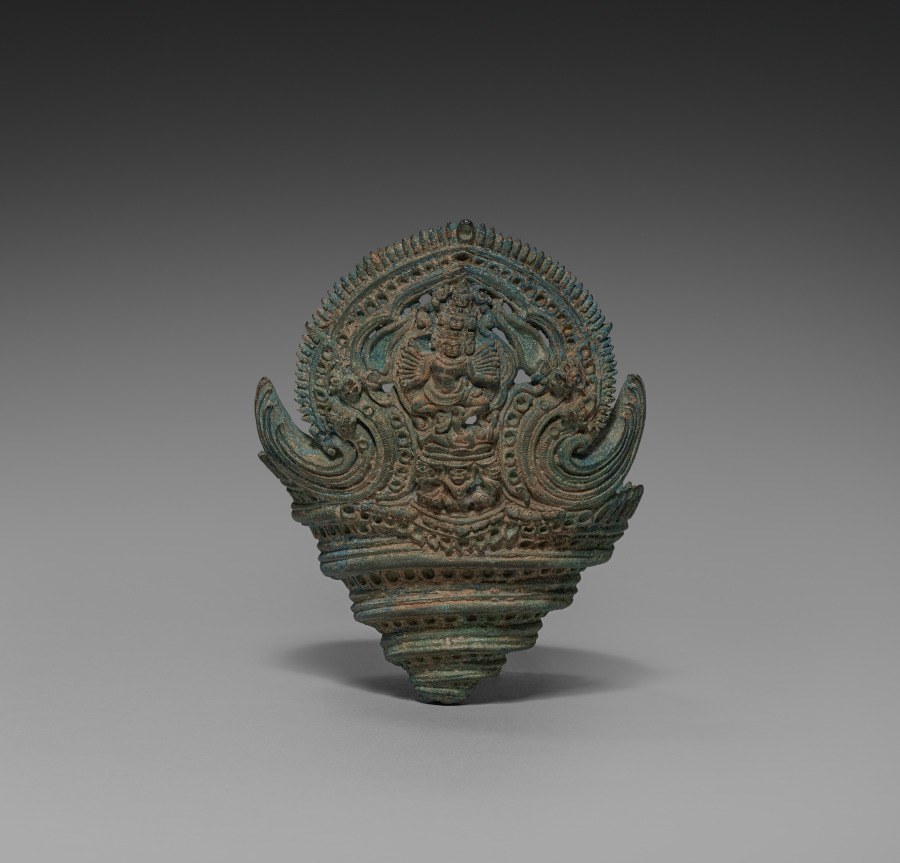
Ritual conch shell base with dancing Hevajra
Unknown artist
- Medium:
- shell and bronze
- Collection:
- Indian and Southeast Asian Art
- Source:
- Cleveland Museum of Art
- Rights:
- Public domain — free to use, share and adapt.
- Recorded as:
- CC0
For dancers and historians, this object reveals how dance functioned in Buddhist tantric practice: not as entertainment or court spectacle but as a method of invoking and embodying divine presence. The Hevajra figure carved here is a template for ritual movement, preserved in bronze to ensure its transmission across generations and across the sprawling Khmer kingdom. Understanding this object opens a window onto non-Western dance practice where the distinction between visual art and performed movement dissolves entirely.
What you are looking at
This is a ceremonial bronze ornament designed to crown a conch shell, shown against a neutral ground. The piece is a freestanding sculptural element, roughly teardrop-shaped with a flattened base, cast in bronze with visible patina. The upper two-thirds of the object is densely carved with relief imagery: a central figure with multiple heads (characteristic of Hevajra) is surrounded by ornamental borders made up of repeated geometric and naturalistic motifs. Two large spiral forms, resembling stylized tusks or serpents with upturned ends, project outward from either side of the main body at roughly the widest point. The surface is worked with fine detail throughout—small figures, plant forms, and intricate pattern-work fill the background, creating a sense of sacred abundance. The object appears to be functional as well as devotional: it would sit atop a ritual conch shell, its weight and sculptural form designed to be grasped and activated during ceremony.
The dancing
The central dancing figure of Hevajra is depicted in dynamic pose within a mandala-like frame. The deity is shown with multiple limbs arranged in a spiral composition: the eight heads are stacked or clustered in the upper register, while the sixteen arms radiate outward, many holding ritual implements or gestures. The four legs are positioned to suggest movement—a dancing stance rather than static stance. The body language conveys agitation and cosmic energy; this is a visualization of transcendence in motion, not a human dancer's vocabulary. The serpentine forms flanking the figure are rendered as if curling upward in response to the deity's movement, adding to the sense of ritual activation.
The dance depicted
This depicts Hevajra, a wrathful Buddhist deity central to tantric practice in Khmer Buddhism during the Angkorian period (roughly 9th–15th century). The Hevajra-tantra, a sacred text, prescribed ritual dances in which this figure was invoked and embodied. This is not secular dance but ritual visualization: the object itself becomes a conduit for transformation when blown as a ritual conch. The dancing posture visible in the carved image reflects tantric iconography in which the deity's movement is a form of cosmic action—each gesture (mudra) and body position carries metaphysical meaning. The dance is performed by the priest or ritual specialist who uses the conch; the figure carved into it is what they invoke.
How it was made
Bronze, cast and chased, with fine detail work throughout. The material—a base metal alloy—allowed for mass production and distribution across temple sites; this is not a unique artwork but one of a type, suggesting wide circulation of this liturgical form. The casting technique permitted the creation of the three-dimensional sculptural elements (the projecting serpent forms, the stacked heads) as well as the dense surface carving. Bronze darkens and develops a protective patina over centuries, which we see here; the greenish-blue discoloration is chemical evidence of age. The durability of bronze was essential for an object intended for repeated ritual use, where it would be grasped, heated by palm oil, and sounded in ceremony.
About this work
This is a ritual conch ornament from 12th-century Cambodia, a functional liturgical object designed to focus tantric Buddhist practice. It combines sculpture, metalwork, and dance iconography: the crowned conch shell would be blown to sound the sacred syllable *om* at the opening of ceremonies, while the carved figure of Hevajra on its crown served as a focal point for visualization and transformation. The object represents a moment in Southeast Asian art when the boundaries between visual representation, ritual action, and embodied practice were fluid—the dance is not depicted for aesthetic viewing but inscribed as a technology for spiritual work. Bronze conch ornaments of this type were produced across the Khmer empire and remain among the finest surviving examples of 12th-century metalwork.
How to look at it
Approach this object as a performance script rather than a representation. The carved figure is not meant to be observed passively but to be activated through ritual action—the sounding of the conch, the visualization of the deity's dance. The spiral serpent forms framing the central figure serve a functional purpose (they may stabilize the ornament on the shell's opening) but also a symbolic one: they suggest the cosmic energy released when the ritual is performed. The density of the carved surface, packed with smaller figures and ornamental motifs, reflects the tantric principle of divine abundance—every part of the object is charged with meaning and power.
The period
In the 12th century, during the reign of Jayavarman VII, Khmer Buddhism underwent a transformation centered on tantric practices and the worship of enlightened beings (devas and bodhisattvas) as paths to liberation. Hevajra rose to prominence as the supreme figure denoting tantric ritual. Temples like Banteay Chhmar were built not merely as shrines but as active ceremonial spaces where priests performed elaborate rituals intended to ensure the kingdom's prosperity and protection. The Hevajra-tantra prescribed specific ritual actions and visualizations; this conch ornament, blown at the ceremony's opening, would have served as both a practical tool and a spiritual anchor. In the same period, Khmer sculptors were creating some of Southeast Asia's most sophisticated stone and metal reliefs, reflecting a broader flowering of artistic and religious creativity.
Where it lives
The object is held in the Indian and Southeast Asian Art collection, catalogued as a 12th-century work. It is identified with the artistic tradition of the Khmer empire, likely produced at or for a royal temple site like Banteay Chhmar (a temple commissioned by Jayavarman VII and known to have contained Hevajra imagery). The source attribution (CMA) suggests it is part of a major American institutional collection, though the original context of its removal from Cambodia is not recorded here.
Dance in this work
Questions about this work
How was this object actually used?
During tantric Buddhist rituals, a priest would place this ornament on top of a large conch shell and blow into the shell, producing a deep, resonant sound corresponding to the sacred syllable *om*. This sound marked the opening of the ceremony and was believed to invoke the presence of Hevajra. The carved figure on the ornament's crown served as a visual focal point for meditation and visualization, helping the priest embody or merge with the deity's dance during the ritual.
Why does Hevajra have eight heads and sixteen arms?
In tantric Buddhist iconography, these features are not representations of a physical body but expressions of enlightened consciousness. Each head and arm encodes a layer of meaning: together they represent the fullness of wisdom (prajna), compassion, and power over the forces of delusion. The multiple limbs allow the figure to perform many sacred gestures (mudras) simultaneously, illustrating the non-dual nature of reality where all contradictions resolve in enlightenment.
Is this a dance or a sculpture?
Both. The object is a three-dimensional sculpture cast in bronze, but the central figure is carved in a posture of cosmic dance—a visualization of movement frozen in metal. In tantric practice, there is no separation between visual art and ritual movement; the sculpture is a script for embodied action, and the dance performed during the ritual is a living enactment of the sculpted form.
What is Banteay Chhmar?
Banteay Chhmar is a 12th-century temple complex in northwestern Cambodia built under Jayavarman VII. It was designed not only as a shrine but as an active ceremonial center, containing numerous images of Hevajra and other tantric deities. Such temples served the dual purpose of spiritual retreat and imperial power-broker; the rituals performed within them were believed to protect and enrich the kingdom.
More dance artwork





