49 works in this view — arrow keys or swipe to move between them.
Dance in Art
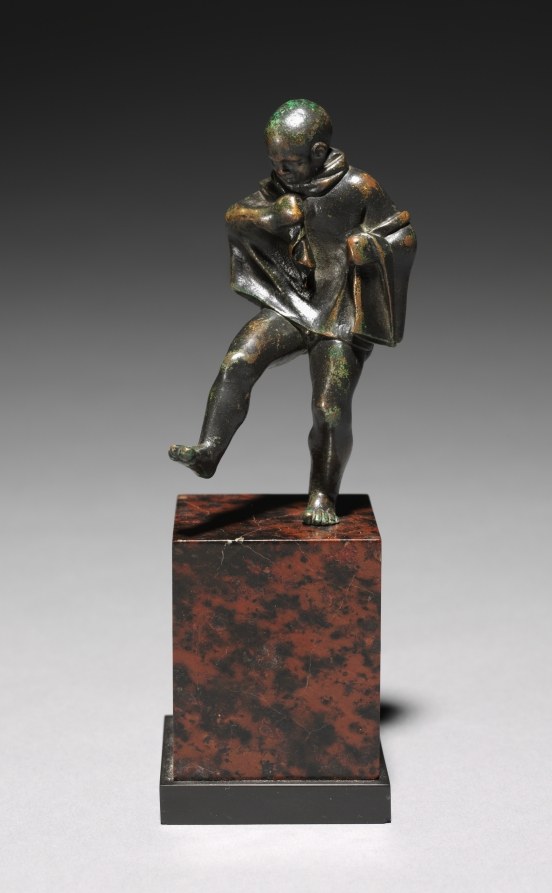
Dancing Boy
Unknown artist
- Medium:
- bronze
- Collection:
- European Painting and Sculpture
- Source:
- Cleveland Museum of Art
- Rights:
- Public domain — free to use, share and adapt.
- Recorded as:
- CC0
This sculpture documents how Renaissance artists understood movement and the male body as subjects worthy of bronze and fine execution. It also raises a question: when does a moving figure become a dancer, and when is movement simply life? The ambiguity is instructive for art historians of dance, who often rely on explicit costume and social context to identify a work as 'dance.' Here, a figure in motion resists that category.
What you are looking at
A nude or near-nude bronze figure of a youth stands in a dynamic contrapposto pose on a deep burgundy and black marble plinth. The boy's body twists energetically, with one leg bent and raised as if mid-stride or in the act of turning, while his arms are held close to his torso in a gathered, protective gesture. His head is tilted back slightly, gaze upward, and his musculature is rendered with anatomical precision typical of Renaissance sculpture. The patina of the bronze—greenish and warm golden tones—suggests considerable age. The figure's lithe frame and the arrested quality of the pose convey a moment of youthful exuberance rather than formal, codified movement.
The dancing
A single male figure, pre-adolescent or early adolescent, stands in a pose of dynamic tension. The weight is carried on the lower leg, while the raised knee and twisted torso suggest a pivoting or turning action. The arms are folded inward at the chest, fingers splayed slightly, elbows bent—a gesture that reads as both self-contained and reactive. The head is thrown back in a line of energy that runs through the spine, creating a spiral composition. There is no partner, no formal dance frame; the posture is that of an individual body responding to an internal impulse.
The dance depicted
This cannot be confidently identified as a representation of a specific named dance form. The pose does not conform to any documented Renaissance dance hold or stance—there is no partner, no courtly frame, and no costume typical of danza bassa or saltarello as depicted in period dance manuals. The sculpture appears to capture a moment of juvenile movement, perhaps play or the kind of improvisatory turning and jumping that children performed. If it depicts dance at all, it is a study of movement quality and youthful physicality rather than a codified social or theatrical dance. The work may be genre or allegorical rather than documentary.
How it was made
This is a small-scale bronze sculpture, cast by the lost-wax method typical of Renaissance workshops. The patina—largely dark with areas of bright wear on the highest points—indicates the work has been handled and examined closely over centuries. Bronze allowed for the fine detail and sharp definition of musculature visible here, and the compact scale suggests it was made as a cabinet piece for a patron's private collection. The choice of medium and subject implies a learned, elite audience familiar with classical ideals of the male nude.
About this work
This is a small Renaissance bronze of a single nude or draped youth in a pose of turning or pivoting movement, dated to the late 15th century. The figure stands alone, his body twisted in a spiral, arms gathered at the chest, head thrown back—a composition that conveys energy and youth but does not correspond to any documented social or theatrical dance of the period. The work sits at the intersection of movement study, classical sculpture revival, and allegorical representation: a meditation on the beauty and dynamism of the young male body rather than a record of actual dance practice. It speaks to the Renaissance fascination with antique sculpture and with the expressive possibilities of the human form in motion.
How to look at it
Pay attention to the direction of force running through the figure: the raised knee, the twisted torso, the thrown-back head form a spiral line of energy that reads as a moment in flight or rotation rather than a stable pose. Notice the hands—gathered, close to the body, almost clutching—which give the figure an inward, gathered quality even as the whole body seems to propel outward. The artist has chosen the instant of turning, when balance is precarious and the body is most alive. This is observation from life or from classical models, not from a dance manual.
The period
The late 15th century saw an intense revival of interest in classical sculpture and the nude male form as a subject of artistic study. The workshop tradition of northern Italy and Florence produced numerous small bronzes for wealthy collectors—allegorical figures, classical heroes, biblical subjects, and studies of movement and emotion. At the same time, the formalization of Renaissance dance—the courtly danza—was being codified in manuals by figures like Guglielmo Ebreo, with rigid positions and partner holds. This sculpture stands apart from that systematization; it captures movement as a phenomenon in itself, closer to the athletic and playful than to the ballroom or ceremonial.
Where it lives
The work is held in the collection of European Painting and Sculpture at the Cleveland Museum of Art (cma). As an accessioned sculpture, it has been part of an institutional collection and research record for at least the 20th century onward.
Dance in this work
Questions about this work
Is this a dancer?
The figure is certainly in motion, and the pose captures a moment of turning or jumping. Whether the artist intended to depict a specific dance, or simply a youth in the act of moving joyfully, cannot be determined from the image alone. The lack of costume, partner, and formal dance context suggests this is a study of movement and beauty rather than a record of actual dance practice.
Why is the figure nude?
The nude or lightly draped male youth was the central subject of Renaissance sculpture, especially in bronze, because it allowed artists to study and celebrate the human body in idealized form. Nudity also allowed viewers to see the musculature and articulation of the body in movement without the obstruction of clothing.
What does the pose tell us about Renaissance movement?
The twisting, energetic pose suggests that Renaissance artists valued dynamism and spiral composition—a very different aesthetic from the upright, contained postures of formal courtly dance. This may reflect either observation of children at play or an idealized, classical vision of movement.
More dance artwork





