49 works in this view — arrow keys or swipe to move between them.
Dance in Art
Dancing Woman in Kneeling Position Enveloped in Drapery
Pierre Roche (French, 1855–1922)
- Medium:
- gypsograph
- Collection:
- Prints
- Source:
- Cleveland Museum of Art
- Rights:
- Public domain — free to use, share and adapt.
- Recorded as:
- CC0
Loïe Fuller was arguably the first modern dancer, pioneering a radical departure from ballet's geometric vocabulary toward continuous, organic movement. Roche's relief series is primary-source documentation of her technique and aesthetic by a serious sculptor who worked closely with her, offering insight into how her contemporaries understood her revolutionary innovation. For historians of modern dance, this work is crucial evidence: Fuller's own performances are gone, her films are fragmentary, but Roche's careful formal study preserves the visual logic of her art—the integration of fabric, body weight, asymmetry, and ecstatic gesture—in a medium designed for study and reproduction.
What you are looking at
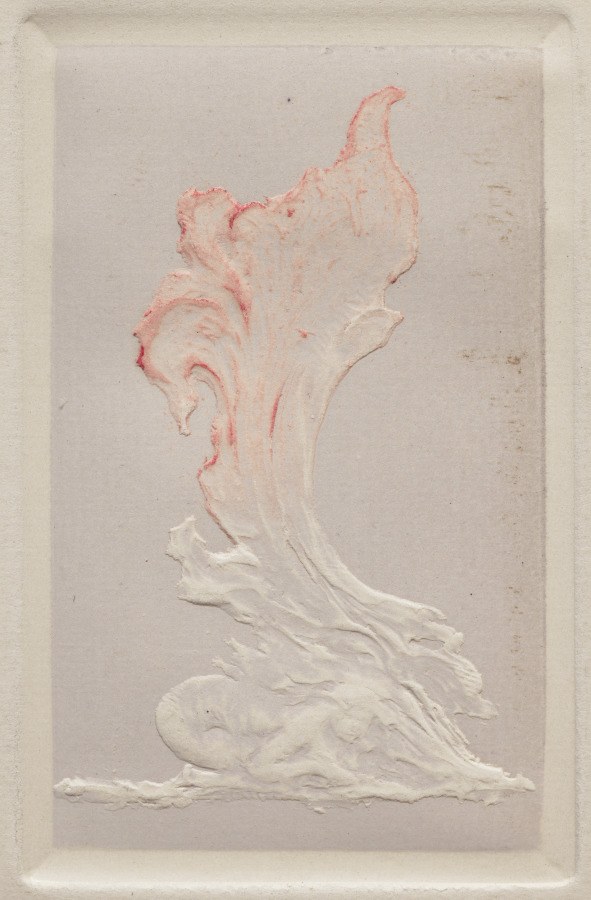
A plaster relief presents a solitary female figure in a kneeling or reclining position, her body caught mid-movement as she leans back with arms raised. The composition is vertical and contained within a shallow recessed frame. Her form, rendered in pale plaster, dominates the composition; her torso twists, one arm extends upward and curves, while drapery—rendered in warmer peachy-red tones—swirls around her lower body and legs, suggesting dynamic motion. The drapery itself becomes a sculptural element, with deep folds and billowing forms that suggest flight or weightless movement. The relief captures a moment of ecstatic abandon or transcendent gesture, the figure's body arching as if in response to invisible music or force. The contrast between the figure's flesh tones and the heavily textured drapery creates visual rhythm; the fabric appears to propel her upward, a visual metaphor common to representations of Loïe Fuller's serpentine dance.
The dancing
A single dancer occupies the space, her body arched backward in a radical extension, knees bent beneath her as if she is either kneeling or in the act of rising or falling. Her upper body and extended arm create a long diagonal line; her head tilts back slightly. The gesture suggests neither static pose nor grounded dance vocabulary—instead, it evokes the weightless, fluid positions characteristic of Fuller's serpentine style, where the body seems suspended or caught between states. The figure is enveloped rather than clothed; drapery becomes inseparable from her body, creating unified forms.
The dance depicted
This relief belongs to Pierre Roche's extended series documenting Loïe Fuller, the American pioneer of modern dance whose serpentine and skirt dances revolutionized theatrical movement in Paris from 1892 onward. Fuller's vocabulary abandoned the geometric positions of classical ballet in favor of continuous, undulating motion achieved through manipulation of vast quantities of silk fabric—often twenty or more yards per costume. The gypsograph reproduces a design meant to illustrate an essay by critic Roger Marx celebrating Fuller's art. The arched, ecstatic gesture and the interweaving of body and drapery in this relief faithfully captures Fuller's aesthetic: the dancer as vehicle for ethereal, abstract movement rather than technical display.
How it was made
A gypsograph—or gypsum print, also called a plaster print—is a photomechanical relief process in which an image is transferred to a gypsum or plaster surface, then printed. It produces subtle gradations of tone and excellent detail reproduction, making it ideal for capturing sculptural nuance. Roche's use of the medium here allows the relief to be both a drawing and a reproduction method, enabling the work to circulate widely while maintaining the tactile, dimensional quality of carved plaster. The warm and cool tones visible in the print likely result from hand-coloring or variable inking; the technique was particularly suited to art-historical and critical publications, placing this work within the scholarly and aesthetic discourse of the turn of the century.
About this work
This gypsograph is one of a series of plaster reliefs by sculptor and printmaker Pierre Roche documenting the revolutionary movement vocabulary of Loïe Fuller, the American dancer who transformed European theatrical dance between 1892 and 1910. Produced around 1904 to accompany critic Roger Marx's essay on Fuller, the work captures her signature aesthetic: a female body made weightless and abstract through the interplay with enormous quantities of silk drapery, rendered in three dimensions then printed for wide circulation. The relief shows Roche's deep engagement with Fuller's art—he understood not merely her costume but the fundamental transformation of the human figure her work achieved, where fabric and flesh become inseparable visual and kinetic elements. Fuller's influence on early modern dance, theatrical innovation, and visual culture was profound; Roche's series represents the serious critical and artistic attention her work commanded.
How to look at it
Observe the figure's abandonment of vertical, grounded posture—she is neither standing nor seated but suspended in an impossible, ecstatic lean. Notice how the drapery does not passively drape but becomes active, swirling upward and propelling her motion; fabric and body are not separate elements but a unified sculptural form. The artist has chosen the moment of greatest extension and weightlessness, freezing an instant that could not be sustained in actual movement. The relief's shallow depth and pale tones make the drapery's peachy-red color (applied to the print) pop visually, echoing how Fuller's colored silk appeared to glow under stage lighting. Look at how the figure's musculature is simplified and sublimated to the gesture; Roche's sculptural language prioritizes the line and arc of movement over anatomical detail.
The artist
Pierre Roche (1855–1922) was a French sculptor, engraver, and printmaker of considerable versatility and productivity. Best known for his sculpture, he worked across media including clay, bronze, marble, and plaster, as well as various print techniques. His engagement with Loïe Fuller's work began in the early 1890s and became a sustained artistic preoccupation; he created multiple sculptures and reliefs of her, drawn to the technical and aesthetic challenge of translating her fluid, weightless movement into static form. His willingness to work in popular reproductive media like the gypsograph suggests an artist concerned not only with fine-art production but with circulating images of important cultural figures to a broader audience. The Fuller series remains his best-known work and a testament to his skill in capturing ephemeral movement.
The period
The 1890s and early 1900s witnessed the rise of modern dance as a rupture from classical ballet. Loïe Fuller's Paris debut in 1892 coincided with Art Nouveau's ascendancy, and her aesthetic—organic, asymmetrical, suggesting natural forces and the unconscious—aligned with broader artistic currents of the period. Visual artists across media were fascinated by her work: sculptors sought to capture her weightlessness, photographers and illustrators documented her performances, and critics wrote lengthy essays analyzing her technique and meaning. The turn toward the body as a vehicle for emotion and abstraction rather than technical display was central to early modernism; Fuller's work sat at the intersection of dance, visual art, and modernist aesthetics. Roche's series, produced for Roger Marx's essay (Marx was the influential critic and collector), represents the intellectual and artistic seriousness with which Fuller's innovation was received in France.
Where it lives
The work is held in the Prints collection at the Cleveland Museum of Art, acquired from an unspecified source. As a gypsograph—a reproductive print medium—it was produced for circulation, likely as part of or related to Roger Marx's critical essay on Fuller. Multiple impressions likely exist.
Dance in this work
Questions about this work
Who was Loïe Fuller and why did so many artists document her?
Loïe Fuller was an American dancer who debuted in Paris in 1892 and single-handedly transformed theatrical dance by abandoning ballet's vocabulary in favor of fluid, undulating movement created through manipulation of vast quantities of silk. Her work was revolutionary and attracted intense interest from visual artists, photographers, critics, and intellectuals because she represented a modernist break with tradition. Roche was one of several sculptors and artists fascinated by the challenge of translating her weightless, abstract movement into visual form.
What is a gypsograph?
A gypsograph is a photomechanical relief printing process in which an image is transferred onto a gypsum or plaster surface and then printed. It was used in the late 19th and early 20th centuries for fine art reproduction, especially in art historical and critical publications, because it could capture fine detail and tonal gradation while maintaining a tactile, dimensional quality. The medium allowed artists and sculptors to circulate their work widely without loss of nuance.
How does this relief relate to Fuller's actual dance technique?
Fuller danced with enormous quantities of fabric—often 20+ yards of silk per costume—which she manipulated to create flowing, continuous movement. She used colored lighting effects and worked on stages with painted backdrops to enhance the sense of weightlessness and abstraction. This relief captures the fundamental visual vocabulary of her work: the integration of fabric and body, the emphasis on continuous curved lines over geometric positions, and the sense of the dancer as weightless and ethereal rather than grounded and technically skilled in the ballet sense.
Why does the figure appear to be kneeling or reclining rather than standing?
Fuller's movement vocabulary deliberately abandoned the upright, grounded positions of classical ballet. Dancers could be seen in asymmetrical, weightless positions that seemed to defy gravity, achieved through the interplay of their bodies with fabric and lighting effects. Roche's choice to show the figure in an arched, extended posture captures this essence: the body is not executing a pose but is caught in a moment of continuous, fluid motion where traditional balance and verticality are irrelevant.
More dance artwork





