49 works in this view — arrow keys or swipe to move between them.
Dance in Art
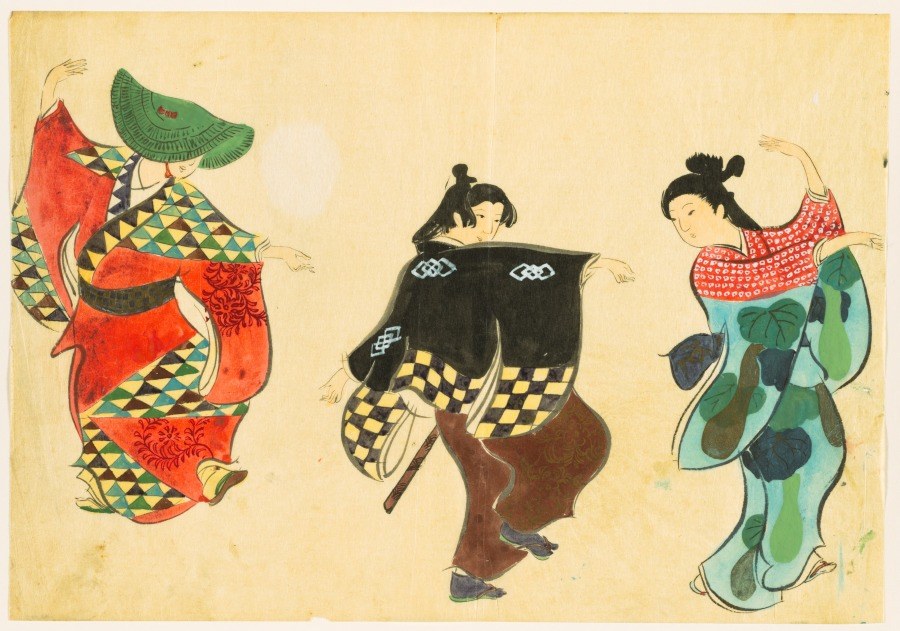
Flowers of a Hundred Worlds (Momoyogusa): Dancing (Odori)
Kamisaka Sekka (Japanese, 1866–1942)
- Medium:
- ink and color on paper
- Collection:
- Japanese Art
- Source:
- Cleveland Museum of Art
- Rights:
- Public domain — free to use, share and adapt.
- Recorded as:
- CC0
This drawing documents a moment when Japanese artists were actively synthesizing traditional performance practices—kabuki, festival dance, costume—into modernist visual language, influenced by both Japanese design tradition and contemporary European aesthetics. For dancers and historians, it offers evidence of how early 20th-century Japanese artists understood and visually translated the vocabulary of their own theatrical traditions, and how those traditions were being repositioned as design subjects rather than as living practice.
What you are looking at
Three figures in Japanese dress occupy the composition, each rendered in a distinctive pose against a cream-colored paper. The leftmost figure wears a vivid red garment with geometric patterning in green and yellow, topped with a large green hat, and holds a fan. The central figure is dressed in black with a checkered lower garment in yellow and brown, leaning forward dynamically. The rightmost figure wears a turquoise-blue garment with large green leaf or gourd motifs, also in motion. All three have their hair styled in the traditional Japanese topknot (mage) and appear to be captured mid-movement, their bodies angled and limbs extended in a way that suggests active dance or theatrical performance. The composition places them in a shallow, undefined space with no ground line or setting details—the focus is entirely on the figures and their costume.
The dancing
Each of the three dancers displays a distinct body position suggesting movement through space. The left figure's torso twists with one arm raised and extended, the other holding a fan downward; the right leg appears lifted or turned. The central figure bends forward at the waist with arms positioned as if gesturing or reaching, the upper body angled sharply. The right figure also demonstrates a twisted torso with arms extended and fingers articulated, one leg appearing to step or glide. The poses are not static but caught in what appears to be a moment of rotation or transition, with careful attention to the articulation of hands and the angle of the head. The artists has conveyed weight and momentum through the cant of the shoulders and the extension of the limbs.
The dance depicted
These appear to be figures from Japanese theatrical or celebratory dance, most likely from the Edo or early Meiji period based on costume and style. The dynamic poses, the theatrical dress with bold patterning, and the topknot hairstyles are consistent with kabuki dance (Kabuki Dance / KABU) or with festival dance traditions. The exaggerated gestures, twisted spines, and extended reaches suggest a stylized theatrical vocabulary rather than a naturalistic movement vocabulary. Without inscription or clearer contextual detail, the specific dance tradition cannot be definitively identified, but the image documents a moment of Japanese movement practice that prioritizes ornament, costume, and expressive gesture over anatomical realism.
How it was made
This is a preparatory drawing for a woodblock print, rendered in ink and color on paper, as confirmed by the catalogue record. The loose, freehand quality visible in the brushwork and the fluid line work distinguish this from the finished, more refined printed compositions that would follow. The artist worked with transparent and opaque pigments applied to create the bold blocks of color—the vivid reds, greens, and blues—while the black ink outlines and details (visible in the facial features, costume patterns, and finger positions) define the forms. This technique allowed rapid ideation and variation before committing to the carving and printing process, and the sketch demonstrates the artist's attention to color harmony and composition even in preliminary stages.
About this work
This is one of three preparatory studies for a composition within Kamisaka Sekka's *Flowers of a Hundred Worlds* series, a major work of Japanese decorative art from the early 20th century. The drawing captures three dancers in Japanese theatrical or celebratory dress, each rendered with exuberant gesture and costume detail. Sekka's work bridges the traditional and modernist impulses of Meiji-era Japanese art: while the subject matter and stylization draw from kabuki and festival traditions, the compositional strategy—three isolated figures against a flat background, no narrative context, pure attention to form and color—reflects the artist's interest in abstraction and design. The preparatory nature of the work reveals the artist's creative process, showing how the looser, more expressive initial studies became refined into the published compositions.
How to look at it
Attend to the three distinct poses: each dancer occupies a different moment in a movement phrase, suggesting either three dancers performing simultaneously or three sequential moments of a single performer. Notice how the artist has used the twisted torso and extended limbs to create visual dynamism on the flat plane of the paper—there is no illusion of deep space, but rather a compressed, theatrical space where the figures' gestures and costume patterns create rhythm and movement. Look at the hands especially: Sekka has taken care to articulate the fingers and position them expressively, a detail that suggests these are not generic figures but studies of specific, recognizable movement vocabularies. The bold color blocking and the interplay of pattern (in the costumes) with the cream ground create a design that prioritizes visual impact and decorative harmony over naturalism.
The artist
Kamisaka Sekka (1866–1942) was a major figure in Japanese decorative arts and design during the Meiji and Taishō periods. Trained in traditional painting and design, he became known for bold, flattened compositions that synthesized Japanese design principles with modernist formal concerns. His *Flowers of a Hundred Worlds* (Momoyogusa), begun in 1909, was an ambitious project comprising hundreds of sketches and studies exploring botanical and figurative subjects. Sekka worked across multiple media—painting, woodblock printing, design—and was instrumental in establishing the ryūkoku or 'Japanese-style' modernism that positioned traditional Japanese aesthetics as contemporary and forward-looking rather than antiquarian.
The period
Japan in 1909 was in the early Taishō period (1912–1926), but already well into the visual modernization that followed the Meiji Restoration (1868). Japanese artists were intensely engaged with both the preservation of traditional arts—including kabuki, Noh, and festival dance—and the development of new visual languages influenced by European modernism. At the same moment, kabuki was being redefined as 'high art' rather than popular entertainment, and traditional costume and movement vocabularies were being aestheticized and documented by artists and photographers. Sekka's project sits within this moment of synthesis, treating traditional performance costume and gesture as subjects worthy of sustained formal exploration.
Where it lives
This drawing is held in the Japanese Art collection of the Cleveland Museum of Art. It is one of multiple preparatory studies for the *Flowers of a Hundred Worlds* series that exist in museum collections, representing a moment in the artist's creative process before the designs were finalized and printed.
Dance in this work
Questions about this work
Who were these dancers? Is this a specific dance or ceremony?
The catalogue record does not identify a specific dance or performance context. Based on the costume, hairstyles, and movement vocabulary, these figures appear to represent Japanese theatrical or festival dance traditions—possibly kabuki or related performance forms. The image itself does not provide enough contextual detail to identify a specific dance, occasion, or performer. Sekka may have drawn from live performance, from earlier prints and paintings, or from his imagination.
Why are there three dancers and why are they in these poses?
It is unclear whether Sekka intended these as three simultaneous performers or as three sequential moments of a single dancer. The preparatory nature of the sketch suggests this may have been an exploratory study, testing different poses or costume variations within a single composition. The variety of the three poses—each with a different twist, reach, and costume pattern—suggests Sekka was exploring compositional rhythm and visual balance through contrast.
What is a preparatory drawing for a woodblock print?
A preparatory drawing is a study made before the final design is carved into a woodblock for printing. Artists would create multiple versions, experimenting with composition, color, and detail. This looser, hand-drawn study allowed Sekka to work out ideas quickly and refine them before committing to the labor-intensive carving and printing process. The preparatory drawings often show more visible brushwork and spontaneity than the finished prints.
What is the 'Flowers of a Hundred Worlds' series?
The *Momoyogusa* or *Flowers of a Hundred Worlds* is an extensive collection of sketches and studies by Kamisaka Sekka, begun around 1909. It includes hundreds of designs exploring botanical forms, landscapes, animals, and—as in this example—human figures and theatrical subjects. The project was a major work of Japanese decorative design, and individual studies were developed into woodblock prints, paintings, and design applications.
More dance artwork





