49 works in this view — arrow keys or swipe to move between them.
Dance in Art
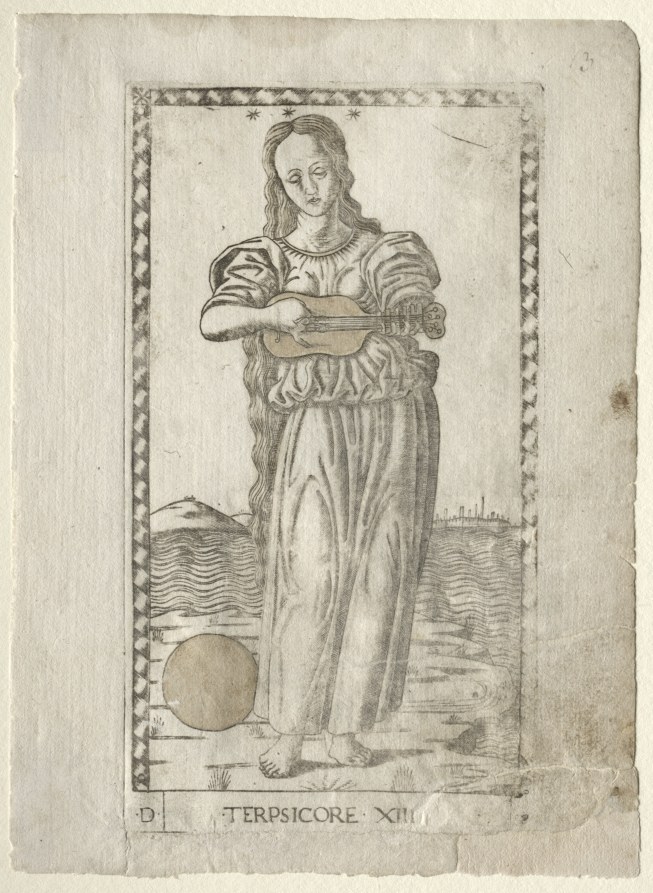
Terpsichore (dancing and song) (from the Tarocchi series D: Apollo and the Muses, #13)
Master of the E-Series Tarocchi (Italian, active 1460s)
- Medium:
- engraving
- Collection:
- Prints
- Source:
- Cleveland Museum of Art
- Rights:
- Public domain — free to use, share and adapt.
- Recorded as:
- CC0
For dance historians, this image is valuable not as a record of Renaissance dance technique but as evidence of how dance was conceptualized and valued in the mid-fifteenth century: as one of the classical arts, worthy of inclusion alongside music and poetry in an educational series, and as a domain governed by an ancient, authoritative muse. The association of Terpsichore with the lute rather than depicting her in active motion reveals a period understanding of dance as inseparable from music and song, and as a refined courtly accomplishment rather than a folk or purely kinetic practice.
What you are looking at
A single female figure stands in frontal view against a seascape background, rendered in the linear, precise style of a Northern Renaissance engraving. She wears voluminous Renaissance dress with puffed sleeves and a high waistline, her long hair falling loosely past her shoulders. She holds a stringed instrument—a lute or early guitar—across her body with both hands, positioned as if mid-performance or ready to play. The landscape behind her shows a seacoast with gently undulating waves and a distant shoreline. The entire composition is framed within a decorative border of small repeated ornamental patterns. The engraving is formal and emblematic rather than narrative: this is a personification of an abstract concept rather than a snapshot of lived performance.
The dancing
The figure's stance is upright and nearly symmetrical, with weight evenly distributed, conveying stillness rather than motion. Both arms hold the instrument across the front of the body in a stable, self-contained frame. The posture is one of poise and dignity rather than physical exertion. There is no suggestion of the footwork or dynamic weight-shift that would characterize an actual dancer in motion; instead, the body presents itself for contemplation. The relaxed positioning of the arms and the instrument suggest a moment of readiness before performance rather than an active dance movement.
The dance depicted
This engraving represents Terpsichore, the muse of dance and song in classical mythology, but the figure does not depict an actual dance. Instead, she is presented as an allegorical personification—a symbol of the dance arts rather than a documentation of how dance was performed in the 1450s–60s. The instrument she holds is significant: it identifies her domain as music and song rather than choreography alone. During the Renaissance, the nine muses were commonly represented in this manner, as static emblematic figures embodying abstract principles. No specific dance style is visible; the work commemorates the concept of dance rather than depicting any particular movement vocabulary or social context.
How it was made
This is an engraving—a printmaking technique in which an image is incised into a copper plate and then inked and printed. The medium is evident from the precise parallel hatching lines used to create shadow and volume, the crisp linear detail, and the characteristic controlled tonality. As a print, this work was reproducible and circulated in multiple impressions, making it affordable and accessible beyond the elite manuscript tradition. Engravings were a primary vehicle for disseminating allegorical and mythological imagery during the Renaissance, particularly in series like the Tarocchi, where standardized imagery could be widely distributed and collected.
About this work
This engraving is the thirteenth card in a series depicting Apollo and the Nine Muses, a popular Renaissance subject that gave visual form to classical learning and the arts. Terpsichore, identifiable by her association with the lute and her placement within this documented series, represents the abstract principle of dance rather than dance practice itself. The work is a product of Northern European Renaissance printmaking, likely created in Italy or the Low Countries during the 1450s–60s, when such allegorical series were fashionable among educated collectors and courts. It demonstrates how Renaissance artists visualized the ancient muses: as dignified, classically draped female figures, each bearing the symbolic attributes of their domain.
How to look at it
This is not a moment frozen mid-movement but a static presentation—a visual definition. Notice the symmetry and stillness: the figure is arranged to be memorable and emblematic rather than naturalistic. The lute is the key: it identifies Terpsichore and signals that Renaissance culture understood dance not as abstract kinetic expression but as a partner to music, song, and courtly refinement. The formal border and careful composition announce this is a serious, didactic work, meant to instruct as much as to ornament. The seascape behind her is a classical convention for mythological subjects, placing her in an idealized, timeless space rather than a court or ballroom.
The artist
The print is attributed to the Master of the E-Series Tarocchi, an anonymous Northern European engraver active in the 1460s whose identity remains unknown. This artist is defined by their work on the Tarocchi series—allegorical and mythological card sets that were not playing cards in the modern sense but rather educational or contemplative works printed in small editions for collectors. The style is characteristically precise, with fine parallel hatching, careful anatomical rendering, and balanced compositions. The master's work represents a major phase in the development of Northern European engraving, a technique increasingly used to disseminate classical and learned imagery.
The period
The mid-fifteenth century saw the revival of classical learning during the Italian Renaissance, extending northward through Flanders and Germany. The nine muses were a standard vehicle for representing the liberal arts and human knowledge. At the same time, engraving was emerging as a powerful new medium for reproducing complex allegorical imagery across multiple copies. In the dance sphere, the Renaissance court was cultivating an increasing interest in formalized, choreographed dance—the basse danse, branle, and almain were becoming codified—but these learned prints present dance in its classical, mythological guise rather than contemporary courtly form. The Tarocchi series represents an attempt to create a comprehensive visual encyclopedia of classical knowledge for educated elites.
Where it lives
This engraving is part of the Tarocchi series marked 'D: Apollo and the Muses,' one of several allegorical card series produced in Northern Europe during the 1450s–60s. The work is held in the collection of the Cleveland Museum of Art (listed as source: cma). It survives as a print impression on paper, a format that allowed these works to circulate widely among collectors and scholars of the period.
Dance in this work
Questions about this work
Is this Terpsichore actually dancing?
No. She is a personification—a visual embodiment of the abstract concept of dance and song. Renaissance artists represented the nine classical muses as dignified, still figures bearing symbolic attributes rather than as figures caught in the act of performance. The lute identifies her domain; the formal posture conveys authority and timelessness. This reflects how educated Renaissance viewers understood the muses: as eternal principles rather than as active agents.
What is the lute doing there?
The lute was the quintessential courtly instrument of the Renaissance and was intimately connected with dance. Many Renaissance dances were accompanied by live music from lutes, vielles, and other stringed instruments. By giving Terpsichore the lute, the artist emphasizes that dance and music were understood as inseparable arts—parts of the same courtly culture. This pairing also reflects the etymology: 'Terpsichore' derives from Greek words meaning 'delighting in the dance,' but she was invoked for both dance and song.
How do we know this is part of a series?
The inscription 'TERPSICHORE XIII' at the bottom identifies her as card thirteen in the sequence. The formal frame, consistent style, and the documented existence of parallel cards depicting Apollo and the other eight muses confirm this is one component of an organized, didactic series. Such Tarocchi series were often printed in complete sets for collectors, making them a form of Renaissance visual reference library.
What does the seascape in the background mean?
Classical convention. Mythological figures were typically placed in idealized, timeless landscapes rather than contemporary settings. The sea and distant shore locate Terpsichore in the realm of classical antiquity, far removed from the artist's own time. This convention helped viewers understand they were encountering eternal, universal principles rather than contemporary courtly figures.
More dance artwork





