49 works in this view — arrow keys or swipe to move between them.
Dance in Art
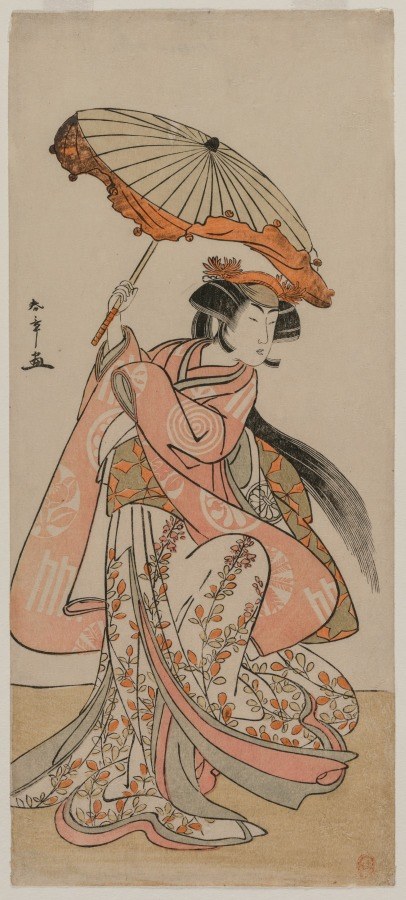
The Actor Segawa Kikunojo II Dancing with a Parasol
Katsukawa Shunshō (Japanese, 1726–1792)
- Medium:
- color woodblock print
- Collection:
- Japanese Art
- Source:
- Cleveland Museum of Art
- Rights:
- Public domain — free to use, share and adapt.
- Recorded as:
- CC0
For historians of kabuki and Japanese theatre, this print documents a celebrated performer and preserves the precise appearance of mid-18th-century stage costume, including textile patterns and props that would otherwise be lost. For dance historians, it demonstrates how dance and theatre were integrated in the kabuki tradition and shows the refined, postural quality of onnagata performance—a gendered theatrical mode that incorporated dance elements into a larger physical vocabulary. The print is also evidence of how woodblock printing functioned as a medium for theatrical publicity and cultural memory in Edo Japan.
What you are looking at
A single figure dominates the composition: an actor dressed in elaborate kabuki costume, shown in three-quarter profile against a plain ground. The dancer wears a striking salmon-pink outer robe with ornamental floral patterns woven throughout, layered over multiple inner garments visible at the neckline and sleeves. The robes fall in cascading folds to the ground, displaying the characteristic silhouettes and textile patterning of mid-18th-century Edo-period kabuki dress. Most distinctively, the figure holds aloft an open parasol with a bamboo frame and paper canopy, decorated in burnt orange with geometric patterns and tied ribbons. The parasol is tilted back at an elegant angle, almost overhead. The actor's face is rendered in profile with the stylized makeup of kabuki theatre—defined brows, sharp cheekbones, and a composed expression. A small cartouche bearing the artist's signature appears in the lower left. The entire image is executed in colour woodblock print, with careful attention to the gradation of hues and the precision of line work.
The dancing
The body is upright and elegantly poised, weighted evenly on both feet in a standing posture that conveys stillness rather than active movement. The left arm extends upward at shoulder height, holding the parasol handle with a graceful curve; the right arm hangs at the side, hand visible with fingers delicately positioned. The neck extends in a subtle forward tilt, a characteristic of kabuki performance posture. There is no visible footwork or active stepping; instead, the pose suggests a moment of display or pause in action—a studied attitude rather than caught movement.
The dance depicted
This is a portrait of a kabuki actor in performance costume, specifically the onnagata (female role specialist) Segawa Kikunojo II, as stated in the title. The parasol is a standard prop in kabuki theatre, often used in female roles and in scenes depicting courtship or refined domestic life. The pose and dress suggest a moment from a theatrical scene rather than the documentation of an actual dance pattern or choreographic technique. Kabuki incorporated dance elements (particularly in the form called *mai* or *odori*), but this image captures theatrical performance costume and a refined tableau rather than a specific dance style or movement sequence. The parasol gesture and the elegant cascading robes would be elements within a larger choreographed scene.
How it was made
This is a colour woodblock print, a medium that allowed for precise registration of multiple colours and the fine linear detail evident in both the fabric patterns and the parasol frame. Woodblock printing in Japan was a commercial medium with a wide audience, particularly for actor portraits (*yakusha-e*), which were widely circulated and affordable. The technique required carving separate blocks for each colour layer and careful alignment during printing. The use of delicate gradations in the salmon pink and burnt orange indicates skilled technical execution and suggests this print was made for a relatively affluent audience familiar with kabuki theatre.
About this work
This is an actor portrait in the *yakusha-e* tradition, a genre of Japanese woodblock prints that documented and celebrated kabuki performers. Katsukawa Shunshō was one of the leading masters of the form in the 1770s, and his prints were prized for their accuracy of costume detail and the dignified portrayal of celebrated actors. The work combines portraiture, theatre history, and textile documentation. The figure's costume bears the crests of three other actors, a convention that may have commemorated a significant performance or ensemble work. This image sits at the intersection of theatrical documentation and fine art print culture—it is neither a record of an actual movement nor a depiction of a dance style, but rather a frozen moment of kabuki performance, capturing the visual and material richness of the theatre.
How to look at it
Attend first to the silhouette and the fall of the layered robes—note how Shunshō has used line and colour gradation to suggest the weight and texture of the fabrics. The parasol is the focal point of the composition and the central prop in the scene; its tilt and the delicate handling of the frame convey a sense of refined, controlled gesture. Look at the facial profile and the posture of the neck and shoulders—these small adjustments of the body indicate the cultivated restraint and elegance of onnagata performance. The inscription of three actor crests on the robe is a specific detail that may commemorate a particular performance or collaboration; it demonstrates how even commercial actor portraits could encode theatrical and social information for a knowledgeable audience.
The artist
Katsukawa Shunshō (1726–1792) was one of the most accomplished and prolific designers of *yakusha-e* in the late 18th century. He was the founder of the Katsukawa school and is credited with elevating the actor portrait print to a fine art through his attention to individual likeness, psychological presence, and technical mastery of the woodblock medium. His prints combined precise observation of costume and makeup with a refined sense of composition and line. Shunshō worked during the height of the actor print market in Edo and was highly influential on the next generation of print designers.
The period
The 1770s were a golden age for kabuki theatre in Edo (present-day Tokyo) and for the actor print as a commercial and artistic medium. Kabuki had developed into a highly codified performance tradition with specialist roles (including the onnagata, or female impersonator role), elaborate costumes, and integrated dance sequences. The same period saw the refinement and mass production of colour woodblock printing, which allowed prints to circulate widely and function as souvenirs, publicity, and art objects. Actor prints were collected avidly and helped to fuel the celebrity of popular performers. The theatrical world and the visual arts were closely interconnected; actors were depicted by leading print designers and their images became iconic representations of both individual performers and broader aesthetic ideals.
Where it lives
The work is held in the Japanese Art collection at the Cleveland Museum of Art and is catalogued in the museum's database. Actor prints of this period were produced in editions and circulated widely in Japan and later collected internationally; this is a surviving impression of a commercial print.
Dance in this work
Questions about this work
Was Segawa Kikunojo II a real person, and was this a portrait of an actual performance?
Yes. Segawa Kikunojo II was a celebrated onnagata (female-role specialist) in Edo-period kabuki. Shunshō's prints were based on observation of actual performances or were created in collaboration with popular actors. The parasol scene may reference a specific performance or a stock scene type common in female roles. Actor prints were not necessarily portraits of single moments but could represent the actor's characteristic roles and appearance.
What does the parasol signify in kabuki?
The parasol (or umbrella) was a standard prop in kabuki theatre, particularly in female roles and in scenes depicting courtship, domestic life, or refined leisure. It allowed for graceful gestural play and was associated with elegance and femininity in the aesthetic conventions of the theatre. The prop gave performers an object around which to build choreographed movement and tableau.
What are the three crests shown on the robe?
According to the catalogue record, the crests belong to three kabuki actors: Ichimura Uzaemon IX, Nakamura Nakazo I, and Nakamura Tomijuro I. The presence of multiple crests on a single costume print is unusual and may commemorate a significant ensemble performance, a collaborative arrangement, or an actor's relationships within the kabuki world. The specific occasion is not documented in the print itself.
How was this print made and distributed?
This is a colour woodblock print, made from separate carved blocks for each colour layer. The artist designed the image, which was then carved by specialist craftsmen and printed in editions, likely of hundreds of impressions. These prints were inexpensive compared to paintings and were sold as theatre souvenirs, as collectibles, and as a form of celebrity publicity. They were displayed in homes and shops and helped make popular actors recognizable to a wide audience.
More dance artwork





