49 works in this view — arrow keys or swipe to move between them.
Dance in Art
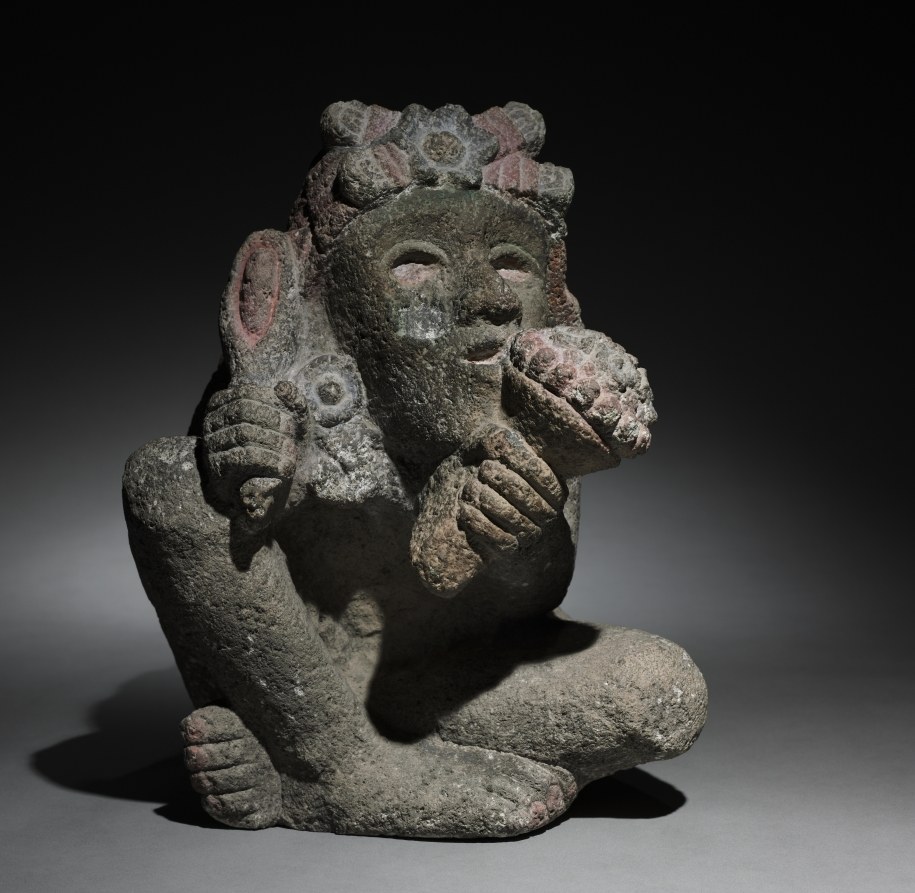
Seated Male Carrying Maize
Unknown artist
- Medium:
- stone, pigment
- Collection:
- Art of the Americas
- Source:
- Cleveland Museum of Art
- Rights:
- Public domain — free to use, share and adapt.
- Recorded as:
- CC0
This sculpture embodies a non-Western approach to representing dance and dancers: not as captured movement, but as the spiritual essence of creativity and pleasure that dance expresses. It reminds us that in many cultures, dance is inseparable from the sacred and from fertility; the maize on the figure's back connects human movement and artistic expression to agricultural cycles and survival. For historians seeking to decolonize dance history, this work is crucial evidence of how differently other societies have understood the relationship between the moving body and spiritual or political power.
What you are looking at
A stone sculpture in the round depicts a seated figure in a posture of devotional or ceremonial significance. The figure sits with legs crossed or folded, the body upright and frontal. The face is broad and serene, with almond-shaped eyes and a calm expression. The most striking feature is the elaborate headdress: a crown or ceremonial ornament rises from the head in the form of clustered, rounded forms—possibly stylized flowers or a cactus bloom—rendered in the stone with lighter pigmentation (pink or coral-toned) visible in the weathered surface. The figure holds objects in both hands: in the right hand, a cone or cluster of flowers or plant material; in the left hand, what appears to be a small animal or mask-like form. Across the shoulders and back rests a substantial burden of maize cobs—the dried cores of corn—a load that speaks to agricultural abundance or spiritual burden. The stone shows age and weathering, with lichen or mineral deposits creating a mottled surface of grey, tan, and rust tones. The work is carved from volcanic stone and retains traces of pigment in recessed areas.
The dancing
The seated pose is stable and grounded, suggesting meditation, ceremony, or divine presence rather than active movement. The spine is straight, the shoulders broad and squared. Both arms are positioned to display the objects held—the gesture is presentational rather than gestural. The figure's scale and frontality suggest this is an iconic, votive work intended to be approached and viewed from multiple angles rather than depicting a moment of movement or choreography. The crossed-leg position may indicate ritual sitting rather than a dance posture.
The dance depicted
This sculpture does not appear to depict dance in the conventional sense. Rather, it represents a deity or spiritual figure associated with dance, music, flowers, and fertility in Aztec cosmology. The figure likely represents Xochipilli or Macuilxochitl, divine patrons of the arts and pleasures. The flowers, maize, and composed posture speak to Aztec concepts of beauty and creative abundance rather than to a captured moment of movement. The work functions as a sacred object imbued with the qualities and domains of the deity it represents, including dance, but is not itself a representation of dancers or dancing.
How it was made
The work is carved in the round from a single block of volcanic stone, likely andesite or similar Mesoamerican stone. The carving technique shows skilled understanding of mass and volume: the figure emerges from the block with confident planes and rounded forms. Surface details—the headdress, facial features, the small animal or mask in the hand—are achieved through incising and careful modeling. The original pigment application (pink or red ochre visible in shadow areas) would have enhanced the symbolic meaning: red being associated with life, blood, and the east in Aztec thought. The durability of stone ensured the work's survival and likely indicates a high-status commission, as monumental stone sculpture was a practice reserved for elite or state-sponsored art.
About this work
This is a pre-Columbian Aztec votive sculpture representing a deity of dance, music, flowers, and creativity. Although it does not depict active dancing, it is made for inclusion in a gallery of dance in art because the figure it represents presided over dance and the arts in Aztec religious practice, and because understanding sacred art and its relationship to performance is part of dance history. The work demonstrates how dance and the plasticity of the human body were integrated into Aztec cosmology and religious devotion. For a dancer or choreographer studying how societies have imagined the connection between body, spirit, and creativity, this object reveals an entirely different conceptual framework from European traditions of depicting the body in motion.
How to look at it
Approach this work as you would a portrait or an icon: the face and posture are meant to be read as a presence rather than as a moment in time. Notice how the scattered pigment in the crevices (particularly the pink tones in the headdress) would have glowed when the work was new and perhaps ritually anointed or lit. Observe the careful balance between the figure's calm frontality and the animated, clustered forms of the headdress—tension between stillness and the implicit movement of flowers, flame, or abundance. The maize cobs, which would have been a familiar and precious material to the sculptor's audience, anchor the work in the physical world of sustenance and labor, reminding us that divine beauty and human survival are one concept.
The period
This work dates to the Aztec Empire's height (circa 1325 onward, the traditional founding date of Tenochtitlan). In Aztec society, dance was a central form of religious observance, courtly entertainment, and state ritual. Sculptures like this served as votive objects in temples or elite households, embodying the deity's presence and blessing. The Aztecs had a sophisticated visual language for representing deities, layered with symbolic meaning in every detail—the flower crown, the maize burden, the held objects—all communicating concepts of fertility, abundance, divine favor, and the relationship between human creativity and cosmic order. Stone sculpture was one of the highest art forms, produced by specialist craftspeople and associated with monumental public works and sacred precincts.
Where it lives
The sculpture is held in the Art of the Americas collection at the Cleveland Museum of Art, part of the museum's holdings of pre-Columbian Mesoamerican art. The work's specific excavation history and original context are not recorded in the available catalogue.
Dance in this work
Questions about this work
Why is this in a collection about dance if nobody is dancing?
In Aztec belief, Xochipilli and Macuilxochitl were divine patrons of dance and music. This sculpture represents the deity itself, not a dancer, but it embodies dance as a sacred and cosmic principle. Many ancient cultures—Mesoamerica, ancient Egypt, China—made votive sculptures of gods and spirits associated with music and dance. Understanding how societies represent the sacred dimensions of dance through objects like this is essential to dance history. It shows that dance was not primarily entertainment or exercise, but a form of spiritual and political power.
What does the maize on the figure's back mean?
Maize (corn) was sacred in Aztec culture—the source of life and the material of creation myth. That the deity carries maize cobs suggests that artistic creativity, pleasure, and beauty are as fundamental to life as food itself. Some scholars interpret the burden as representing the weight of creative responsibility or the abundance flowing from the deity's domain. The load may also reference ritual practices in which dancers themselves wore elaborate and heavy regalia, making the act of dancing an embodiment of carrying gifts or tribute.
Is this the same as the Aztec god Xochiquetzal?
The catalogue record identifies the figure as either Macuilxochitl or Xochipilli. Xochiquetzal is related—also a deity of flowers, crafts, and sexuality—but Xochipilli (Five Flower) is more specifically the patron of dance, music, games, and beauty. Without additional context or inscriptions, definitive identification is difficult, but the attributes (especially the flower crown and the maize) align most closely with Xochipilli or Macuilxochitl (Five Flower).
What is the small object in the figure's right hand?
The catalogue describes it as a cone of flowers, possibly a cactus blossom or an agave flower. In Aztec art, flowers were symbols of beauty, refinement, and fertility. The object may also represent a ritual offering or a sacrificial element. The hand gesture is presentational—the figure is displaying or offering the flower rather than holding it casually, suggesting a ceremonial or votive purpose.
More dance artwork





