49 works in this view — arrow keys or swipe to move between them.
Dance in Art
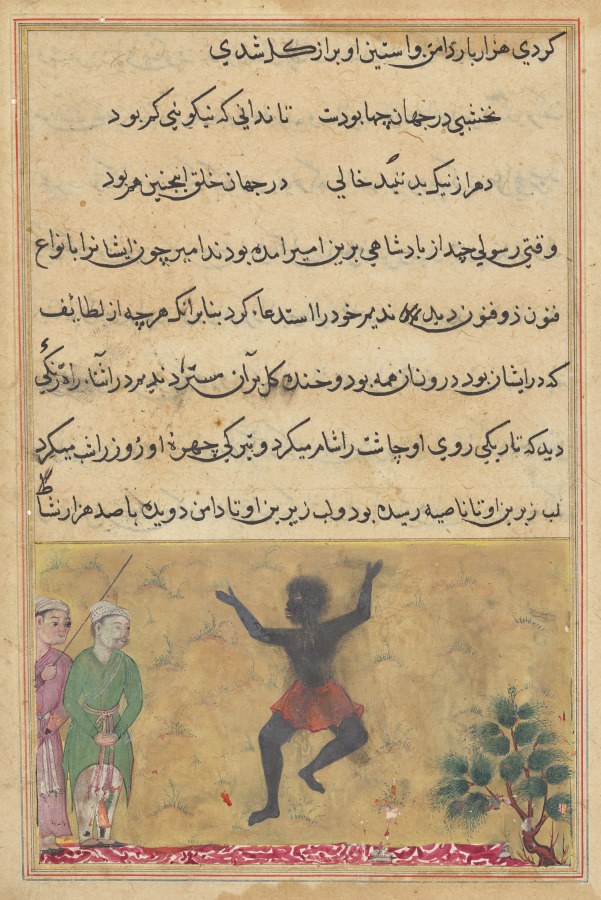
The court jester meets a Zangi dancing with joy, and learns from him that the cause of his happiness is his assignation with a woman who is the jester’s own wife, from a Tuti-nama (Tales of a Parrot): Twenty-second Night
Unknown artist
- Medium:
- gum tempera, ink, and gold on paper
- Collection:
- Indian and Southeast Asian Art
- Source:
- Cleveland Museum of Art
- Rights:
- Public domain — free to use, share and adapt.
- Recorded as:
- CC0
This image preserves a rare depiction of non-court dance and ecstatic movement in a courtly artistic tradition, and it does so while making visible the racial and social hierarchies embedded in that tradition. For historians of South Asian dance, slavery, and courtly representation, it offers concrete evidence of how dance functioned as a language of social and moral coding in early modern Indo-Persian narrative.
What you are looking at
A figure identified as Zangi (Ethiopian) dances vigorously in the center of the composition, his dark body bare-chested and dynamic against a pale background. His arms are raised high and spread wide, his legs bent in an energetic stance that communicates joy and abandon. To the left stand two figures in profile wearing rich court dress—one in deep green, one in pink or mauve—observing the dancer. The setting is minimal: a decorative ground line suggests a roadside or open space, with a single leafy plant or shrub sketched on the right. The entire scene is framed within a dark border and surrounded by several lines of Persian or Arabic text in black ink above the image.
The dancing
The Zangi dancer occupies the composition's visual center with his body in an open, exuberant stance: knees flexed, hips shifted, torso upright, both arms raised and separated at shoulder height or above. His posture conveys weightlessness and exultation—a body moving freely without the constraints of formal court deportment. The two observers stand still in profile, their bodies aligned vertically, their attention directed toward the dancing figure. The contrast between the static, upright carriage of the clothed courtiers and the dynamic, spread openness of the unclothed dancer structures the entire composition.
The dance depicted
This depicts a social or celebratory dance rather than a codified court form. The image illustrates a narrative moment from the Tuti-nama (Tales of a Parrot), in which a court jester encounters an Ethiopian slave or servant dancing by the roadside in unrestrained joy. The dance is characterized by open arm gestures, flexed legs, and an overall posture of uninhibited pleasure—a deliberate visual contrast to the formality expected of court performers. The text records that the dancer's happiness stems from an illicit assignation, and the visual language of the dance itself—expansive, grounded, ecstatic—communicates that emotional state directly.
How it was made
This is a page from an illustrated manuscript, executed in gum tempera, ink, and gold leaf on paper, a technique standard for luxury Mughal or Indo-Persian court manuscripts of the 16th century. The figures are rendered in flat, bold color fields with minimal modeling; the ground and background are left nearly bare. Gold leaf and fine linear details create ornament and emphasis. This technique allowed for brilliant color and jewel-like precision on a small, portable scale, suited to intimate viewing in a royal library or study. The work circulated among a court elite who could read Persian and commission or own such manuscripts.
About this work
This is a page from a 16th-century Indo-Persian narrative manuscript depicting a moment of social dance outside court structures. The image illustrates a slave or servant named Zangi dancing in an open, joyful posture while court attendants observe—a scene that encodes both racial and social difference and positions ecstatic dance as an expression of private emotion and desire. The work is significant as evidence of how dance was understood and depicted in Mughal-era court art: as a marker of social status, emotional authenticity, and moral transgression, and as a moment of visual contrast between the body constrained by court protocol and the body released into feeling.
How to look at it
Attend to the artist's choice to render the dancer's body in dynamic, open posture at the exact moment of exuberant movement, with limbs extended and spread. Notice the deliberate contrast between the smooth, vertical silhouettes of the clothed observers and the energetic, bent, open form of the dancer. The raised arms and flexed legs convey a specific emotional and social register—pleasure, freedom, and a kind of bodily license that marks the figure as outside courtly restraint. The text above explains what the image shows: a body expressing joy at transgressive desire.
The period
The Tuti-nama was a popular Indo-Persian narrative text, versions of which were illustrated for Mughal court patrons in the 16th and 17th centuries. Court dance in Mughal India was formalized and hierarchical, performed by musicians, dancers, and courtesans within strict protocols of decorum. Social or vernacular dance existed outside these structures, and was often associated with lower social ranks, non-Muslims, and uninhibited sexuality. This image sits at that boundary, using dance to visualize and moralize on the transgression of social order. The style of the manuscript—its refined technique, precious materials, and literary sophistication—contrasts pointedly with the figure at its center, whose dance is depicted as wild, unconstrained, and racially marked as other.
Where it lives
This page belongs to an illustrated manuscript held in the Indian and Southeast Asian Art collection. It is one of many surviving copies or versions of the Tuti-nama, a tale known in multiple illustrated editions from the Mughal period.
Dance in this work
Questions about this work
Why is the dancer depicted as dark-skinned and unclothed while the observers wear rich clothing?
The manuscript encodes social and racial hierarchies through visual language. The term 'Zangi' refers to a person of African descent, and the contrast between bare skin and court dress signals both social subordination and moral difference. The narrative positions the dancer as a servant or enslaved person, and the sparse clothing combined with the unrestrained posture implies a body subject to different rules of conduct than those governing court insiders.
What kind of dance is this?
This is not a formal court dance with a codified name or technique. It is social or celebratory movement—a joyful, ecstatic response to anticipation of a romantic encounter. The open arms, flexed knees, and upright torso convey emotional authenticity rather than technical accomplishment. In the context of the narrative, the dance functions as a window into the dancer's interior state.
Is this a photograph or a painting?
This is a page from an illuminated manuscript, created using tempera paint (pigments bound in gum), ink, and gold leaf applied by hand to paper. It was made in the 16th century and circulated as a luxury object within elite Mughal court collections.
What is the text above the image?
The text is in Persian or Urdu and is part of the Tuti-nama (Tales of a Parrot), a narrative frame-story. It tells the story of the jester, the Zangi, and the circumstances that lead the jester to perform the dance. The image illustrates a specific moment in that larger narrative.
More dance artwork





