49 works in this view — arrow keys or swipe to move between them.
Dance in Art
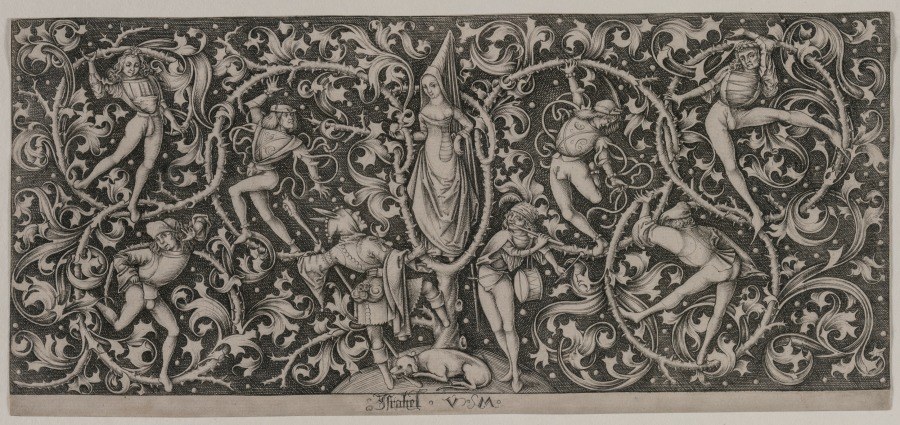
Ornament with Dance of the Lovers
Israhel van Meckenem (German, c. 1440–1503)
- Medium:
- engraving
- Collection:
- Prints
- Source:
- Cleveland Museum of Art
- Rights:
- Public domain — free to use, share and adapt.
- Recorded as:
- CC0
This engraving is one of the most detailed surviving images of early Renaissance courtship dance in motion. It shows how male dancers were expected to use their bodies—the reach, the extension, the competitive display—and how music and ornament framed that performance. For choreographers, historians, and anyone interested in how court dance was understood and taught in the German-speaking world of the 1480s, it is invaluable visual testimony.
What you are looking at
An engraving bursting with interlocking figures and scrolling ornament, the composition so densely packed that dancers, cherubs, and foliage almost merge into one writhing field. At the center stands an elegant woman in a long gown, her pose composed and vertical, around whom male suitors in contemporary dress gesture and reach. Two musicians occupy the middle distance—one plays a stringed instrument, the other a wind instrument—their presence anchoring the dance narrative. The suitors bend and extend their bodies as if competing for the woman's attention, their limbs often enfolded by or emerging from thorny vines that spiral across the entire surface. The engraving technique renders every form in fine hatching: the vines cast deep shadow, the figures glow against dark grounds, and the ornamental scrollwork that fills every corner space—acanthus leaves, tendrils, heraldic shields—pulses with the same visual energy as the dancers themselves. Light comes from nowhere and everywhere; the medium allows no spatial recession, only a compression of lust and courtship into almost abstract pattern.
The dancing
The male figures adopt open, expansive poses—arms raised or extended in supplication, bodies in half-turns and lunges. Their movement suggests the fluid, decorative language of Renaissance and early modern courtship dance: bent knees, raised chests, a willingness to display the body for an audience. The woman at center maintains an upright, almost monumental stance, her gown's volume and her vertical axis setting her apart from the men's more mobile exuberance. At least six to eight figures are engaged in active dance or play around her. The twisted spines, reaching arms, and interlocking of limbs suggest a competitive energy—multiple suitors performing simultaneously, their bodies not in unison but in rhetorical excess, each trying to outdo the others.
The dance depicted
The existing catalogue record identifies this as possibly a Morris dance or folk dance related to courtly love and troubadour tradition. The presence of musicians, the competitive male display, and the central woman as object of desire fit that reading. However, the style of dress, the formal courtly setting implied by the woman's elegance, and the ornamental language of the engraving point more clearly to Renaissance courtly dance—likely an Almain, Galliard, or similar social dance of the 1480s German court. The thorns suggest a metaphorical obstacle (love's pain, desire thwarted) rather than a literal stage. The moment captures not a single choreographed figure but the principle of the dance: male elaboration, female stillness, and music as the binding force. Without inscription or clearer context, the specific dance style remains ambiguous, but the image documents how Renaissance courts staged competitive masculine display within the grammar of ornament.
How it was made
This is an engraving—a intaglio print made by incising a design into a metal plate (almost certainly copper), inking the recessed lines, and pressing paper against it under pressure. The technique allowed for extraordinary fine detail and fine hatching, as seen in the dense cross-hatching that models the drapery and creates the illusion of light and shadow. Engravings were reproducible and could circulate widely in multiple impressions, making them ideal for distributing images of courtly manners and ornament across the Holy Roman Empire. The cost of production and the skill required meant engravings were typically made for educated patrons—courtiers, merchants, artists seeking to study ornament and composition. The date and signature suggest this is a print from Israhel van Meckenem's workshop, a prolific German engraver whose designs for ornament, dance, and courtship were much copied.
About this work
This is a densely ornamented engraving depicting a courtship dance of the 1480s, with at least five male suitors competing for the attention of a central woman, accompanied by musicians playing a stringed and wind instrument. The dance itself is rendered inseparable from the surrounding ornament—thorny vines, heraldic shields, scrollwork—so that the image functions simultaneously as a record of courtly behavior and as an essay in decorative composition. The work belongs to a Northern European tradition of prints documenting courtship rituals, and it would have circulated among courts and workshops as both a model for courtly conduct and a study in the human figure in motion. For historians of Renaissance dance and social performance, it is a rare document of how young men in the 1480s were supposed to move in the presence of a woman of status.
How to look at it
Look first at the central woman and how the male figures orient themselves around her. Notice that she is nearly motionless while they reach, bend, and gesture—a visual hierarchy that tells you this is a male performance for a female audience. Then trace the limbs of the men: how they extend into lunges, how their torsos twist, how their arms reach upward or outward in welcome or supplication. The thorny vines that wind through the composition are not mere ornament but a visual metaphor for the obstacles and pain of courtship. Finally, note the musicians: they occupy a position of authority, their instruments defining the tempo and character of the dance. The engraving technique—the fine hatching, the delicate line—makes every gesture legible; the artist understood movement and translated it into a language of line and shadow.
The artist
Israhel van Meckenem (c. 1440–1503) was one of the first and most prolific German engravers, based in Boppard on the Rhine. He produced an estimated 600 prints, many of them copies or reworkings of other artists' designs, and his workshop was hugely influential in establishing the engraving as a medium for ornamental design, courtly imagery, and narrative scenes. He was especially drawn to subjects of courtship, dancing, and aristocratic leisure—themes that appealed to his clientele of merchants, minor nobility, and aspiring courtiers. His prints circulated widely and were copied and recopied; many survive in multiple impressions and states, suggesting sustained demand.
The period
In the 1480s, courtship dance was central to courtly life across Europe. The Italian dance master Guglielmo Ebreo (William the Jew) had recently codified Renaissance dance in texts like the De pratica seu arte tripudii (c. 1460), which emphasized geometric precision, competitive male display, and music as the foundation of movement. German courts, while less documented than Italian ones, followed similar conventions: dances like the Almain and Galliard involved rapid footwork, elevation, and opportunities for individual display. The ornamental language of the engraving—the scrollwork, the heraldic allusions, the use of thorns as metaphor—reflects the aesthetic of the Northern Renaissance, where decoration and meaning were inseparable. Prints like this one were how those courtly ideals circulated beyond the courts themselves.
Where it lives
The work is held in the Prints collection of the Cleveland Museum of Art (CMA), source listed as "cma." It is catalogued as a print, almost certainly an impression from the copper plate engraved by Israhel van Meckenem c. 1485. Like most prints from this period and workshop, multiple impressions likely exist in other collections.
Dance in this work
Questions about this work
Is this a real dance or invented?
This is almost certainly a real dance—a courtship ritual or competitive display known in the German-speaking courts of the 1480s. However, the engraver has theatricalized and ornamented it. The thorny vines and scrollwork are decorative and metaphorical, not literal stage elements. The image shows us what the dance meant and how people moved, rather than a documentary record of a specific performance.
Why is the woman so still while the men move so much?
This reflects Renaissance courtship convention: men performed for women, displaying skill, athleticism, and wit. The woman's stillness is not passivity but authority—she is the center and object of attention. By standing composed while the men elaborate around her, she holds the visual and social power of the composition.
What do the thorns mean?
The thorns are a metaphor for love's pain and difficulty, a common conceit in medieval and Renaissance courtship literature and art. They suggest that the path to the woman's heart is blocked or painful—a visual representation of the obstacles suitors must overcome. This ties the dance to the tradition of courtly love poetry.
How would this engraving have been used?
Prints like this circulated as models for courtly behavior and ornament. A young nobleman or merchant might study it to understand how to move in a courtship dance, or a painter might use it as a composition study. It would also hang on a chamber wall as evidence of refinement and good taste. The engraving made courtly knowledge portable and reproducible.
More dance artwork





