49 works in this view — arrow keys or swipe to move between them.
Dance in Art
The Proverbs: If Marion Will Dance, Then She Has to Take the Consequences
Francisco de Goya (Spanish, 1746–1828)
- Medium:
- etching and aquatint
- Collection:
- Prints
- Source:
- Cleveland Museum of Art
- Rights:
- Public domain — free to use, share and adapt.
- Recorded as:
- CC0
This print preserves a rare visual record of the saraband in its original, disreputable Spanish context before it became a court formality. It shows how dance was weaponized in gender politics: the female dancer is literally surrounded and gestured at, her body the subject of male and female scrutiny and implied judgment. For historians of early modern dance and of gender performance, this is primary visual evidence of how popular dance was understood as transgressive and how that transgression was framed through print culture.
What you are looking at
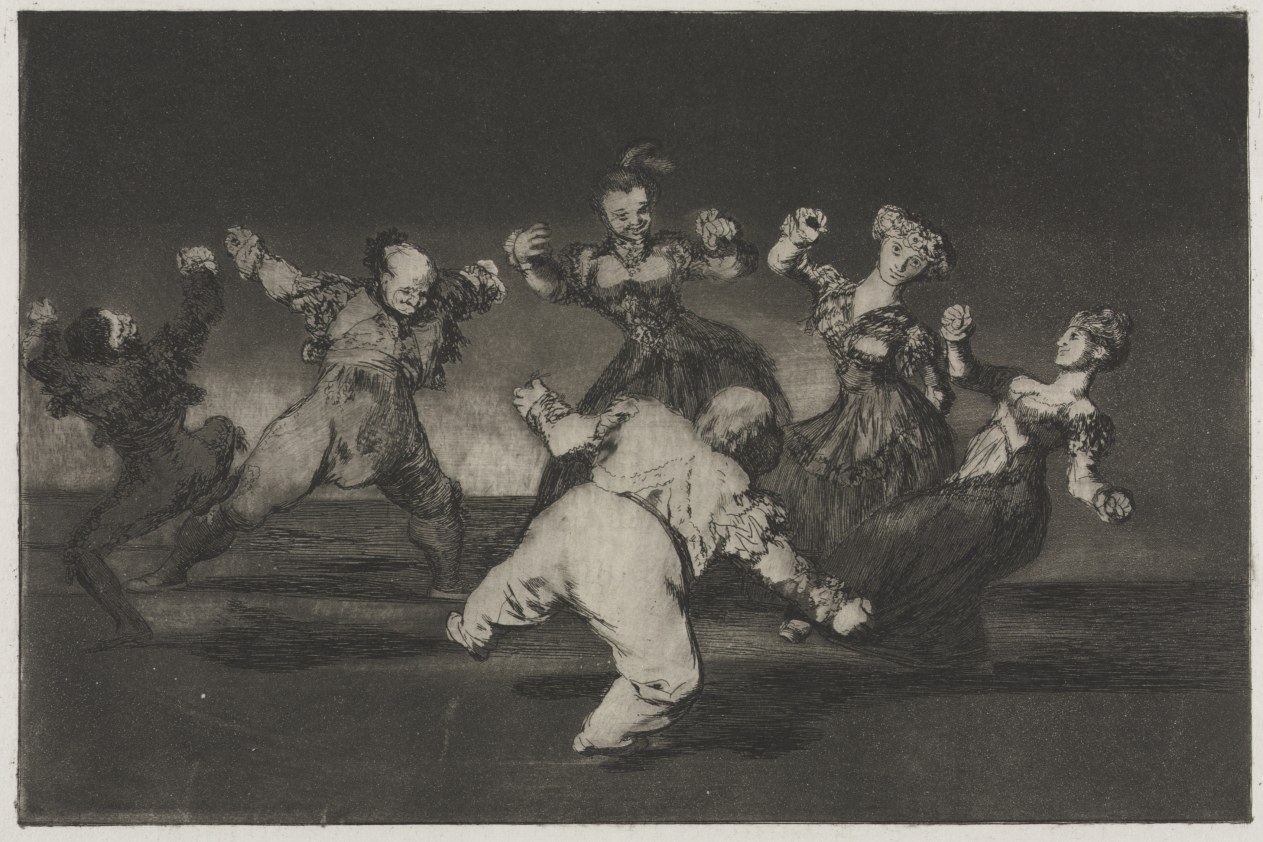
A nocturnal scene crowded with figures in motion across a dark stage or interior space. At center, a crouching or bent female figure with exposed legs dominates the composition; she wears draped fabric and appears to be the focal point of the action. Around her stand multiple figures—women in elaborate period dress with feathered or plumed headdresses, and at least one demonic or grotesque male figure at left—arranged in a semicircle. The women hold their arms raised, some with hands near their faces or in animated gesture. The etching technique renders the scene in bold blacks and grays with dramatic contrasts, creating a sense of movement and theatrical intensity. The sparse setting and dark background emphasize the figures and their gestures; no props or clear architectural features interrupt the action.
The dancing
The central female figure is bent forward or crouching, her legs extended and weight thrown low, suggesting an acrobatic or exaggerated movement. The surrounding women stand and gesture with raised arms, hands held aloft in various attitudes—some with palms up, others with fingers splayed or curled. At least seven female figures and one male grotesque are visible. The poses suggest excitement, approval, or participation in a spectacle; none of the women are in closed or contact holds with each other. The gestures are open, expansive, and individual rather than coordinated.
The dance depicted
This appears to depict a saraband or related early modern Spanish social dance, consistent with the catalogue's reference to the saraband's association with castanets (visible as shell-shaped objects in some figures' hands) and its reputation for licentiousness. The central figure's low, bent posture and the women's raised-hand gestures and animated expressions suggest the sexually charged, improvisational character of the saraband in its 16th-century Spanish context before it was refined into the stately court dance known in 17th-century France. The title references Marion and 'consequences'—a common early modern motif in which a woman dancer faces mockery, censure, or ribald commentary for her freely executed movement. This is a satirical or moralistic print about folk or popular dance, not a court performance.
How it was made
Etching and aquatint, a combination that allowed Goya fine control over tonal gradation and dramatic effect. The aquatint creates the dense blacks and atmospheric shading that give the scene its nocturnal character and psychological intensity. Etching lines define the figures' contours and gesture. This technique was suited to wide circulation as a print; such works reached educated viewers across Europe and were often used for social or political commentary. Goya's command of both techniques is evident in the subtle modeling of flesh against the dramatically rendered garments and shadows.
About this work
This etching depicts a moment of uninhibited social dancing—a saraband or related popular dance—frozen in a composition that is both vivid and morally pointed. The print records not a refined court spectacle but a folk or lower-class dance scene marked by exaggerated gesture, sexual tension, and what the title suggests is public consequences for the female dancer at its center. Goya's technical mastery of etching and aquatint serves a sharply observational purpose: to capture the character of a dance form notorious in early modern Spain for its erotic associations and social impropriety, and to comment on the gendered dynamics of public dancing.
The work belongs in a gallery of dance in art because it documents how a specific dance form—the saraband—was understood and represented in the cultural imagination, and because it reveals the moral and social stakes that attached to women's dancing bodies in the period. It is not celebrating dance but rather depicting and implicitly critiquing it through the apparatus of prints and satire.
How to look at it
Attend to the central figure's posture and the geometry of the surrounding women's bodies and gazes. The bent or crouching stance of the main dancer is unusual in court or refined dance imagery; it suggests flexibility, improvisational movement, or a moment of exertion. The women around her are not dancing together in formation but rather witnessing, reacting, and gesturing—they are audience and chorus rather than partners. Notice how Goya's etching technique creates dramatic shadows and isolation even within the crowd: each figure is defined by contour and gesture against the dark background. The absence of a clear stage or interior architecture forces attention onto the bodies themselves.
The artist
Francisco de Goya (1746–1828) was a Spanish painter and printmaker whose etchings and aquatints often engaged with social satire, folk custom, and the grotesque. His series on witchcraft, popular superstitions, and scenes of Spanish life used the print medium to reach wide audiences and to comment sharply on social practices and beliefs. This work appears consistent with his interest in documenting and satirizing Spanish folk culture, though his satirical stance—whether sympathetic to the dancers or moralistic—remains ambiguous.
The period
In the 16th century, the saraband was a lively, sexually charged folk dance from Spain and the Mediterranean, often accompanied by percussion instruments including castanets. By the 17th century, a refined version had entered the European court, where it was slowed and made formal. Goya's print, made in the early 19th century (though the catalogue dates it 1864, which may reflect a later edition), looks backward to recover that earlier, transgressive form and the social anxieties it provoked. The print participates in a long European tradition of satirizing popular and folk dance as disorderly, sexually dangerous, and in need of moral supervision—especially when women danced.
Where it lives
This work is held as a print in the collection; the catalogue record gives the date as 1864, which likely indicates a later edition or printing of Goya's original etching and aquatint plate. Goya's prints circulated widely and were reissued, so understanding the date and edition of a particular impression is important for provenance.
Dance in this work
Questions about this work
What are the shell-shaped objects the dancers are holding?
Those are castanets, percussion instruments worn on the fingers and used to accompany the saraband and other Spanish dances. They were particularly associated with folk and popular dance and with dance performed in non-courtly contexts. Their presence in the print reinforces the identification of this as a vernacular rather than refined court dance.
Why is the central figure in such an unusual posture?
The bent or crouching stance suggests either a moment of extreme flexibility or exertion, or a deliberate posture associated with erotic or transgressive movement. In the context of the saraband's reputation for licentiousness, the posture may be Goya's way of encoding the dance's sexual charge and impropriety without depicting explicit movement.
Is this a serious representation of dance, or is Goya mocking it?
The print is ambiguous. The title references 'consequences'—suggesting moral judgment—and the composition emphasizes the female dancer's isolation and scrutiny. But Goya's technical brilliance and the vividness of the scene suggest genuine interest in documenting how this dance was performed and understood, even if satirically.
What does the title 'If Marion Will Dance, Then She Has to Take the Consequences' mean?
The title references a common early modern motif in which women dancers face public judgment or mockery for their freely executed movement. Marion is a generic or proverbial name for a woman dancer or woman of dubious virtue. The 'consequences' are social censure and the male and female gaze fixed upon her body.
More dance artwork





