49 works in this view — arrow keys or swipe to move between them.
Dance in Art
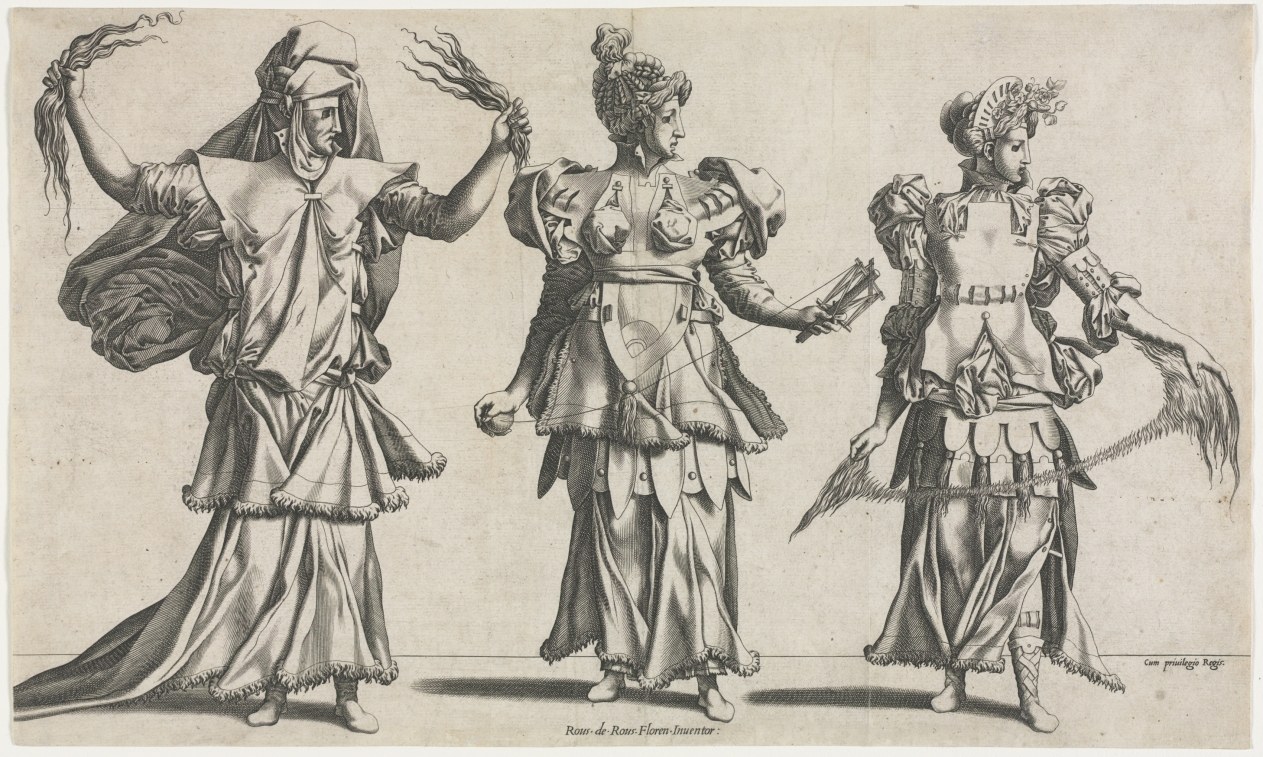
The Three Fates, Costume Designs
Pierre Milan (French)
- Medium:
- engraving
- Collection:
- Prints
- Source:
- Cleveland Museum of Art
- Rights:
- Public domain — free to use, share and adapt.
- Recorded as:
- CC0
This work documents the visual language of Renaissance court spectacle and the important role of professional costume design in elite entertainment. It shows how printmaking disseminated fashionable ideas about courtly dress, mythological costume, and court performance to a broad audience of patrons and designers, making Paris engravers essential intermediaries between the design centers of Fontainebleau and the courts of Europe.
What you are looking at
Three female figures stand in a line against a plain background, each costumed as one of the Three Fates from classical mythology. They wear elaborate Renaissance-style garments with voluminous skirts, puffed sleeves, and ornate headdresses adorned with jewels and feathers. The leftmost figure wears a long trailing cloak and holds aloft a distaff or spindle with wool or fibers flowing from it. The central figure, most prominently placed, holds thread or yarn in one hand and a scroll or tablet in the other, her costume the most heavily armored with decorative plates and embellishments. The rightmost figure holds flax or similar material and is attended by what appears to be a winged putto or cherub at her side. Each figure strikes a commanding, almost heraldic pose with raised arms and forward-facing stance, suggesting dignity and authority rather than movement or dance. The figures are rendered in fine linear detail with careful attention to fabric texture, drapery, and ornamental detail.
The dancing
All three figures stand in nearly static, frontal poses with minimal weight shift or dynamic action. Their arms are raised or extended outward in gesture rather than in any recognizable dance hold or frame. The bodies are upright and formal, with no indication of turned-out positions, balletic carriage, or coordinated relationship to one another. The poses suggest theatrical presentation or heraldic display rather than partnered or group dance: each figure is self-contained and could stand independently. Their bearing is processional and stately rather than lyrical or animated.
The dance depicted
While the catalogue identifies these as costume designs for a masquerade ball, the image does not depict a dance in progress. The static poses, heraldic presentation, and focus on costume detail suggest designs for a court spectacle or tableau vivant—a form of living picture common at Renaissance courts—rather than an active dance performance. If these figures did dance, it would likely have been a formal court dance such as a pavane or almain, which valued processional dignity and slow, measured movement. However, the image itself shows the Fates as standing allegorical figures rather than dancers in motion, emphasizing costume and mythological identity over choreographic action.
How it was made
This is a copper engraving, a printmaking technique that produces fine, precise lines through incised metal plates. Unlike etching, which uses acid to bite the design, engraving employs a burin (a sharp tool) to cut lines directly into the copper surface. The technique allows for crisp definition and dense linear detail, as seen here in the intricate rendering of feathers, jewelry, fabric folds, and facial features. Engravings were labor-intensive but produced prints of exceptional clarity that could be reprinted many times, making them an ideal medium for disseminating designs and fashionable images across European courts and printing centers. Pierre Milan's signature work in Paris suggests this was produced for a broad audience of courtiers and patrons interested in contemporary fashion and court spectacle.
About this work
This engraving reproduces costume designs attributed to Rosso Fiorentino, the Florentine Mannerist painter and designer who worked for King Francis I of France. The three figures represent the Three Fates—Clotho, Lachesis, and Atropos—the classical deities who controlled human destiny through the spinning, measuring, and cutting of the thread of life. The designs are likely intended for a masquerade or court entertainment at Fontainebleau, where mythological themes and elaborate costuming created immersive spectacles that blended visual art, costume, and performance. As a widely circulated engraving produced in Paris by the professional printmaker Pierre Milan, this work would have influenced courtly fashion and court entertainment practices across Europe and provided a model for similar spectacles at other princely courts.
How to look at it
Observe how the artist has frozen each figure in an iconic, almost heraldic stance—each holding the attributes of her mythological role (distaff, thread, shears or flax) as if in a display or presentation. The emphasis is entirely on costume, ornament, and symbolic identity rather than on bodily movement or dance technique. Notice the careful distinction of each figure's costume: the layering of textures, the weight of the fabrics, the placement of jewels and feathers. The putto attending the rightmost figure adds a playful note of courtly refinement. These are designs meant to impress through visual splendor and mythological learning, not through kinetic or choreographic sophistication.
The artist
Pierre Milan was a professional engraver working in Paris in the early 16th century, active during the reign of Francis I. He specialized in reproducing designs by leading artists of the Fontainebleau school, particularly Rosso Fiorentino, and was instrumental in spreading the innovative Mannerist style developed at the royal château to a wider audience. Unlike the experimental etchers working directly at Fontainebleau, Milan produced highly finished, technically refined engravings intended for commercial distribution through the Paris printing industry. His prints were widely collected and influenced courtly taste and artistic practice across Europe.
The period
This work dates to the mature Renaissance, when European courts—particularly those of Francis I at Fontainebleau—were centers of artistic innovation and courtly spectacle. Masquerades, pageantry, and elaborate court entertainments blended classical mythology with contemporary fashion and theatrical design. The 1520s saw the consolidation of Rosso's influence on the Fontainebleau school and the rapid professionalization of printmaking as a medium for design dissemination. Court dances of the period, such as pavanes and almains, were often performed in costume as part of larger spectacles; this design suggests the visual and mythological ambitions of such events rather than the actual choreography.
Where it lives
The work is held in the Prints collection of the Cleveland Museum of Art. It is a copper engraving, one of a series of prints produced by Milan after designs by Rosso Fiorentino in the 1520s–1530s, likely commissioned or inspired by court entertainments at Fontainebleau.
Dance in this work
Questions about this work
Were these costumes actually worn at court?
It is likely that figures dressed in similar costumes performed in court masquerades or pageants at Fontainebleau, given Rosso's close association with Francis I and the king's known passion for elaborate spectacle. However, this engraving is a design document, not a record of a specific performance. The static poses and heraldic presentation suggest these are costume proposals or celebrations of courtly fashion rather than depictions of dancers in motion.
What kind of dance would the Three Fates have performed?
If these costumed figures danced at court, it would most likely have been a formal Renaissance court dance such as a pavane or almain—slow, measured, and processional. Such dances valued stately dignity and clear geometric formations rather than virtuosic footwork. The symbolic and allegorical role of the Fates would have called for solemn, almost ritualistic movement to emphasize their power over human destiny.
Why are the designs in an engraving rather than a painting or drawing?
Engraving was the ideal medium for disseminating courtly fashions and designs to a wide, affluent audience of nobles and patrons across Europe. As a professional Parisian printmaker, Milan could produce multiple high-quality copies from a single copper plate, making these designs accessible to other courts and courtiers. This gave Fontainebleau's influence on fashion and spectacle a far broader reach than a unique painting could achieve.
What are the Three Fates holding?
From left to right, they hold the distaff and wool (Clotho, who spins), thread (Lachesis, who measures), and flax or shears (Atropos, who cuts). These are the traditional attributes of the classical Fates, symbolizing their control over the thread of human life. The inclusion of these symbols makes the mythological identity of each figure immediately clear to a Renaissance courtly audience.
More dance artwork





