49 works in this view — arrow keys or swipe to move between them.
Dance in Art
Ballet Dancer
André Derain French, 1880-1954
- Medium:
- Oil on canvas
- Collection:
- Modern Art
- Source:
- Art Institute of Chicago
- Rights:
- Rights reserved by the holding institution — do not reuse without permission. Source record ↗
- Recorded as:
- AIC — rights reserved
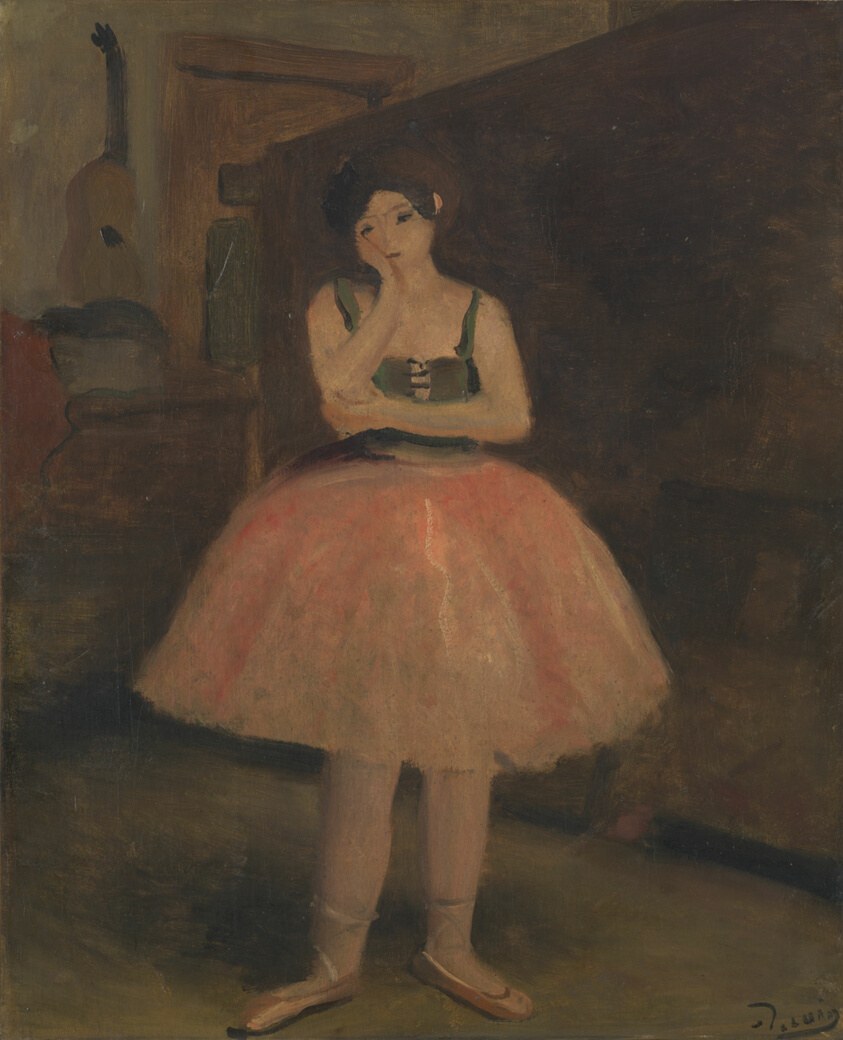
Derain's painting is significant because it offers an alternative to the dominant documentary mode of dance portraiture in the early twentieth century. Rather than capturing a leap, a turn, or a formal pose, it presents the dancer as a thinking, feeling subject in private space—a shift that reflects both modernist interest in interiority and a growing social awareness of the labor and emotional complexity of performance. For historians of dance and visual culture, this work demonstrates how early twentieth-century artists began to use dance not as spectacle but as a lens through which to explore questions of selfhood, vulnerability, and the price of beauty.
What you are looking at
A young female dancer stands alone in a sparse, dimly lit interior space, wearing a pale pink tulle skirt and a dark corset-style top. The setting appears to be a rehearsal studio or dressing room: wooden beams cross the ceiling, and a violin hangs on the wall to the left. The palette is dominated by warm browns and ochres, with the dancer's luminous skin tone and soft pink skirt providing the only bright notes. Her posture is introspective—one hand raised to her face in a gesture of thought or weariness, the other arm across her body. She gazes downward and to the side, not outward at an audience. The composition is intimate and psychologically complex: this is not a moment of performance but of private reflection, capturing something of the loneliness and internal focus of a working dancer between rehearsal and stage.
The dancing
The dancer's weight appears to rest evenly on both feet, which are positioned in soft ballet slippers. Her upper body is gently turned, with her left shoulder forward. The raised hand to her face—a gesture of contemplation or slight melancholy—breaks any impression of formal ballet presentation. Her frame is relaxed rather than rigidly extended; she is not demonstrating technique but inhabiting a moment of stillness. The isolation of the single figure, combined with her downward gaze and inward-turning posture, suggests vulnerability and introspection rather than the confidence typically shown in theatrical portraiture.
The dance depicted
The subject is almost certainly a professional ballet dancer, identifiable by the pink tulle skirt (the uniform of classical ballet), the pointe shoes, and the rehearsal-studio setting. The work does not depict active dancing but rather the dancer in repose—a common motif in early twentieth-century art exploring the psychology and labor of performance. The style of the skirt and the softness of the pose suggest this is not a moment of classical technique demonstration but a study of the dancer as a person: the physical and emotional toll of a life in dance. This pivots away from pure performance documentation toward portraiture and psychological observation.
How it was made
This is an oil painting on canvas, executed in a loose, impressionistic style characteristic of early modernist portraiture. Derain's handling of paint is notably fluid: the form of the dancer emerges through warm, muted tones and soft edges rather than precise line. The artist has used cool shadows (deep browns, grays) to carve form from the warm mid-tones of the figure and ground. This technique—allowing pigment to build atmosphere rather than define edges sharply—was common in European modernism of the 1920s and creates an effect of immediacy and psychological depth rather than formal polish. Oil on canvas of this scale and style would have circulated among dealers and private collectors in Paris, positioning it as a work for the educated bourgeois and art-world audience rather than the general public.
About this work
This 1925 oil by André Derain depicts a young female ballet dancer alone in a rehearsal studio, caught in a moment of private reflection rather than public performance. Dressed in the pink tutu and pointe shoes of classical ballet, she stands with hand raised to her face, gazing downward in an attitude of weariness or thought. The painting is a study not of technique or theatrical spectacle but of interiority: it positions the dancer as a psychological subject, exploring the internal life of a performer rather than the external display of skill. This work belongs in a dance gallery because it represents a crucial modernist turn in how dance was represented in visual art—away from the documentation of movement toward the portraiture of the dancing body in its moments of rest and reflection.
How to look at it
Notice the artist's choice of the moment: not the leap or the turn but the pause, the hand to the face, the downward gaze. This is a deliberate rejection of the heroic or virtuosic pose. Look at how Derain renders the tulle skirt—soft, almost impressionistic in its handling, not outlined but suggested through warm and cool tones. The violin on the wall is a reminder of the musical accompaniment and rehearsal context. The sparse, austere interior (with its wooden beams and muted palette) frames the figure as solitary rather than social. The painting asks the viewer to see the dancer not as a performer in the moment of display but as a person in the moment of rest—to recognize that what we see is vulnerability, not virtuosity.
The artist
André Derain (1880–1954) was a French modernist painter and founding figure of Fauvism who, after the explosive color experiments of his youth, developed a more measured, classical approach in the 1920s and beyond. By 1925, when this painting was made, Derain was known for figure painting and portraiture executed in a post-Fauvist style: still modern in sensibility but grounded in the tradition of European painting. He worked frequently from theater and performance, and had engaged with Sergei Diaghilev's Ballets Russes world, but his approach was never decorative or theatrical in the way of some of his contemporaries. This painting sits within a body of work exploring modern life through the figure, characterized by psychological depth and a restrained, introspective mood.
The period
The 1920s saw a resurgence of interest in classical ballet after the disruptions of World War I, with the Ballets Russes at the height of its cultural influence and Paris established as the capital of dance modernism. At the same time, there was a broader shift in visual art—especially in Paris—away from Cubism and Expressionism toward a more introspective, classical figuration sometimes called the "return to order." Derain was part of this movement. In the same period, photographers and painters increasingly sought to capture not the moment of performance but the dancer's life offstage: in rehearsal, in repose, preparing. This shift reflects both artistic interest in authenticity and candor and a growing humanistic concern with the working life of performers—a theme that would become central to twentieth-century dance writing and visual culture.
Where it lives
The work is held in the Modern Art collection of the Art Institute of Chicago, one of the major repositories of early twentieth-century European and American modernism. It entered the collection as part of the AIC's growth in the mid-twentieth century and is part of a significant holding of Derain's work.
Dance in this work
Questions about this work
Is this a famous ballerina?
The painting is titled simply "Ballet Dancer" and does not identify a specific individual. Derain painted many portraits of performers, but this work presents the dancer as a type—a representative figure—rather than as a named celebrity. The anonymity is part of the point: Derain is interested in the condition of being a dancer, not in the fame of a particular person.
Why is she not dancing?
The artist chose to depict her in repose, likely in a rehearsal studio or dressing room, to explore her inner life rather than her technical skill. This was part of a broader modernist turn away from the spectacle of performance toward the psychology and labor of the performing body.
What kind of ballet is this?
The pink tutu and pointe shoes indicate classical ballet technique, but the painting does not document a specific ballet or choreography. It is a study of the dancer as subject rather than a record of a particular work.
Why does the painting look unfinished?
The loose, impressionistic handling of paint is deliberate. Derain's style in the 1920s favored suggestion over finish, using broad strokes and soft edges to create mood and atmosphere. This technique was part of the modernist move away from academic polish toward a more direct, emotionally resonant way of seeing.
More dance artwork





