49 works in this view — arrow keys or swipe to move between them.
Dance in Art
Ballet Society, New York
Irving Penn American, 1917–2009
- Medium:
- Platinum-palladium print
- Collection:
- Photography and Media
- Source:
- Art Institute of Chicago
- Rights:
- Rights reserved by the holding institution — do not reuse without permission. Source record ↗
- Recorded as:
- AIC — rights reserved
This photograph is essential to understanding how ballet was positioned in postwar American culture: not as a vernacular or immigrant art form, but as a classical ideal to be curated, promoted, and consumed by educated male professionals. It captures the moment when ballet became institutionalized in the United States through organizations like Ballet Society, whose members and mission shaped American dance for decades. For historians of dance and photography, it shows how a still image can make visible the social hierarchies and gender dynamics embedded in theatrical practice.
What you are looking at
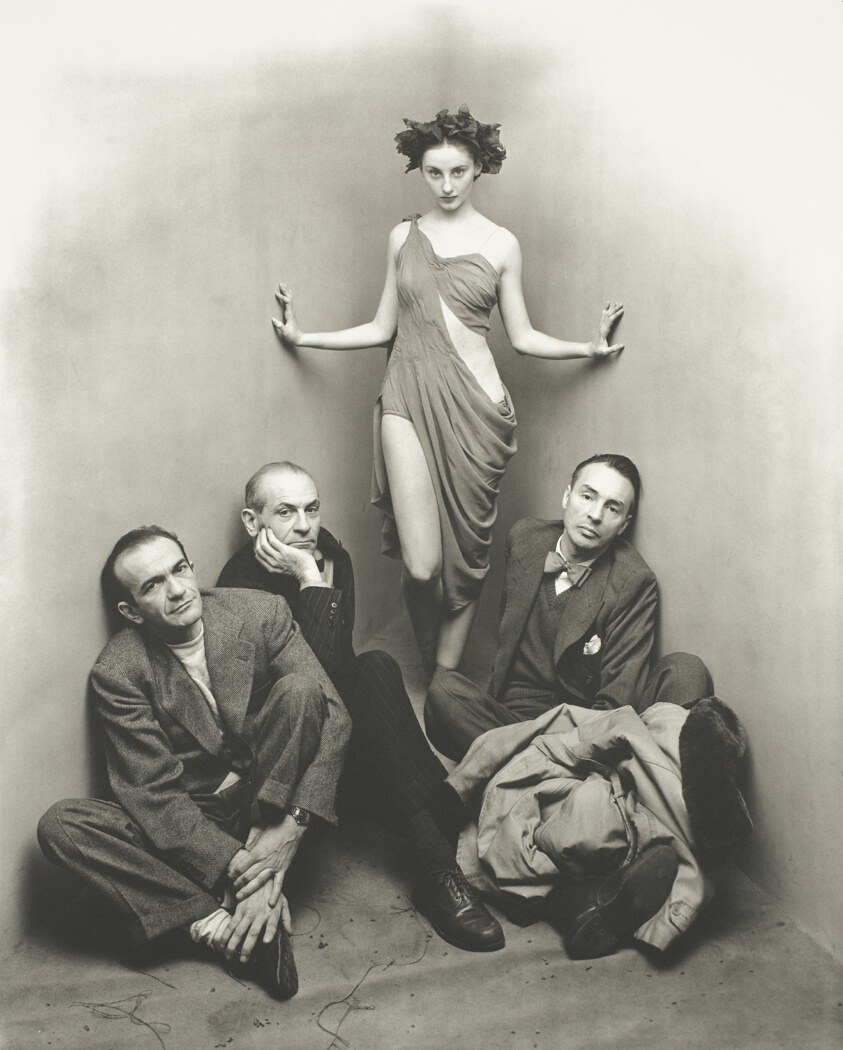
A platinum-palladium photograph of five figures arranged in a staged composition against a plain wall. A woman in classical drapery stands elevated on a platform or step at the center-back, her body weight shifted, arms raised in a welcoming or presenting gesture, dark hair piled loosely atop her head. Four men in dark business suits crouch or sit at ground level around her, gazing upward with expressions ranging from contemplative to admiring. The woman's single-shouldered chiton or draped garment exposes her leg and suggests classical statuary; the men's modern tailoring creates a sharp temporal and sartorial contrast. The lighting is soft and even, modeling the figures against the neutral background to emphasize their poses and mutual focus. The composition reads as a reversal or parody of worship—the lone female figure presented as an object of collective male attention, yet her raised position and open gesture dominate the frame.
The dancing
The woman's stance is that of a classical contrapposto or a formal ballet fifth or closed position, weight centered and body lifted, with both arms extended outward at shoulder height in a gesture of presentation or benediction. Her posture is upright, elongated, and frontal—the classic pose of a dancer addressing an audience. The four men below display no balletic alignment: their spines are rounded, their limbs are folded or resting, their gaze is directed upward in a posture of observation or subordination. The spatial and gestural relationship is hieratic—vertical versus horizontal, active versus passive, clothed figure as subject versus clothed figures as audience.
The dance depicted
This photograph does not depict an active dance or choreographed movement. It appears to be a studio portrait of members of Ballet Society, a New York–based arts organization (active 1946–1950) co-founded by Lincoln Kirstein and George Balanchine. The woman's pose draws on classical ballet vocabulary—the lifted torso, the open arms, the sense of address—but she is posed rather than caught mid-motion. The four men, likely dancers, choreographers, or administrators of the company, assume attitudes of admiration or deference. The work documents the social and hierarchical structures of postwar American ballet more than it captures dance itself.
How it was made
This is a platinum-palladium print, a photographic process that uses platinum and palladium metals to create the image rather than silver. The technique, favored for its tonal range and permanence, produces the soft, luminous quality and subtle grays visible here. Platinum-palladium printing was expensive and time-consuming, limiting circulation; it was preferred by art photographers and those working for high-end editorial and commercial clients. Irving Penn's choice of this medium signals that the photograph was intended as a fine-art object, not mere documentary. The precision of the pose, the control of lighting, and the classical reference all confirm this was a carefully composed studio session.
About this work
This 1948 photograph by Irving Penn captures five members or associates of Ballet Society posed in a studio setting that conflates classical art with modern corporate culture. The woman's classical drapery and balletic stance position her as a muse or idealized figure; the four men in business suits below suggest her as an object of professional or aesthetic devotion. The work does not depict choreography or movement but rather the mythology and power structures surrounding ballet in postwar New York—the elevation of the (female) dancer, the administration and promotion of ballet as high art, and the all-male gaze of authority. Penn's platinum-palladium process, sharp composition, and use of classical reference make this a meditation on the art form itself, not a record of it in motion.
How to look at it
Look first at the woman's pose: is it truly a dance position, or a classicizing stance borrowed from art history—from a statue, a painting of a muse or nymph? Note how her body is elongated and her arms are open, creating an almost heraldic or emblematic quality. Then observe the four men: their informality, their upward gaze, their modern dress. The photograph is asking you to see the contrast and to read the social meaning of it. Penn has not frozen a moment of choreography; he has staged a moment of presentation and reception, turning the dynamics of ballet and patronage into a visual argument about who dances, who watches, and who decides what counts as art.
The artist
Irving Penn (1917–2009) was an American fashion and portrait photographer who worked primarily for Vogue and created fine-art photographs for gallery and museum exhibition. He was known for his platinum-palladium prints, his use of large-format cameras, and his ability to create composed studio portraits that elevated the everyday or the commercial into fine art. Penn photographed many subjects from culture and society, often exploring the relationship between the individual and collective, and between fashion, beauty, and power. His work in the 1940s bridged commercial photography and art photography.
The period
Ballet Society was founded in 1946 by Lincoln Kirstein and George Balanchine in the immediate postwar period, as part of an effort to establish ballet as a central American art form and to free it from dependence on European models or touring companies. The late 1940s saw a surge in ballet's prestige and institutional support in the United States, aided by wealthy patrons, intellectual and cultural leadership (Kirstein was a Harvard-educated dance intellectual), and the cultivation of a sophisticated urban audience. Photography, especially fine-art photography, was being used to document and promote ballet as a serious cultural endeavor. Penn's photograph is thus both a document of Ballet Society's membership and a statement about how ballet itself was being framed as art worthy of aesthetic and institutional investment.
Where it lives
The photograph is held by the Art Institute of Chicago in its Photography and Media collection. The source is recorded as 'aic' (Art Institute of Chicago). The work is a fine-art photograph made for potential exhibition and collection, not a documentary still from a performance or rehearsal.
Dance in this work
Questions about this work
Is this a photograph of a ballet performance?
No. This is a studio portrait staged specifically for the camera. The woman's classical pose and drapery reference ballet aesthetics, but the five figures are posed, not dancing. The photograph documents the people and cultural authority behind Ballet Society rather than capturing choreography or movement.
Who is the woman in the center?
The catalogue record does not identify any of the five figures by name. The photograph is titled 'Ballet Society, New York,' suggesting these are members or associates of the organization, but the specific identities are not recorded.
What is Ballet Society?
Ballet Society was a New York–based arts organization founded in 1946 by Lincoln Kirstein and George Balanchine. It was a vehicle for promoting ballet as an American art form and for supporting new choreography. It dissolved in 1950, and many of its operations and dancers merged with the newly formed New York City Ballet.
Why would a photographer pose dancers with non-dancers?
The composition is intentional. By positioning the woman as a classical ideal above four men in business suits, Penn visualizes the institutional and economic structures that support ballet. The men may be administrators, patrons, choreographers, or dancers; the photograph invites you to read them as the machinery of cultural authority and promotion that elevates the (female) dancer as muse.
More dance artwork





