49 works in this view — arrow keys or swipe to move between them.
Dance in Art
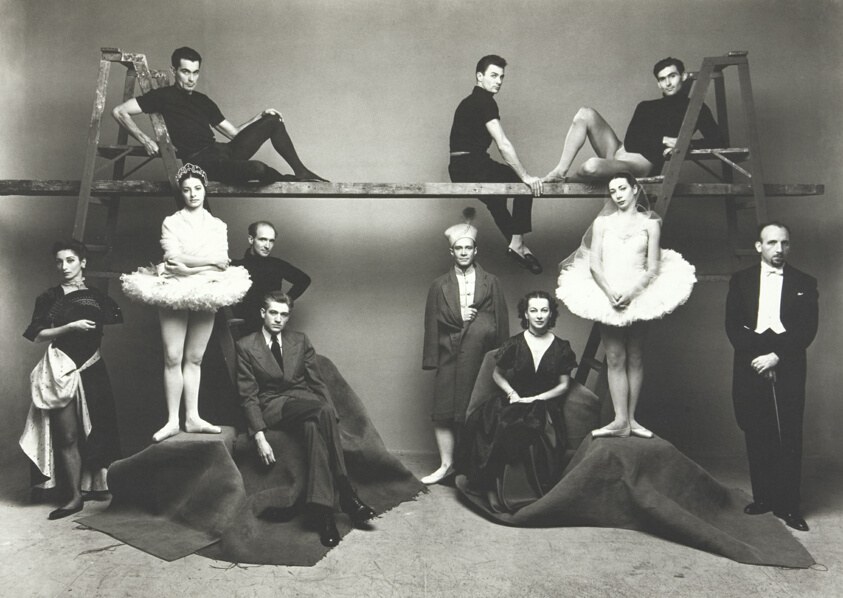
Ballet Theatre, New York
Irving Penn American, 1917–2009
- Medium:
- Platinum-palladium print
- Collection:
- Photography and Media
- Source:
- Art Institute of Chicago
- Rights:
- Rights reserved by the holding institution — do not reuse without permission. Source record ↗
- Recorded as:
- AIC — rights reserved
This photograph documents a pivotal moment in American cultural history—the establishment of ballet as a distinctly American art form through Ballet Theatre's success in the 1940s. Penn's approach of treating dancers as formal subjects rather than capturing the spectacle of performance offers a different kind of evidence: who these artists were as public figures, how they were presented to American audiences, and what ballet signified in mid-century American visual culture.
What you are looking at
Fourteen figures arranged in a precise, theatrical composition against a neutral background, divided into two tiers. Three men in dark suits sit or recline on the ground level; two women in white ballet tutus stand elevated on platforms or structures, flanked by four men in black attire—two seated at the outer edges, two standing between them. Above this arrangement, three more figures recline on a horizontal beam or rail: two shirtless men in dark trousers and one figure in dark clothing. The lighting is even and classical, characteristic of studio portraiture, casting no strong shadows. The women's tutus are voluminous and crisp, their bodies held in formal, posed positions rather than mid-movement. The men's postures range from relaxed reclines to seated introspection. The composition is symmetrical and architectural, treating the human body as sculptural form within a geometric stage.
The dancing
The two ballerinas stand in posed, presentational attitudes rather than executing steps—their bodies are upright and elongated, tutus creating an ideal silhouette. The surrounding figures are inactive or minimally gestural; several recline with apparent ease, suggesting a group portrait rather than a document of performance. No partnering is visible, no holds, no indication of immediate movement or weight transfer. The composition treats the dancers as icons of ballet rather than capturing the kinetic discipline of the form.
The dance depicted
This appears to be a studio portrait of Ballet Theatre, the American modern ballet company founded in 1940. Ballet Theatre championed new choreography alongside classical repertory and was a major force in establishing ballet as an American art form during the 1940s. The presence of the tutus and the formal arrangement suggests this is a company photograph—a promotional or documentary image of personnel rather than a representation of a specific work. The pose and lighting are characteristic of mid-century American dance photography, presenting dancers as artists and public figures rather than as performers in motion.
How it was made
This is a platinum-palladium print, a photographic process that produces rich blacks and subtle tonal ranges, favored for fine-art portraiture and archival stability. The technique allowed Penn to achieve the luminous, sculptural quality of the figures and the clarity of detail—the texture of the tutus, the definition of musculature, the subtle modeling of faces. Platinum-palladium prints were expensive and labor-intensive, suggesting this was an important commission, likely intended for exhibition or publication rather than casual documentation.
About this work
Irving Penn photographed Ballet Theatre in 1947 at the height of its influence as America's flagship classical ballet company. The image departs from conventional dance photography by presenting the dancers not as performers captured mid-action but as a formal group—a company portrait that treats ballet as an American cultural institution. The composition is rigorously geometric and classical, with the dancers' bodies functioning as sculptural elements within the frame. Penn's platinum-palladium technique gives the image an archival weight and fine-art finish that elevates it beyond documentary photography.
How to look at it
Notice the rigid formality of the composition: the geometric arrangement of bodies, the frontal presentation of the tutus, the absence of narrative or dramatic action. This is not a moment of performance but a statement of identity and institutional status. Observe how Penn uses the horizontal and vertical axes of the frame to create a kind of social hierarchy—the elevated position of the ballerinas, the grounded repose of the men, the architectural beam that frames the upper figures. The evenness of the lighting and the neutral background eliminate any sense of stage or spectacle, presenting instead a timeless, almost archaeological view of the company.
The artist
Irving Penn (1917–2009) was among the most influential fashion and portrait photographers of the twentieth century, working primarily for Vogue and Condé Nast. He was known for his restrained, formally composed images that treated the human figure with sculptural precision. Penn rarely worked with dance subjects, making this commission noteworthy; his approach to the Ballet Theatre dancers reflects his broader practice of elevating vernacular or commercial subjects through classical compositional rigor and fine printing techniques.
The period
In 1947, Ballet Theatre was at its zenith as an American company, having premiered significant new works and attracted major international talent. This was the era of American cultural consolidation after World War II, when American institutions sought to establish themselves as equal to European traditions. In photography, Penn's work exemplified a turn toward fine-art practice and the platinum-palladium print as a medium of cultural prestige. The formal, architectural composition reflects modernist design principles that were transforming American visual culture.
Where it lives
The work is held in the Art Institute of Chicago's Photography and Media collection. It is a fine-art platinum-palladium print, indicating it was produced as an exhibition or publication print rather than a press photograph or documentary snapshot.
Dance in this work
Questions about this work
Is this a photograph of an actual Ballet Theatre performance?
No. This is a studio portrait, made in a controlled setting with posed figures. It is a company photograph—a formal group portrait of Ballet Theatre's personnel. Penn has not captured the dancers in the act of performing or rehearsing a specific work.
Why does it look so formal and still when these are dancers?
Penn's approach was deliberately classical and sculptural. He treated the human body as form rather than motion, arranging the dancers within a geometric composition. This reflects both his artistic practice and the function of the image as a statement of institutional prestige rather than a document of performance.
Who are the people in the photograph?
The catalogue record does not identify individual dancers. This appears to be a company-wide portrait of Ballet Theatre members, mixing ballerinas in tutus with male dancers and supporting personnel. Without additional documentation, individual identification is not possible from the image alone.
Why is this platinum-palladium rather than standard gelatin silver?
Platinum-palladium was a prestige medium—more expensive, longer-lasting, and capable of richer tonal subtlety. Penn's choice signals that this was a significant commission, intended for exhibition or fine-art circulation rather than journalistic use.
More dance artwork





