49 works in this view — arrow keys or swipe to move between them.
Dance in Art
Arabesque
Edgar Degas (French, 1834–1917)
- Medium:
- Bronze
- Collection:
- Painting and Sculpture of Europe
- Source:
- Art Institute of Chicago
- Rights:
- Public domain — free to use, share and adapt.
- Recorded as:
- CC0 (Public Domain)
This work is among the relatively small number of artworks that treat ballet as a technical and aesthetic subject in its own right, rather than as narrative entertainment or social decoration. The arabesque itself became a visual symbol of ballet's aspirations toward weightlessness and extension, and this sculpture documents how that aspiration was being realised and celebrated in the late 19th century.
What you are looking at
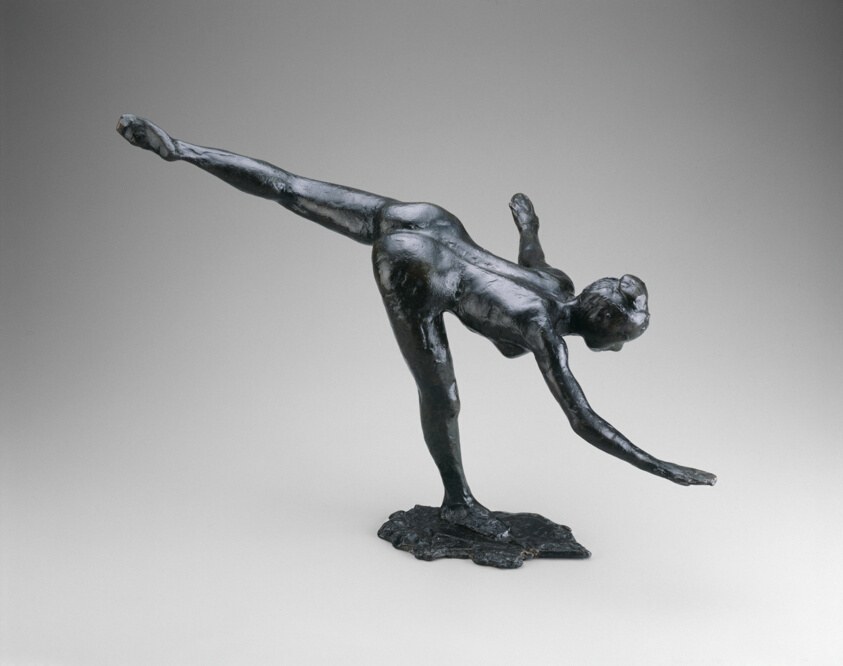
A bronze figure of a female dancer captured mid-movement in a posture of dramatic extension and control. The dancer leans sharply forward from the hips, her torso nearly parallel to the ground, supported on a single leg while the other extends behind her in a long line. Her arms are positioned asymmetrically: one stretches forward for balance, the other reaches back along the extended leg. The figure is cast in dark bronze with a greenish patina suggesting age. She stands on an irregular rocky base that grounds the sculpture. The pose conveys both strength and grace—the dancer is poised in that moment between absolute control and apparent weightlessness, her body a single tensioned line from fingertips to toes.
The dancing
The dancer is alone and stands en relevé (on the ball of the supporting foot), which demands considerable strength and ankle control. The extended leg is held at hip height or higher, in line with the torso—a position requiring exceptional flexibility and core stability. The forward-reaching arm and backward-stretching arm create a counterpoise that emphasises the horizontal line of the body. The pose is inherently balletic: it reads as a moment of extension, control, and elongation rather than earthiness or collapse.
The dance depicted
This is almost certainly an arabesque, the classical ballet position in which the dancer stands on one leg with the other extended behind in a straight line. The arabesque was codified in ballet's vocabulary by the 17th century and became a defining element of romantic and classical ballet technique by the 19th century. The sculpture captures the position itself rather than a movement through space, isolating the geometric perfection and the demand for stillness within motion that defines ballet training. This is not a moment of action but a position of balance and presentation—a 'held' moment that dancers train years to achieve.
How it was made
This is a bronze sculpture, cast as a finished work in three dimensions. Bronze allows fine modelling of the human form; the sculptor has captured anatomical detail—the musculature of the supporting leg, the articulation of the extended limb, the precise positioning of hands—that would be difficult in other materials. The patina suggests this is not a modern casting but a work of age, consistent with the catalogue date of 1885. As a sculpture, this work exists in space and can be viewed from all sides, though the pose is clearly legible from a frontal or three-quarter view.
About this work
This sculpture presents the arabesque—one of the foundational positions of classical ballet—as a subject worthy of sustained artistic attention. The work isolates and celebrates a single held position, treating it as a moment of perfect balance and extension rather than as a frame in a sequence of movements. By casting the figure in bronze and mounting it on a base, Degas elevates the arabesque from a fleeting moment in performance to a permanent sculptural study. The work belongs to a broader late-19th-century practice of artists studying the human figure in motion and at rest, informed by photography and the new sciences of movement. For dancers and dance historians, the sculpture is evidence of how ballet technique was understood and valued in its own era—not merely as a means to narrative or spectacle, but as a discipline capable of producing geometric beauty and physical grace worthy of fine art.
How to look at it
Attend to the precision of the balance: the single supporting leg carries all the weight, yet the figure appears weightless. Notice the line created by the extended leg, torso, and reaching arm—a continuous diagonal that reads as both controlled and airborne. The counterbalancing forward arm prevents the figure from tipping forward; this counter-tension is essential to the pose and makes it technically possible. The work invites you to think about what this position costs in muscular effort while appearing to effortlessly transcend effort.
The artist
Edgar Degas (1834–1917) was a French painter and sculptor whose engagement with dance was central to his artistic practice. Though best known for his paintings and pastels of ballet rehearsals and performances, Degas also modelled sculptures in wax and clay, many of which were cast in bronze after his death. He was fascinated by movement, pose, and the training regimen of dancers—particularly the young dancers of the Paris Opéra. His approach was often candid and observational rather than romantic; he drew and painted from life in studios and rehearsal rooms. Yet despite this realism, his works celebrate the discipline, strength, and formal beauty of the classical ballet body.
The period
The 1880s were a period of continued dominance of classical ballet in Europe, though the Romantic era of the earlier 19th century had ended. Degas's work coincides with a moment when ballet technique was becoming more refined, more athletic, and increasingly professionalised. Photography was revealing the mechanics of human movement, and artists were responding by studying the body in new ways. At the same time, the arabesque itself—as a position—had become aesthetically loaded: it was associated with elongation, aspiration, and the illusion of effortlessness that defined classical ballet's visual ideal. Degas's sculpture participates in this late-19th-century celebration of the trained, disciplined dancer's body.
Where it lives
The work is held in the Painting and Sculpture of Europe collection of the Art Institute of Chicago, a major encyclopedic museum collection. As a bronze sculpture, this is likely a cast made after Degas's death, when many of his studio models in wax and clay were posthumously cast in bronze—a common practice for artists whose estates sought to preserve and distribute their work.
Dance in this work
Questions about this work
What is an arabesque?
An arabesque is a classical ballet position in which the dancer stands on one leg with the other leg extended behind at hip height or higher, creating a long line from the back foot through the torso. The position has been part of ballet vocabulary since the 17th century and remains central to classical training and performance. It is one of the most recognisable and aesthetically valued positions in ballet.
Why would Degas sculpt a position rather than a movement?
Degas was interested in capturing the balletic moment itself—the achieved position, the balance, the line of the body. The arabesque is a position that dancers hold and refine; by sculpting it, Degas isolates what he saw as beautiful and worthy of study. This approach was part of a broader late-19th-century interest in movement studies and the formal properties of the trained body.
Is this an original by Degas or a cast made after his death?
Degas modelled in wax and clay but did not cast his own sculptures in bronze during his lifetime. Most of the bronzes known as his work today—including this one—were cast from his original models after his death, often by his heirs or by foundries who purchased the rights. The catalogue record does not specify whether this is from an early or late cast.
What does the patina tell us?
The greenish patina is the natural result of bronze aging. It suggests this is not a modern casting but a work of some age, consistent with the 1885 date in the catalogue. The patina develops over years or decades as the bronze oxidises in air and responds to environmental conditions.
More dance artwork





