49 works in this view — arrow keys or swipe to move between them.
Dance in Art
The Ballet Master
Edgar Degas French, 1834-1917
- Medium:
- Graphite and black chalk with stumping, on buff wove paper, squared in charcoal
- Collection:
- Prints and Drawings
- Source:
- Art Institute of Chicago
- Rights:
- Rights reserved by the holding institution — do not reuse without permission. Source record ↗
- Recorded as:
- AIC — rights reserved
For dancers and historians, this work is a direct record of how a major visual artist understood the ballet master's role and posture in the mid-nineteenth century. It shows that Degas's interest in ballet extended beyond the spectacle of performance to the unglamorous, essential work of training and control. The work also demonstrates the technical process by which studio drawing became finished painting, offering insight into Degas's working method.
What you are looking at
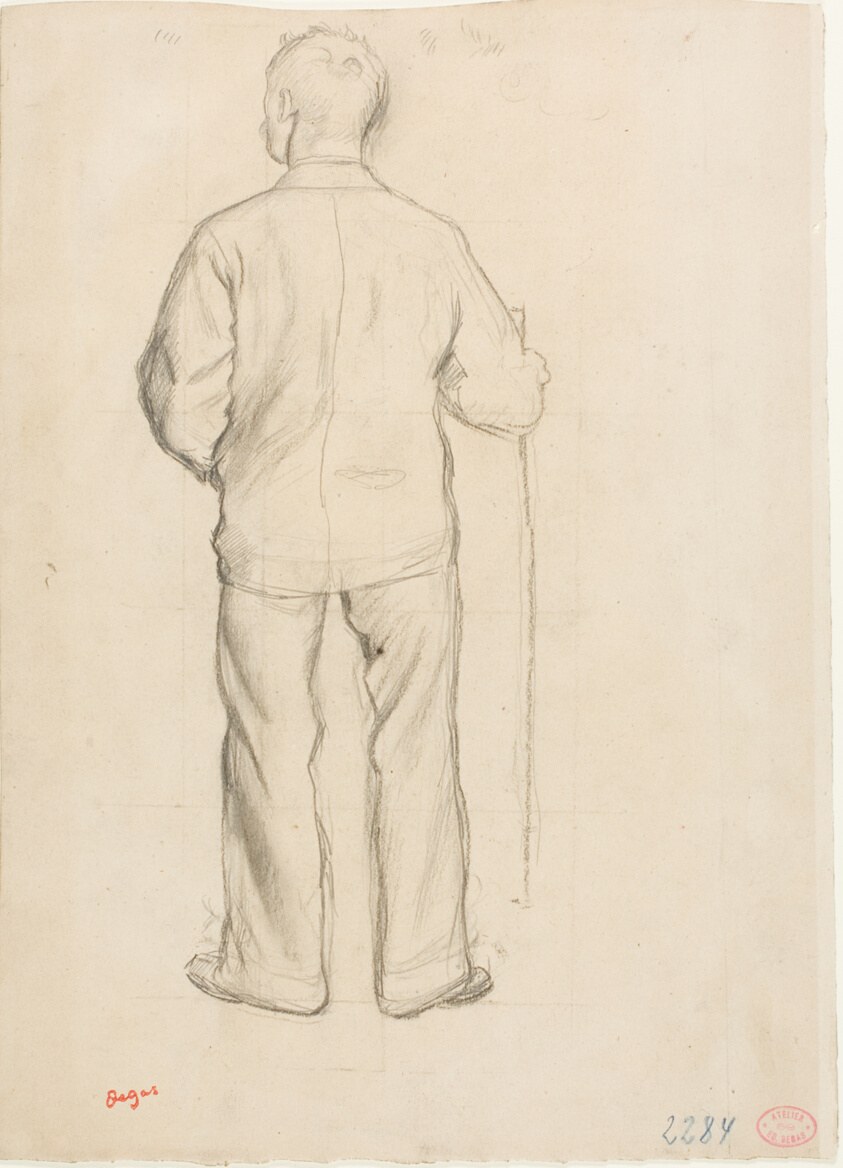
A male figure stands in three-quarter view facing away from the viewer, dressed in nineteenth-century civilian clothes: a fitted jacket, trousers, and what appears to be a waistcoat or undergarment visible at the hip. His posture is upright and formal, with his weight distributed evenly on both legs. He holds a long cane or walking stick in his right hand, extending it downward and to the side. His head is tilted slightly back, the face rendered in profile. The composition is spare: the figure occupies the center of a buff-colored paper, with minimal background or setting suggested. The drawing is squared in charcoal—a grid of light lines overlaid on the whole sheet—indicating this was prepared as a study for transfer or enlargement. The pose suggests a moment of stillness rather than active movement: the figure appears to be at rest, observing rather than performing.
The dancing
A single male figure in a pose of formal repose. The spine is lengthened, the shoulders held back, the torso aligned over the hips. The weight is neutral, not shifted into a movement position. One arm holds the cane; the other rests at the side. The head position—tilted back, the neck extended—conveys a sense of looking upward or over the scene, a posture of authority or detachment common in choreographic studies of the era.
The dance depicted
This is a compositional study, likely for a theatrical work. The pose and costume are consistent with nineteenth-century academic ballet convention, but the figure's role appears to be that of a ballet master or teacher rather than a dancer in performance. The cane and the formal, commanding posture align with the title given in the catalogue record. This is not a study of movement itself but of stillness as a form of presence and control—the disciplining gaze characteristic of ballet pedagogy. The work records a moment of institutional authority rather than a moment of dance.
How it was made
Graphite and black chalk with stumping on buff wove paper, as stated in the record. The squaring in charcoal is a working grid used to scale the image for transfer to canvas or another ground. This indicates the drawing was a preparatory study, part of a larger compositional project—likely a painting or mural work. The choice of chalk and graphite allowed for tonal modeling and correction, visible in the soft gradations across the figure's torso and in the stumped areas that create volume. This was a professional working drawing, not a finished artwork for exhibition.
About this work
This is a preparatory study by Edgar Degas, a leading painter of ballet and theater scenes in nineteenth-century Paris, for a larger composition involving a ballet master—the authority figure responsible for teaching and disciplining dancers. Degas was intensely interested in the hierarchies and backstage rituals of the Opéra, and studies like this formed the foundation of his painted and sculptural works. The work belongs in a dance archive because it documents not the dancer's body in motion but the institutional machinery that produced and regulated ballet: the master's role as observer, instructor, and moral authority. It is a study of power and pedagogy, rendered through the language of pose.
How to look at it
Attend to the posture: notice how the figure's authority is communicated through stillness and vertical alignment rather than through gesture or motion. The cane is not an ornament but an instrument of discipline. Observe how Degas has rendered the figure from behind—a technique that removes the distraction of facial expression and forces the viewer to read meaning from the body itself. The squared grid overlaid on the paper is also important to notice; it reminds the viewer that this is not a finished artwork but a tool, a moment in a longer process of artistic production.
The artist
Edgar Degas (1834–1917) was a French painter, sculptor, printmaker, and draftsman who specialized in scenes of urban Parisian life, particularly the Opéra and its dancers. He was not a Romantic painter of ethereal tulle and pointe; instead, he documented ballet as labor, discipline, and institutional practice. He drew obsessively from life and from models in rehearsal studios, building an archive of thousands of studies like this one. His work redefined how ballet could be represented in fine art—not as fantasy but as craft and embodied discipline.
The period
By 1862, when this drawing was made, academic ballet in France was undergoing significant change. The Romantic era had ended; the tutu was becoming standardized costume; and dancers were increasingly professionalized and regulated by state institutions like the Opéra. The ballet master remained a crucial figure—a choreographer, teacher, and enforcer of classical technique. Degas's interest in this institutional world coincided with the rise of realism in French art, a movement that turned toward the actual conditions of labor and urban life rather than historical or mythological subjects. His studies of dancers belonged to this broader shift.
Where it lives
The work is held in the Prints and Drawings collection of the Art Institute of Chicago, catalogued with accession number 2224. It is one of thousands of Degas studies and sketches in museum collections worldwide, part of his working archive as a painter of modern life.
Dance in this work
Questions about this work
Is this a finished drawing or a study?
It is a preparatory study. The squared grid overlaid in charcoal is a transfer grid used to enlarge or transpose the image onto another surface—typically canvas. The drawing was not made for exhibition but as part of Degas's working process for a larger painting or composition.
What is the figure holding?
A cane or walking stick, rendered as a long vertical line extending from the figure's right hand. In the context of ballet, this is likely an attribute of the ballet master, who used such a stick to tap out rhythm, correct posture, and maintain order during rehearsal and instruction.
Why is the figure shown from behind?
By positioning the viewer behind the figure, Degas emphasizes the posture and presence rather than facial expression. This compositional choice focuses attention on the body as a site of authority and discipline—how the ballet master commands respect through physical bearing rather than through conventional portraiture.
How does this relate to Degas's painted works?
Degas made thousands of drawings and studies of dancers and ballet personnel. These sheets form the foundation of his painted compositions. Studies like this informed his larger narrative paintings of rehearsal rooms, dressing rooms, and backstage moments at the Opéra, allowing him to work out poses, spatial relationships, and institutional hierarchies before committing to paint.
More dance artwork





