49 works in this view — arrow keys or swipe to move between them.
Dance in Art
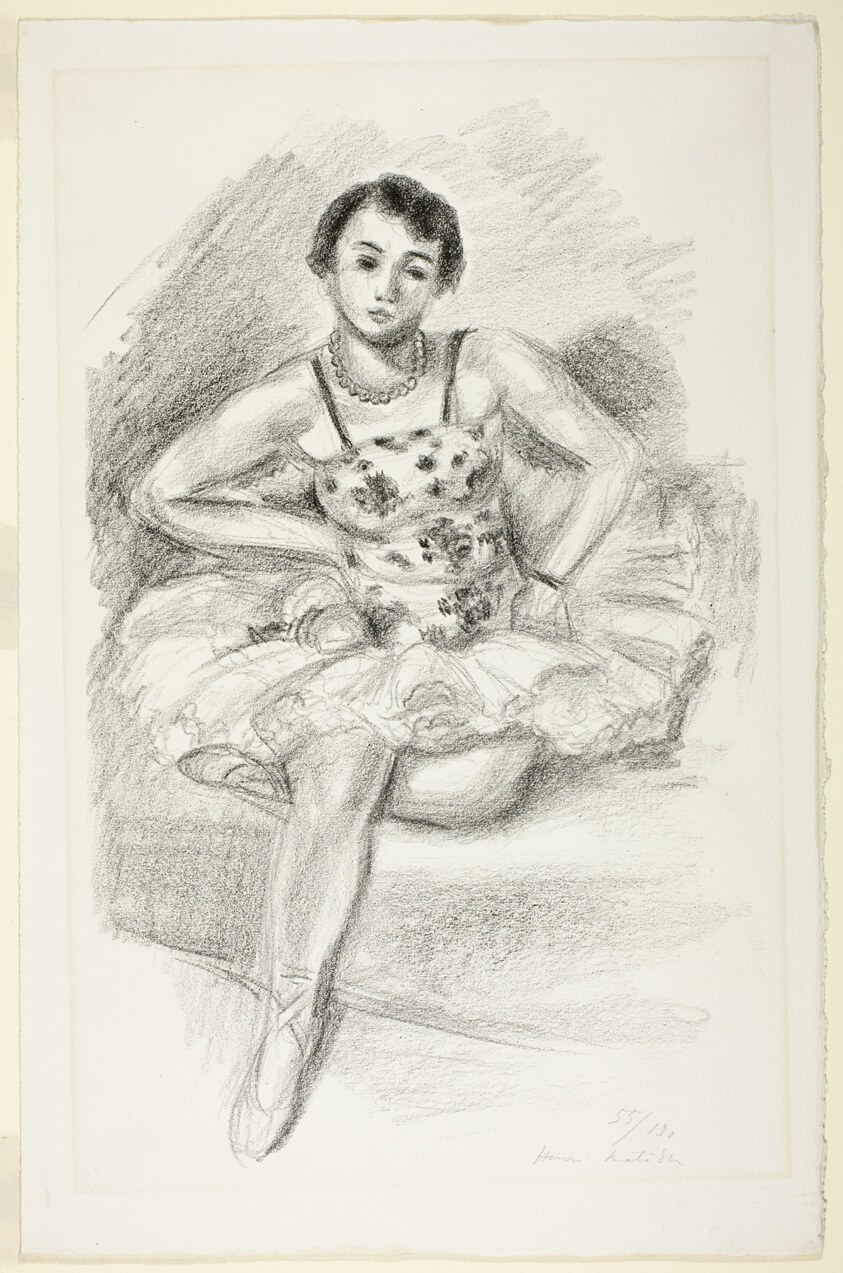
Ballet Dancer, from Ten Dancers
Henri Matisse French, 1869-1954
- Medium:
- Lithograph in black on off-white wove paper
- Collection:
- Prints and Drawings
- Source:
- Art Institute of Chicago
- Rights:
- Rights reserved by the holding institution — do not reuse without permission. Source record ↗
- Recorded as:
- AIC — rights reserved
For anyone studying how dancers and their bodies have been represented in modern art, this series matters enormously. Matisse was one of the century's most significant artists; his direct, unidealized treatment of the dancer's body—not always in motion, not always displaying virtuosity—helped shape how the twentieth century saw dance. The series is also a historical document of the bodies and personalities of the Ballets Russes in its moment of maximum cultural influence.
What you are looking at
A young woman sits in a relaxed, informal pose wearing a simple sleeveless dress and a beaded necklace. She cradles a small spotted dog—likely a terrier—in her lap with easy affection. The lithograph captures an intimate domestic moment: her gaze is direct and contemplative, her posture languorous and at ease. The composition is intimate and closely framed, with softly modeled charcoal tones creating volume in the figure while the background recedes into loose, expressive marks. The work conveys quiet domesticity and the casual grace of a moment stolen from the performance world.
The dancing
The woman's body is seated and deeply relaxed, with one leg extended downward in a casual line; her arm rests naturally around the dog's body. There is no dance posture here—no turned-out legs, no lifted chest, no tension in the upper body. The position is fundamentally restful and anti-balletic, suggesting a dancer at rest rather than in performance. Her other hand gestures gently toward the animal. The overall frame is one of ease and embodied softness.
The dance depicted
This is not a depiction of dance in motion. It is a portrait of a dancer—identifiable as one by context and the catalogue title—in repose. The work belongs to a tradition of artist studies of performers' bodies and personalities away from the stage, exploring the contrast between the disciplined, formal body of theatrical work and the natural, unguarded body at rest. The subject sits as a dancer sits, with the postural awareness and control that remains even in relaxation.
How it was made
This is a lithograph, a printing process that allowed Matisse to work with the fluid responsiveness of crayon and wash on stone, then pull multiple impressions. The medium shows throughout: the soft, grainy texture of the charcoal tones; the economy of line; the way the artist could push and blend the marks to model form. Lithography permitted a directness and intimacy of mark-making that suited portraiture, and it allowed for circulation of the image through multiple prints, making it accessible beyond a single collector.
About this work
This is one work from a series of ten lithographs of dancers executed by Henri Matisse in 1927, a moment when he was intensely engaged with the Ballets Russes and its performers. The print shows not a staged moment but a stolen one—a dancer at rest, holding her small dog. It is a study in the off-stage body: the postural intelligence of the trained performer, but expressed through ease rather than tension. The work sits at the intersection of portraiture, dance documentation, and intimate observation, capturing the person beneath the role.
How to look at it
Notice the economy of line: Matisse renders the figure with a few confident strokes, relying on the viewer's knowledge of anatomy and posture to complete the form. Attend to the extended leg and the relaxed shoulders—these tell you the subject is trained, but not performing. The dog is rendered with the same unsentimental directness as the woman; both are observed with equal attention. The work invites you to see rest as a legitimate subject, and to recognize that even in repose, a dancer's body carries the visible mark of training.
The artist
Henri Matisse (1869–1954) was a leading modernist painter and printmaker whose engagement with dance was deep and sustained. He designed sets and costumes for the Ballets Russes, drew from live dancers throughout his career, and created multiple series of prints and drawings exploring dancers' bodies. His approach combined formal sophistication with directness of observation; he was interested in the essential line and structure of the body, not in photographic likeness. By 1927, when this series was made, Matisse had already spent years in the company of professional dancers and had developed a practiced eye for the subtle markers of training and personality in physical form.
The period
The 1920s were the height of the Ballets Russes' cultural prestige under Sergei Diaghilev. The company was headquartered in Paris and attracted the visual avant-garde—Picasso, Derain, Matisse—to design for it. Simultaneously, modernist artists were intensely interested in the human body as a subject, especially in movement. Matisse's lithographs sit at this convergence: they document actual dancers known to Paris's artistic elite, but they treat them with the formal economy and directness that characterizes modernist printmaking. The series also reflects a shift in how dancers were being represented—less as ethereal Romantic figures, more as disciplined, contemporary professionals.
Where it lives
This work is part of the Art Institute of Chicago's prints and drawings collection. It is one of ten lithographs on the theme of dancers, made in 1927, and represents the kind of work Matisse produced for circulation through print rather than as a unique painting.
Dance in this work
Questions about this work
Is this one of the Ballets Russes dancers?
The catalogue identifies this as part of a series titled 'Ten Dancers,' made in 1927 during the height of the Ballets Russes' Paris period. Matisse was in close contact with the company's dancers during this time. While the catalogue does not identify the specific subject by name, the series is understood to document performers from or associated with the company, though not all were necessarily principal dancers.
Why didn't Matisse show her dancing?
The series is titled 'Dancers,' but it does not require each print to show dance in action. By showing a dancer at rest, Matisse invites us to see the training and discipline in the body itself, even in stillness. This was a modern approach—not the Romantic ideal of the ethereal ballerina in flight, but a recognition that the dancer's body carries its identity even off the stage.
What is the dog doing here?
The dog is part of the domestic scene. Its presence emphasizes the informality and privacy of the moment; this is not a public display or staged pose, but a glimpse of the performer's actual life. The dog is rendered with the same formal attention as the woman, neither sentimentalized nor incidental.
How many impressions of this print exist?
The catalogue record does not specify. Lithographs are printed in editions, often of 25–100 impressions, though Matisse's prints exist in varying quantities depending on the edition size and how many stones were pulled. The Art Institute's holding is one documented impression.
More dance artwork





