49 works in this view — arrow keys or swipe to move between them.
Dance in Art
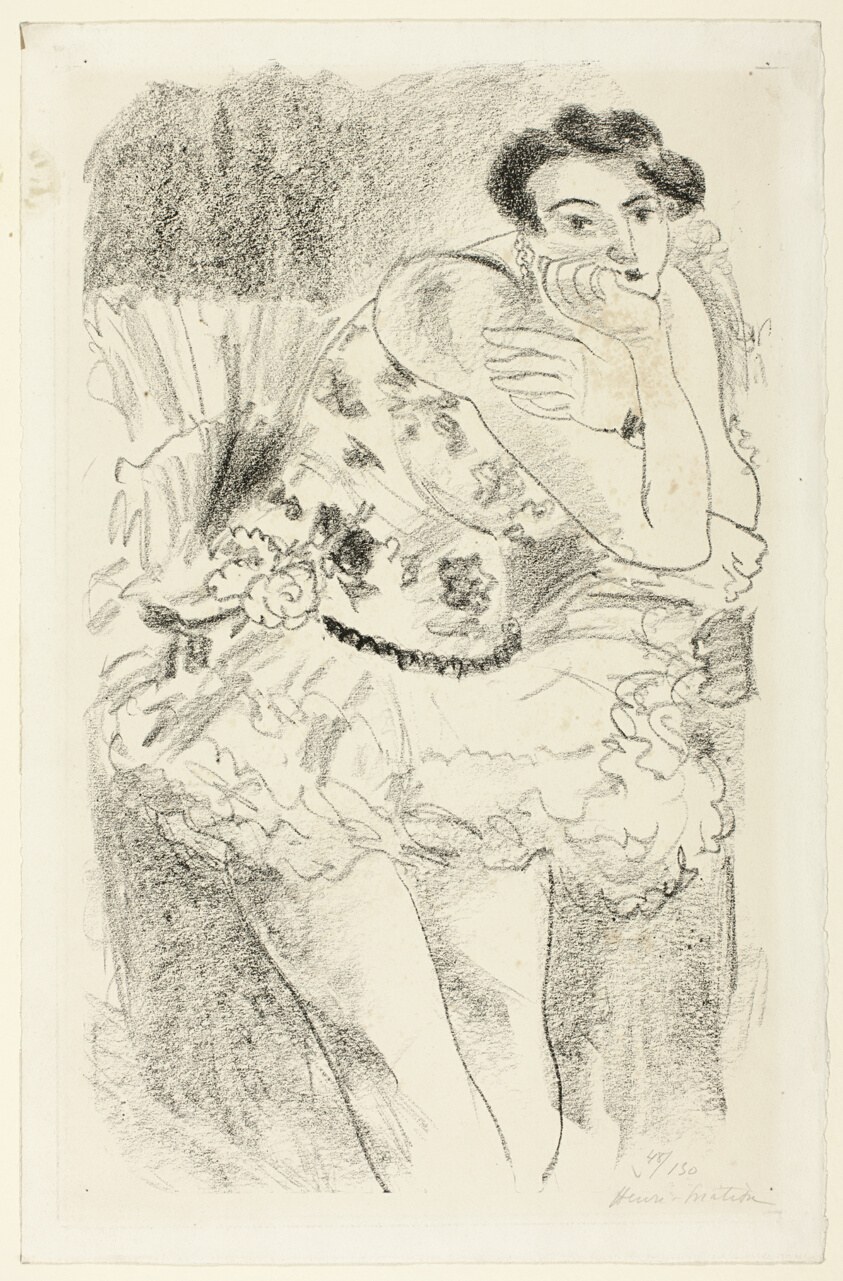
Ballet Dancer, from Ten Dancers
Henri Matisse French, 1869-1954
- Medium:
- Lithograph in black on white wove paper
- Collection:
- Prints and Drawings
- Source:
- Art Institute of Chicago
- Rights:
- Rights reserved by the holding institution — do not reuse without permission. Source record ↗
- Recorded as:
- AIC — rights reserved
Matisse's engagement with dance was serious and sustained, and his lithographs of dancers from this period show a master draftsman at work on the vocabulary of human extension and poise. For students of early twentieth-century dance, this image is evidence of how ballet's aesthetic ideals had registered in the visual art world—what a major modern artist believed was worth recording and repeating.
What you are looking at
A single female dancer is shown in a moment of classical ballet poise, captured in three-quarter view against a loosely rendered background. She wears a short tutu with a fitted bodice, her dark hair styled in the fashion of the 1920s with rolls pinned close to her head. Her body is composed in an elegant contrapposto, with weight shifted onto one leg while the other extends with pointed articulation. Her arms frame her body with grace, one bent and drawn inward while the other opens to the side. The lithograph technique renders her face and torso with crisp detail while the background dissolves into soft stippled marks, a compositional choice that isolates the figure and emphasizes her form. The paper shows age-appropriate toning.
The dancing
The dancer stands in a pose recognizable from classical ballet training—the weight distributed through a supporting leg in turnout, the free leg extended with a pointed foot, the arms arranged in a position of readiness rather than mid-movement. The upper body maintains the upright carriage characteristic of academic ballet, with the head held with quiet dignity and the shoulders relaxed. The pose suggests a moment between movements or a held arabesque variant rather than dynamic action, allowing the artist to study the geometry of the extended line.
The dance depicted
This is classical ballet from the early twentieth-century concert tradition. The dancer's costume, pose, and bearing are unmistakably that of the Ballets Russes era—the period when Diaghilev's company and its imitators dominated European and American dance culture. The tutu, body position, and facial composure all signal the Cecchetti or similar academic method as it was being performed in major theaters around 1927. The artist has chosen a pose that reads as pure ballet vocabulary rather than a narrative or emotional moment, treating the dancer's body as an idealized classical form.
How it was made
This is a lithograph, a planographic printing process in which an image is drawn on a stone with a greasy medium and then chemically treated so that oil-based ink adheres to the drawn areas while being repelled by the wet, undrawn stone. Lithography allowed for soft gradations of tone and a more painterly line than engraving, making it ideal for the subtle modeling of a figure. The technique was well-established and commercially viable by 1927, allowing such a work to reach multiple copies into artist's and institutional collections. The artist's handling shows confident control of the medium—the face is incised with precision while the background is allowed to remain suggestive rather than descriptive.
About this work
This lithograph is one of a suite of ten dancers created by Henri Matisse in 1927, a moment when the modernist master was engaging directly with the subject of professional dance, then at the height of its cultural prestige through the Ballets Russes. Matisse had collaborated with theatrical designers and was deeply attentive to the aesthetics of movement and costume. This print distills ballet into its essential geometry—the lifted body, the articulate extension, the composed face. It belongs in a gallery of dance imagery as a major modernist artist's deliberate study of how the trained body makes form in space, neither caricature nor documentary but a meditation on classical line.
How to look at it
Look first at the pose itself and ask what it tells you about the body's training. The turnout of the supporting leg, the articulate pointing of the free foot, the quietness of the arms—these are not natural positions but ones that must be learned and rehearsed. Matisse has not chosen a moment of virtuosity or dynamic extension but rather a resting-alert pose, what a dancer might hold during rehearsal or between movements. Notice how the background is handled: it is present but insubstantial, making the figure's silhouette and internal line the true subject. The face, too, is calm and composed rather than expressing emotion, treating the dancer as a form rather than a character.
The artist
Henri Matisse (1869–1954) was a founding figure of modernism who sustained a lifelong interest in the human figure and its decorative potential. In the 1920s, as his painting practice matured, he turned to printmaking with increasing frequency, finding in lithography a medium that allowed both spontaneity and precision. His interest in dance was not incidental: he had designed sets and costumes for Diaghilev's Ballets Russes and had attended performances closely. The ten dancers series reflects a moment when Matisse was synthesizing his study of classical form with modernist simplification—neither abandoning figuration nor exploiting it for drama.
The period
In 1927, classical ballet was experiencing a period of international prestige and innovation under the Ballets Russes umbrella and its successors. The 1920s saw ballet aesthetics penetrate visual culture deeply—not only in theater but in fashion, advertising, and fine art. Simultaneously, modernism in visual art was reconfiguring its relationship to the figure. Matisse's decision to make a suite of ballet dancers as fine-art prints is characteristic of this moment: the subject was culturally vital, the medium allowed for mass reproduction and distribution, and the form—the disciplined body in space—aligned with modernist interests in reduction and essential line.
Where it lives
This work is part of the Prints and Drawings collection of the Art Institute of Chicago. It is one of ten lithographs in a series on the subject of dancers, all executed in 1927.
Dance in this work
Questions about this work
Is this a portrait of a specific dancer?
The catalogue record does not identify a sitter, and the image itself contains no identifying marks. Matisse's practice in printmaking was to study types and poses rather than to record individual personalities. This is a study of a classical ballet dancer in a generic but expertly observed pose, not a portrait.
Why did Matisse make prints of dancers?
Matisse had a sustained engagement with dance through his collaborations with the Ballets Russes and his attendance at performances. He was interested in how the trained human body could express form and movement through disciplined gesture. Lithography allowed him to study and circulate these observations in a reproducible medium.
What is the pose the dancer is holding?
The pose combines elements recognizable from ballet vocabulary: the supporting leg is in turnout (rotated outward from the hip), the free leg is extended with a pointed foot, and the arms are held in a position of readiness. This is not a named step but rather a resting or preparatory pose that would be familiar to trained dancers of the period.
How does lithography differ from other printmaking techniques?
Lithography is a chemical process based on the repulsion between oil and water, allowing for softer tonal transitions and a more painterly line than engraving or etching. This gave Matisse the ability to model the figure three-dimensionally while maintaining a clear, incisive line.
More dance artwork





