49 works in this view — arrow keys or swipe to move between them.
Dance in Art
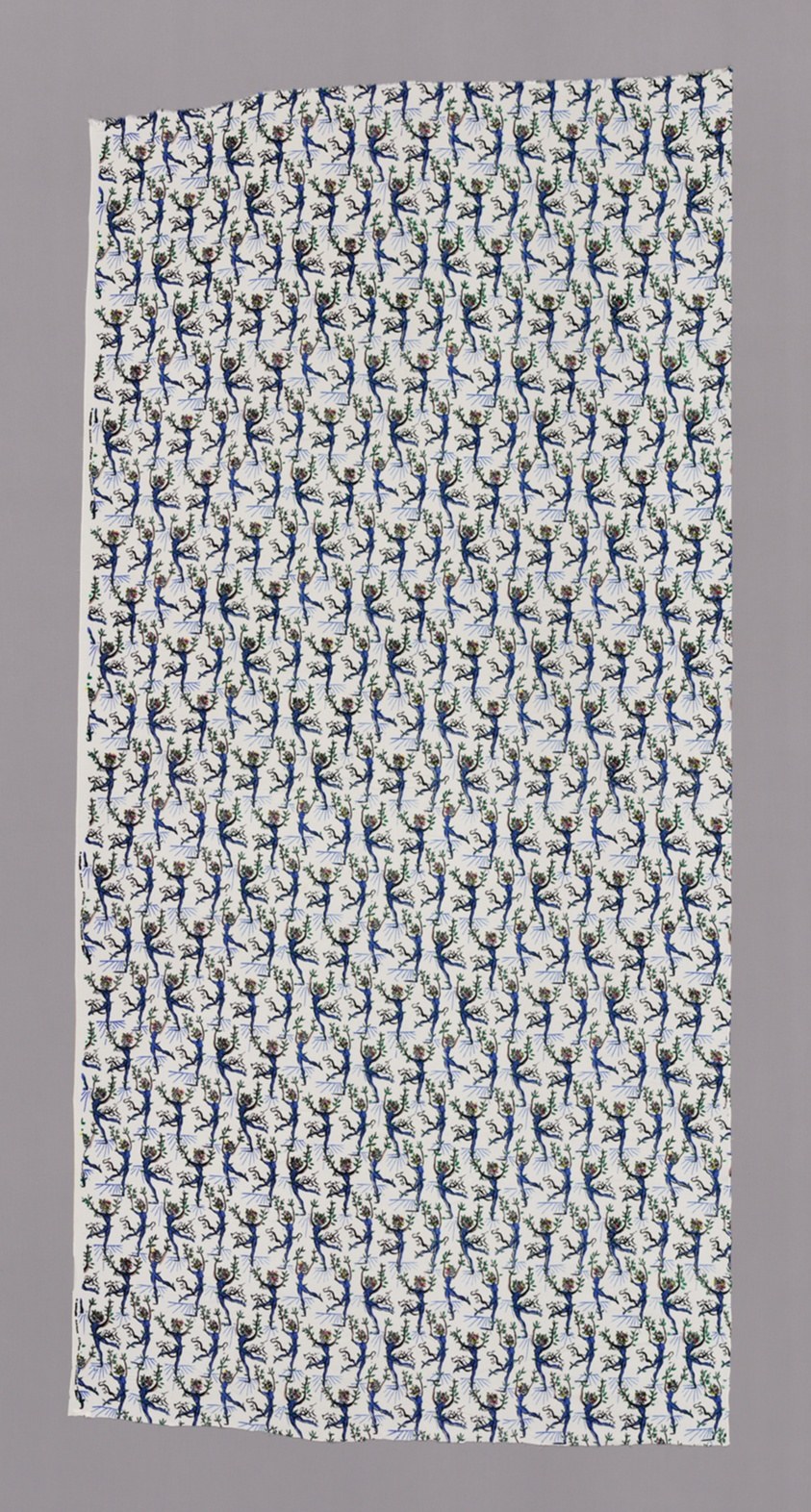
Flower ballet
Designed by Salvador Dali (Spanish, 1904–1989) Manufactured by Wesley Simpson Custom Fabrics Inc. Probably United States
- Medium:
- Rayon, warp-faced plain weave with creped wefts; screen printed
- Collection:
- Textiles
- Source:
- Art Institute of Chicago
- Rights:
- Rights reserved by the holding institution — do not reuse without permission. Source record ↗
- Recorded as:
- AIC — rights reserved
This textile reveals how ballet imagery functioned in twentieth-century consumer culture: as a marker of taste, refinement, and cosmopolitan sophistication. Dali's involvement suggests even commercial textile design could claim modernist credentials, while the image shows how the technical vocabulary of classical dance (the arabesque) was abstracted and flattened into pure design language, stripped of music, narrative, and the labour of the body.
What you are looking at
This is a length of rayon fabric densely patterned with a repeating motif of stylized human figures in dynamic poses arranged in vertical columns. The design uses a limited palette of navy blue, soft green, cream, and off-white. The figures appear to be dancers or performers in arabesque-like positions—one leg extended high, arms raised or curved—rendered in a flatly graphic manner characteristic of mid-twentieth-century textile design. The repetition across the entire surface creates a hypnotic rhythm, almost a visual score of movement. There is no single scene or narrative; rather, the viewer sees dozens of these ballet-like figures tiled symmetrically, their poses suggesting a continuous, almost musical rotation of the same gesture. The weave structure creates a subtle texture that catches light, while the screen-printed pattern sits crisp on the surface.
The dancing
Each figure is depicted in a clear arabesque or attitude pose—back leg elevated, body leaning forward slightly, arms positioned in balletic framing. The execution is linear and decorative rather than anatomically detailed; the limbs are simplified into elegant, tapering lines. The poses are frozen in what appears to be the peak moment of extension, with a sense of weightlessness that aligns with classical ballet technique. There is no interaction or spatial depth between the repeated figures; each occupies its own vertical zone, creating a tessellating effect rather than a scene of dancers together.
The dance depicted
This fabric celebrates ballet as a design subject—specifically the arabesque, one of the foundational poses of classical ballet technique. The repeated pose and the elimination of narrative or setting mark this as decorative modernism rather than illustration of a specific dance. The design translates the vertical logic of classical ballet (upward reach, extended line, effortless extension) into a pattern language suitable for textile production. The choice of arabesque—a pose associated with grace, refinement, and romantic-era ballet—suggests this was marketed as sophisticated, cultured domestic decoration. Dali's involvement suggests a surrealist or dreamlike inflection, though the execution here is restrained and graphic rather than the biomorphic distortion one might expect.
How it was made
The fabric is rayon warp-faced plain weave with creped wefts, screen-printed with the design. Rayon was the synthetic fibre most glamorous and affordable for mid-twentieth-century American fashion and home textiles. Screen printing allowed large-scale repeat patterns to be reproduced consistently and affordably, making this design reproducible in quantity for commercial textile manufacture. The creped (crimped) wefts would give the surface a subtle texture and subtle sheen, appropriate for curtains or apparel. The technique places this firmly in the world of industrial design and consumer goods rather than fine art, yet the credit to Salvador Dali indicates the design carried artistic prestige.
About this work
This is a piece of manufactured textile from around 1960, designed by Salvador Dali and produced by Wesley Simpson Custom Fabrics, a US textile manufacturer. It is a rayon fabric printed with a repeating pattern of ballet figures in arabesque, creating a rhythmic, almost musical surface design. The work sits at the intersection of fine art (Dali's signature), modernist design (the geometric tessellation and simplified figuration), and industrial production (screen-printed rayon intended for commercial sale). For a gallery of dance in art, it represents how ballet became a motif of sophistication in mid-century American design—a language of elegance and refinement domesticated into everyday objects. The work is neither documentation nor illustration; it is ballet translated into pattern, celebrating the pose itself rather than the dancer or the dance.
How to look at it
Look at how the arabesque is repeated like a typographic character or musical note—the design abstracts the pose into pure form, divorcing it from the dancer's body or the moment of performance. Notice how the vertical columns create a sense of continuous, almost frictionless motion, as if the pose loops endlessly. The colour palette is restrained and cool (navy, soft green, cream), avoiding the warmth and romance of Romantic-era ballet imagery. This is modernist reduction applied to a classical subject: the essence of the ballet body distilled into its most iconic frozen posture, then multiplied and tessellated across a consumer good.
The artist
Salvador Dalí (Spanish, 1904–1989) was a surrealist painter and multi-disciplinary artist who frequently moved between fine art, theatre, fashion, and commercial design. By 1960 he was an established master interested in applied and decorative projects alongside his painting practice. His involvement in textile design reflected both the mid-century prestige of such work and Dalí's commercial savvy; his name on a fabric bolstered its market appeal. Dalí often worked with simplified, flattened figures and biomorphic forms, though this design—with its classical ballet poses—shows restraint and a focus on pure geometric patterning rather than his more characteristic dreamlike distortion.
The period
In 1960, ballet occupied a prominent place in American high culture. The Cold War fostered intense interest in ballet as a symbol of Western cultural sophistication; the American Ballet Theatre and New York City Ballet were flagship institutions. At the same time, mid-century modernism was making abstract patterning and simplified figuration the language of sophisticated design. The marriage of these currents—Dali's name, a ballet motif, American industrial manufacture, and modernist geometry—reflects a moment when dance and design were understood as complementary languages of contemporary culture. Textiles were a major arena for artistic ambition and innovation during the 1950s and 1960s, and collaboration between fine artists and manufacturers (a model associated with the Bauhaus) was prestigious and common.
Where it lives
This fabric is held in the Textiles collection of the Art Institute of Chicago. It is a manufactured textile artifact, a finished length of fabric likely intended for sale as apparel or home furnishing yardage. The attribution to Dali as designer and Wesley Simpson Custom Fabrics as manufacturer is supported by the catalogue record.
Dance in this work
Questions about this work
Why is a textile in a gallery of dance?
Textiles are major documents of how dance has been imagined, consumed, and valued across time. This fabric is not a record of an actual dance—it is a design object that uses ballet imagery to convey elegance and sophistication. It tells us what mid-century American consumers understood ballet to be: a symbol of refinement and cosmopolitan taste. The pattern is in conversation with the history of ballet aesthetics.
What is an arabesque?
An arabesque is a fundamental ballet pose in which one leg is extended high behind the body (usually to hip height or higher), the body leans slightly forward, and the arms frame the body in various positions. It is one of the most iconic and recognizable poses in classical ballet, associated with grace, extension, and ethereal quality. The pose appears in virtually every ballet vocabulary and is a staple of both classical and contemporary ballet technique.
Why did Salvador Dalí design fabrics?
By the 1950s, fine artists collaborating with manufacturers on applied design was prestigious and common, a legacy of the Bauhaus. Dalí was commercially astute and prolific across media. A textile with Dalí's name attracted buyers and conferred artistic credibility on a commercial product. It allowed the artist to reach a mass audience while the manufacturer gained cultural prestige.
What is screen printing?
Screen printing is a technique in which ink is pushed through a mesh screen onto fabric, allowing one colour to be printed at a time. For textiles with repeating patterns, the same screen can be used repeatedly to build up the full design. It was (and is) efficient for mass production while allowing artistic design, making it ideal for mid-twentieth-century consumer textiles.
More dance artwork





