49 works in this view — arrow keys or swipe to move between them.
Dance in Art
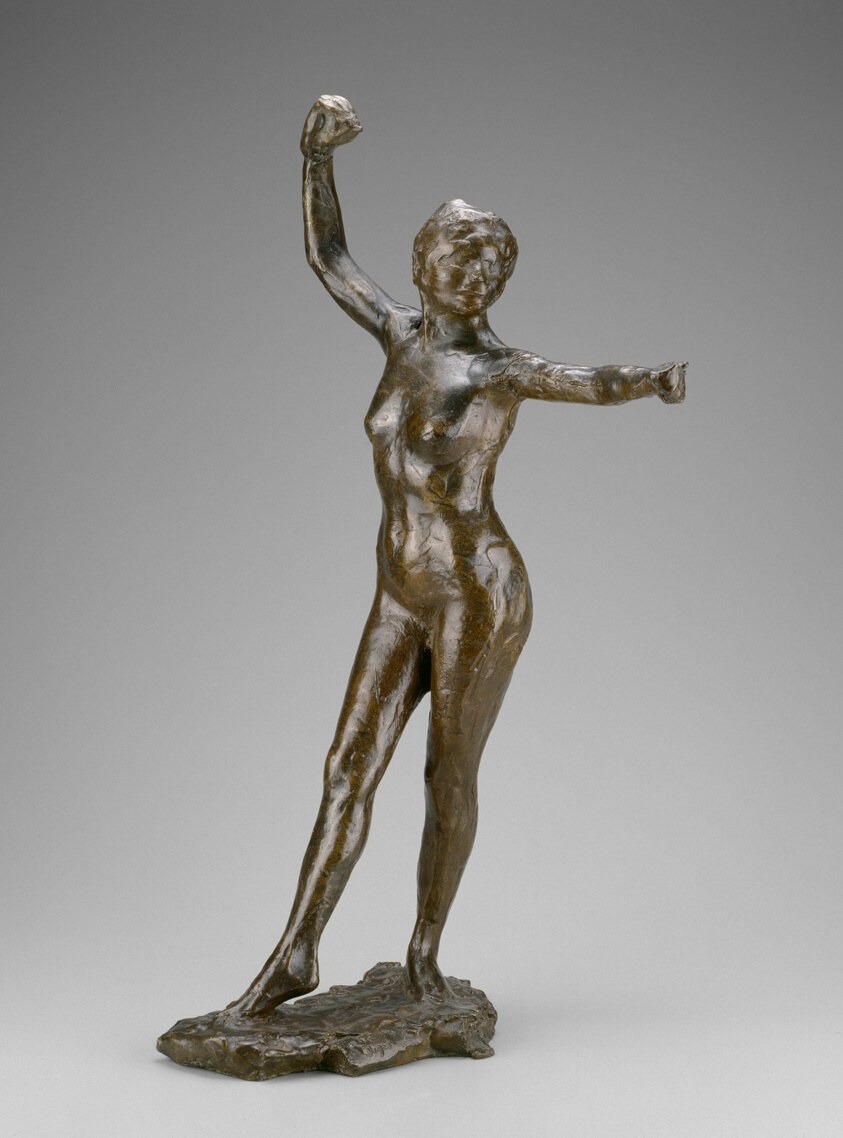
Dancer Ready to Dance, Right Foot Forward
Edgar Degas (French, 1834–1917)
- Medium:
- Bronze
- Collection:
- Painting and Sculpture of Europe
- Source:
- Art Institute of Chicago
- Rights:
- Public domain — free to use, share and adapt.
- Recorded as:
- CC0 (Public Domain)
Degas was one of the first major artists to treat dance not as a spectacle but as a subject for rigorous formal study, and his sculptures reveal an interest in the body's movement that goes beyond the theatrical moment. This work shows the artist freezing a moment of preparation or exultation, a gesture that has nothing to do with narrative or entertainment and everything to do with the pure articulation of the human body in space—a modernist concern that would shape 20th-century dance and sculpture.
What you are looking at
A bronze female nude figure stands in a dynamic contrapposto pose against a neutral gray ground. Her weight is carried on her right leg while the left is relaxed; her right arm is raised in a gesture of victory or exultation, the fist clenched, while her left arm extends outward to balance the composition. Her head is turned upward and to the side, following the direction of her raised arm, creating a sense of aspiration or triumph. The figure's musculature is rendered with anatomical precision, and the bronze surface shows the warm patina characteristic of cast metal sculpture. She stands on a roughly textured base that grounds the figure without being naturalistically detailed. The overall effect is one of arrested motion—a moment of celebration or freedom captured in a pose that suggests the body mid-movement.
The dancing
A single female dancer is isolated in the frame, standing on one supporting leg with the other free. Her torso is upright but animated; her raised right arm reaches upward and slightly back, while her left arm opens to the side at roughly shoulder height, creating an open, expansive upper body. The positioning of her head—lifted and looking upward—reinforces the outward, celebratory quality of the gesture. The weight distribution and the angle of her hips suggest readiness for movement or the completion of a dynamic action. The musculature throughout the legs and torso conveys strength and control rather than tension.
The dance depicted
This appears to be a study of the human figure in motion rather than a specific named dance form. The pose suggests the moment either before a vigorous movement begins or immediately after completion—a moment of readiness or triumph. The raised arm and open frame are consistent with classical or neoclassical aesthetic ideals about the body in space, and the title's reference to "ready to dance" with "right foot forward" indicates that Degas was interested in capturing the preparatory attitude of the dancer. The work reflects 19th-century academic interest in the ideal human form, but Degas was known for studying actual dancers in rehearsal and performance, so this likely derives from observation of real movement, even if it is idealized and abstracted through classical proportions.
How it was made
This is a bronze cast, which suggests it was produced from a modeled original, likely in clay or wax. The surface shows evidence of careful modeling and finishing; the anatomical details are precise and the overall volume is controlled. The patina indicates age and oxidation of the bronze surface, creating warm golden-brown tones. As a cast bronze, this work would have had limited direct circulation—bronzes were expensive and typically owned by museums, wealthy collectors, or institutions—but it participates in the long tradition of bronze sculpture as the premium medium for figural study, suggesting the work was intended as a serious artistic statement rather than a commercial product.
About this work
This bronze study of a female figure in a dynamic, open pose represents Degas's sustained investigation of the human body in motion. Created in 1882, it captures the moment of readiness or celebration—the instant before or after movement—through a carefully balanced contrapposto that emphasizes both anatomical accuracy and classical idealization. The work is characteristic of Degas's practice of studying dancers in unconventional poses and moments, moving beyond the formal ballet vocabulary to capture the body's actual range of attitudes and gestures.
The sculpture belongs to a body of work that challenged 19th-century academic conventions about how the body should be represented. Degas was unusual among painters of his era in treating dancers as subjects worthy of serious artistic investigation, and his sculptures—long less famous than his paintings—demonstrate the same commitment to studying actual movement and the specific, sometimes ungainly positions that real bodies occupy.
How to look at it
This work asks the viewer to consider the moment before or after action, not the action itself. Notice how the open frame of the arms and the uplifted gaze create a sense of release or celebration, while the placement of weight on one leg keeps the body ready to move. Degas chose to isolate the figure completely, against a neutral ground, forcing the viewer to see the body as pure form—muscles, joints, balance—rather than as part of a narrative or theatrical scene. The work reflects the classical academic tradition of the figure study, but the pose itself is neither grand nor heroic in the classical sense; it is specific, observed, almost casual in its readiness.
The artist
Edgar Degas (1834–1917) was a French painter and sculptor whose work centered obsessively on dancers, particularly those of the Paris Opéra. Unlike his Impressionist contemporaries, Degas worked from careful observation and memory rather than plein-air sketching, and he treated dancers not as picturesque subjects but as serious athletes whose bodies displayed the principles of movement and balance. He made hundreds of sketches, paintings, and—increasingly in his later years—sculptures of dancers in rehearsal, resting, adjusting their costumes, and performing. His sculptures were largely unknown during his lifetime; most were cast in bronze posthumously. Degas's influence on modern dance was profound: his insistence on the dancer's body as a subject worthy of rigorous formal investigation, and his willingness to depict awkward, ungraceful, or unflattering poses, challenged romantic conventions and opened the way for modernist approaches to the moving body.
The period
The 1880s were a pivotal moment for ballet in Paris. The Romantic ballet tradition, with its emphasis on ethereal femininity and pantomime, was giving way to the more athletic, technically demanding style associated with dancers like Rosita Mauri. Degas was documenting this transition through drawings and paintings made in the wings of the Opéra and in rehearsal studios. At the same time, sculpture in the academic tradition was concerned with the ideal human form, often drawn from classical precedent, but Degas's sculpture practice was radically different: he was interested in the specific, sometimes awkward attitudes of real bodies in work. His sculptures represent a kind of artistic ethnography of the dancer's body—a commitment to recording what he actually observed rather than what convention said bodies should look like.
Where it lives
This bronze is held by the Art Institute of Chicago in the Painting and Sculpture of Europe collection. It is one of a series of dancer sculptures that Degas modeled in his later years; many were cast in bronze posthumously, which is standard practice for works in this collection.
Dance in this work
Questions about this work
Did Degas dance or have formal ballet training?
No. Degas was a painter and sculptor who spent decades observing dancers at the Paris Opéra, in rehearsal studios, and backstage. He developed an intimate knowledge of the dancer's body and movement through intensive, sustained looking, not through participation. His notebooks are filled with drawings of dancers in motion, at rest, and in minute anatomical study.
Why did Degas make sculptures when he was famous as a painter?
Degas's sculptures were made largely in private and were little known during his lifetime. They appear to have satisfied a different formal impulse than painting: the ability to see the body in full three dimensions and to freeze a specific moment of balance or gesture. Sculpture allowed him to study form and weight in ways that painting could not.
What does 'ready to dance, right foot forward' mean?
The title describes the pose: the figure is positioned as though about to begin movement, with her weight on the left leg and the right foot forward, ready to step. It is a preparatory attitude—the body's readiness—rather than a depiction of a specific dance step or choreography.
Is this an idealized figure or a study from life?
Both. Degas worked from observation of actual dancers, but he modeled the figure according to classical proportions and ideals of beauty. The result is a figure that is anatomically plausible and derived from real movement, but refined and abstracted through the conventions of academic sculpture.
More dance artwork





