49 works in this view — arrow keys or swipe to move between them.
Dance in Art
Ballet
David Smith American, 1906-1965
- Medium:
- Etching on ivory wove paper
- Collection:
- Prints and Drawings
- Source:
- Art Institute of Chicago
- Rights:
- Rights reserved by the holding institution — do not reuse without permission. Source record ↗
- Recorded as:
- AIC — rights reserved
This work documents a crucial moment when avant-garde visual artists and dancers were collaborating to reimagine ballet itself—moving away from narrative and spectacle toward abstraction and pure movement. Smith's treatment of the dancers' bodies as sculptural forms, freed from the constraints of classical technique, reflects the radical questioning of ballet convention that characterized the modernist period.
What you are looking at
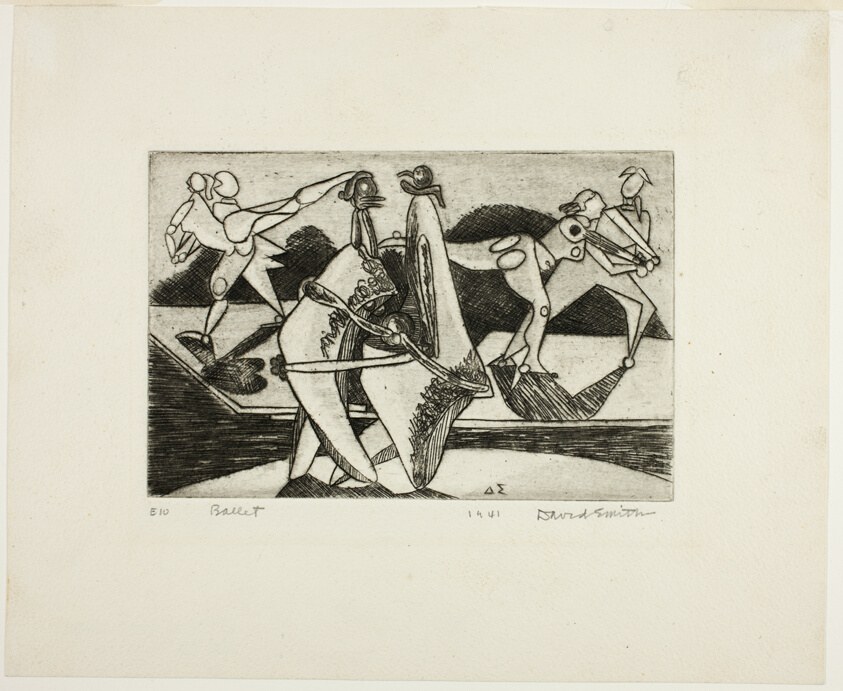
This etching depicts a dynamic ballet scene rendered in bold, high-contrast lines characteristic of early-twentieth-century modernism. Five figures occupy the composition: two dancers in the foreground engage in vigorous movement—one lunging forward with extended limbs, the other in a twisted, acrobatic pose—while three additional figures populate the background in various attitudes of performance or support. The setting is spare: a dark horizontal band at the base suggests a stage floor, and the background is largely empty save for hatched shading that creates depth without literal scenery. The figures are drawn with minimal anatomical detail and exaggerated proportions; their bodies are simplified into geometric forms, with particular emphasis on the arc and tension of the spine, the reach of the limbs, and the relationship between weight and counterweight. No costume detail is rendered—the dancers appear almost nude, their bodies the sole focus—which allows the movement itself to dominate. The overall effect is one of arrested energy: the composition captures ballet not as a refined, posed tableau but as a moment of explosive physical exertion.
The dancing
The two foreground dancers exhibit poses of extreme extension and torsion rather than the upright alignment or ethereal lightness associated with classical ballet. The figure on the left appears to be in a deep lunge or fall, with one leg extended far behind and the torso folded forward, arms outstretched. The central figure displays an inverted or severely twisted spine, suggesting a moment of either rapid rotation or a contorted adagio lift. Neither pose suggests the vertical alignment, turned-out legs, or lifted carriage of traditional ballet technique; instead, they read as expressions of flexibility, power, and spatial exploration. The three background figures are less distinctly characterized but appear to be in supporting or observational roles. The overall impression is of bodies pushed beyond classical constraints—closer in spirit to acrobatic or contemporary movement than to Romantic or Classical ballet convention.
The dance depicted
This work titled Ballet depicts theatrical dance, but the specific style cannot be definitively identified from the image alone. The extreme flexibility, torsion, and apparent use of the floor suggest either an avant-garde ballet experiment of the 1930s–40s (when Smith created this) or possibly a stylized representation of acrobatic movement within a theatrical context. The nude, simplified forms and emphasis on bodily mechanics rather than narrative or character indicate an interest in dance as pure movement—an approach aligned with early-twentieth-century modernism in visual art. The work does not depict classical, Romantic, or Neoclassical ballet in the conventional sense; rather, it appears to be Smith's modernist interpretation of what ballet could express through radical physicality.
How it was made
This is an etching—a printmaking process in which an image is incised into a metal plate and then inked and printed. The bold, directional line work visible throughout (particularly the hatched shading on the figures and background) and the high-contrast distribution of black and white are characteristic of etching technique. The medium allowed for multiple impressions and relatively broad circulation among collectors and institutions, making it an accessible form for modernist artists in the early twentieth century. The bold, expressionistic line style that Smith employs here is well-suited to etching; the technique does not require photographic realism and rewards strong linear composition, which Smith exploits fully to convey movement and energy.
About this work
Smith's Ballet is a modernist etching that captures theatrical dance not as graceful spectacle but as an act of physical extremity and spatial investigation. Created in 1941, it reflects the influence of early-twentieth-century avant-garde movements in both art and dance—a period when sculptors and painters were increasingly interested in the body as a three-dimensional form and in movement as a subject worthy of formal artistic exploration. The work sits at the intersection of Cubism, Constructivism, and dance modernism; Smith's simplified, geometrized forms and dynamic composition suggest familiarity with contemporary developments in both visual art and theater. The etching circulated within the print-collecting world and is now held in a major American museum collection, where it serves as evidence of how modernist artists engaged with dance as a subject of formal and conceptual interest.
How to look at it
Observe the two foreground dancers as studies in extreme flexibility and spatial reach rather than as classical ballet poses. Notice how Smith has distorted and exaggerated the spine, limbs, and center of gravity to suggest explosive movement and weightlessness simultaneously. The background figures, though less detailed, establish a sense of theatrical space and ensemble activity. Pay attention to how the hatching and bold line work create both form and motion—the eye is led along the contours of the bodies and follows the implied trajectories of the limbs. The complete absence of detail (face, costume, setting) forces attention onto the mechanics and energy of movement itself.
The artist
David Smith (1906–1965) was an American sculptor and printmaker whose work bridged painting, drawing, and three-dimensional form. Though best known for his welded steel sculptures, Smith was a prolific printmaker and draughtsman who often explored the human figure, industrial forms, and abstraction. In the 1930s and 1940s, Smith was engaged with both Cubism and Surrealism and maintained an interest in the expressive potential of the human body. His prints and drawings from this period frequently depict movement, gesture, and the figure in states of transformation—concerns aligned with avant-garde dance and performance. The simplification and distortion evident in Ballet are characteristic of Smith's approach to the figure during this period.
The period
In 1941, American modern dance and avant-garde ballet were actively challenging classical tradition. George Balanchine's neoclassical ballets and the work of Martha Graham's contemporary dance company were both pushing the boundaries of what dance could express. In visual art, Cubism and Constructivism had already demonstrated how the body could be deconstructed and reassembled as pure form. Smith's etching reflects this cross-pollination: it adopts the geometric simplification and dynamic composition of modernist visual art while depicting dancers engaged in movement that transcends the constraints of classical ballet. The 1940s were also a period of significant interest in printmaking as a democratic and accessible medium for avant-garde expression, particularly among American artists.
Where it lives
The work is held in the Prints and Drawings collection of the Art Institute of Chicago, one of the largest and most comprehensive print collections in North America. As a twentieth-century American etching, it represents the kinds of experimental works on paper that major American museums actively collected during and after the modernist period.
Dance in this work
Questions about this work
Is this really ballet?
The title identifies it as such, and the theatrical context and number of figures support a reading as a dance scene. However, the extreme poses and emphasis on bodily contortion diverge sharply from classical ballet technique. Smith appears to have used ballet as a subject for exploring modernist ideas about the body and movement, rather than documenting ballet as it was formally practiced.
Why are the dancers drawn so simply?
The simplification serves Smith's modernist aesthetic and allows the viewer to focus on pose, line, and movement rather than personality or narrative. Etching as a medium also rewards bold, legible line work over detailed rendering. The abstraction makes the dancers' bodies read more like sculptural forms—a concern central to Smith's artistic practice.
What technique does this show?
The poses do not correspond to any standard ballet vocabulary. Instead, they suggest acrobatic flexibility, rapid rotation, and exploration of the body's three-dimensional possibilities in space. This aligns with experimental and contemporary approaches to movement that were challenging classical ballet in the 1930s and 1940s.
More dance artwork





