49 works in this view — arrow keys or swipe to move between them.
Dance in Art
Ballet Girl at Window
Robert Bartholow Harshe American, 1879-1938
- Medium:
- Oil paint, over graphite, on off-white wove card
- Collection:
- Prints and Drawings
- Source:
- Art Institute of Chicago
- Rights:
- Rights reserved by the holding institution — do not reuse without permission. Source record ↗
- Recorded as:
- AIC — rights reserved
This work exemplifies the fascination of fin-de-siècle American artists with the theatrical world and the figure of the dancer as a subject of psychological and chromatic interest. It documents how ballet was understood in visual culture not as virtuosic display but as an intimate, often melancholic experience of the body.
What you are looking at
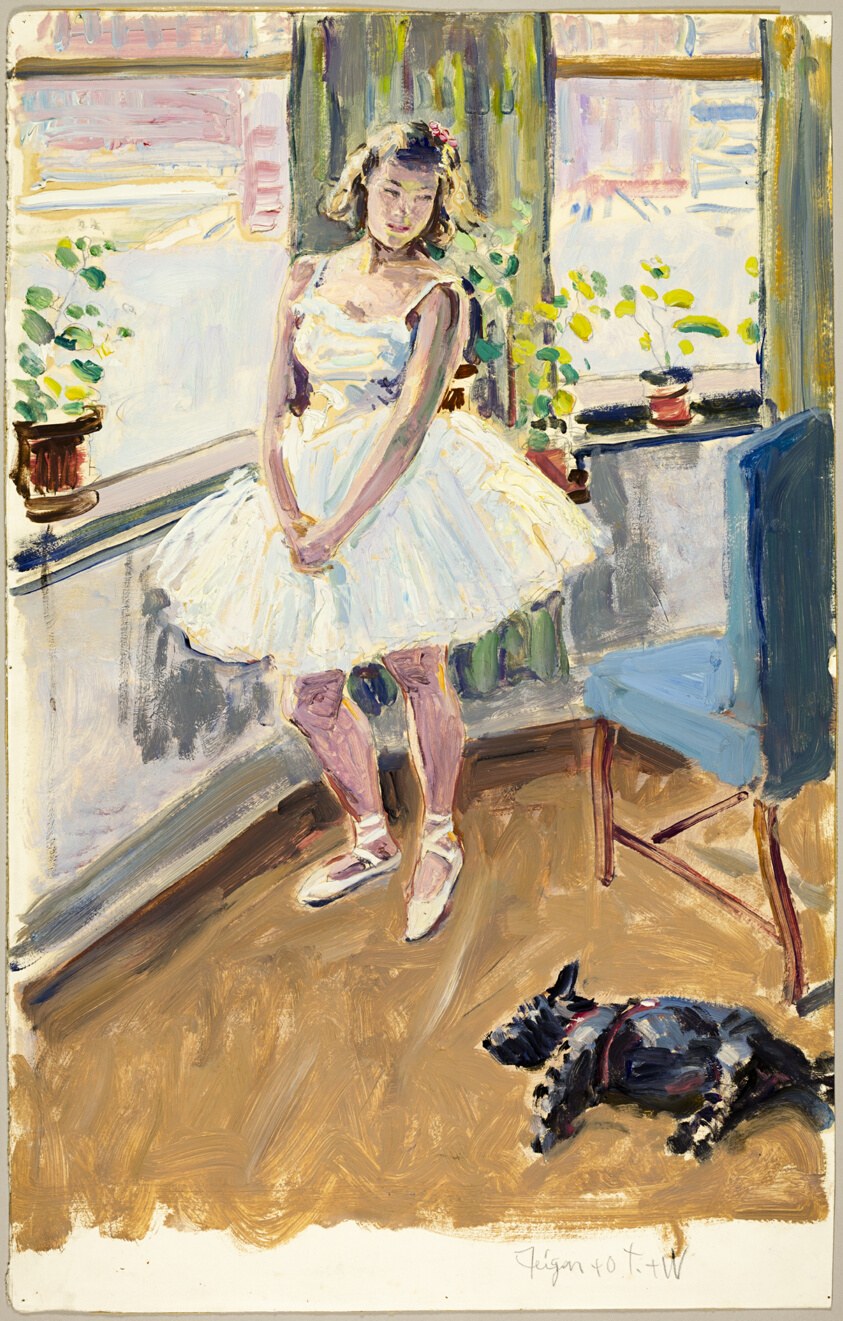
A young woman in a pale yellow ballet dress stands at an open window in a sunlit interior, her weight settled on her right leg in a relaxed contrapposto stance. She gazes downward with a contemplative expression. The window behind her floods the scene with bright, diffused light that bleaches the background to pale pink and cream; potted geraniums and other houseplants sit on the windowsill. The floorboards are warm ochre-brown; a dark dog lies curled on the floor in the immediate foreground, rendered in quick, expressive brushwork. On the right, a simple blue chair and what may be a table edge anchor the domestic interior. The paint is applied loosely and with visible brushwork throughout, capturing the casual intimacy of a backstage or private dressing moment rather than a performance.
The dancing
The dancer's frame is upright but at ease, with her weight distributed through a single supporting leg—a pose suggesting preparation or transition rather than active choreography. Her arms hang naturally, with the shoulder of her supporting side relaxed. Her head is tilted slightly downward in a moment of absorption, not directed toward the viewer. The pose does not exhibit the turnout, lifted spine, or prepared readiness typical of classical ballet technique; instead it reads as a private, unstaged moment of a dancer in her day.
The dance depicted
The catalogue title "Ballet Girl at Window" and the pale tulle skirt with fitted bodice, soft ballet shoes, and pink hosiery all identify the subject as a theatrical dancer of the ballet tradition. However, the image captures no active dancing—no jump, turn, or extension. Instead, it documents the demeanor of a ballet dancer at rest, possibly in a dressing room or rehearsal space, a subject beloved by late 19th-century realist painters. The pose suggests Romantic or Classical ballet training but prioritizes the psychology of rest and reflection over the virtuosity of the technique.
How it was made
The work is executed in oil paint over graphite on off-white wove card—a relatively modest and portable support that allowed for rapid execution and informal subject matter. The loose, visible brushwork and high-keyed palette of pale yellows, pinks, and soft greens were characteristic of American Impressionist practice in the 1890s, which emphasized light, immediacy, and domestic or theatrical subjects. The technique suggests this was likely a studio sketch or a finished work conceived for exhibition among paintings rather than as a formal commission.
About this work
This painting by Robert Harshe documents a moment of private repose, not performance. It belongs to a rich tradition of late 19th-century art depicting the theatrical world—particularly dancers—in intimate, unguarded moments. The work draws from Impressionist and Realist conventions of capturing fleeting light and psychological truth, applying them to the figure of a ballet dancer in what appears to be a backstage or domestic interior. For the history of dance imagery, it represents a significant shift away from the idealized, action-filled performance scenes of earlier generations toward the modern interest in dancers' lives off-stage and in the body at rest.
How to look at it
Note the artist's choice to freeze a moment of absolute stillness and introversion—the downward gaze, the unselfconscious weight distribution, the small scale and domestic setting. This is a radical departure from 18th- and early 19th-century dance imagery, which emphasized spectacle and movement. Observe how the light from the window becomes the subject alongside the figure; the pale yellow of the dress dissolves into the pale yellow-pink of the background, unified by Impressionist light. The small dark dog in the foreground, rendered almost as an afterthought, anchors the scene in lived domestic reality.
The artist
Robert Bartholow Harshe (1879–1938) was an American painter and later influential museum director. Working in the closing years of the 19th century, he was engaged with Impressionist and Realist modes of painting contemporary life, and contributed significantly to the American art establishment as painter, educator, and curator. His interest in theatrical subjects and the play of light reflects the broader engagement of his generation with urban modernity and the artistic world.
The period
The 1890s in American art saw a flourishing of Impressionist-influenced painting and a keen interest in theatrical and entertainment subjects. Artists drew inspiration from French precedents—particularly Degas—in depicting dancers and performers in private, rehearsal, and backstage moments rather than in formal performance. Simultaneously, ballet in America was transitioning from a visiting European spectacle to an increasingly established theatrical form with its own institutions and training systems. The painting of a young ballet dancer at a window, lost in thought, reflects this era's appetite for psychological nuance and informal realism in the depiction of modern life.
Where it lives
Held by the Art Institute of Chicago in the Prints and Drawings collection. The work is catalogued as oil and graphite on card, suggesting it may have been preserved as a sketch or study despite its apparent completeness as a finished work.
Dance in this work
Questions about this work
Is this a real ballet dancer or a model dressed up?
The painting does not provide evidence either way. The title and the costume—tulle skirt, ballet shoes, pink hosiery—identify the subject as a ballet dancer. Whether she was an active performer or posed for the painter by the artist's arrangement cannot be determined from the image alone. The informality of the pose and setting suggest this may have been a studio session rather than an observed backstage moment.
Why is she not dancing?
The artist chose to depict a moment of stillness and repose, not performance. This reflects a broader movement in late 19th-century art toward painting dancers off-stage, at rest, or in rehearsal—subjects that allowed for psychological depth and studies of light and form rather than action. It is a more modern, introspective way of thinking about the dancer as a subject.
What is the dog doing there?
The dog is a detail that grounds the scene in domestic reality. Its presence suggests either a private interior (perhaps the artist's studio or the dancer's own room) rather than a backstage area, or it may simply be a detail included for the sake of lived, observed reality—the kind of specific, non-idealized detail that Realist and Impressionist artists favored.
When was this painted and why?
Dated to 1899, the work was created at the end of the 19th century when American artists were intensely engaged with Impressionist modes of painting and with theatrical subjects. The fashion for such works followed the international success of Degas's ballet paintings and reflected the cultural prestige of the theatrical world in cities like Chicago, where Harshe was based.
More dance artwork





