49 works in this view — arrow keys or swipe to move between them.
Dance in Art
In the Wings
Jean Louis Forain (French, 1852–1931)
- Medium:
- Oil on canvas
- Collection:
- Painting and Sculpture of Europe
- Source:
- Art Institute of Chicago
- Rights:
- Public domain — free to use, share and adapt.
- Recorded as:
- CC0 (Public Domain)
For dance historians, this painting is valuable not for depicting technique or choreography, but for documenting the social context and infrastructure of performance—how audiences watched, who had access to privileged viewing positions, and how the experience of theatre operated as a marker of class and cultural refinement. The work offers evidence of the gendered dimensions of theatre attendance and the theatricality of spectatorship itself in the modern era.
What you are looking at
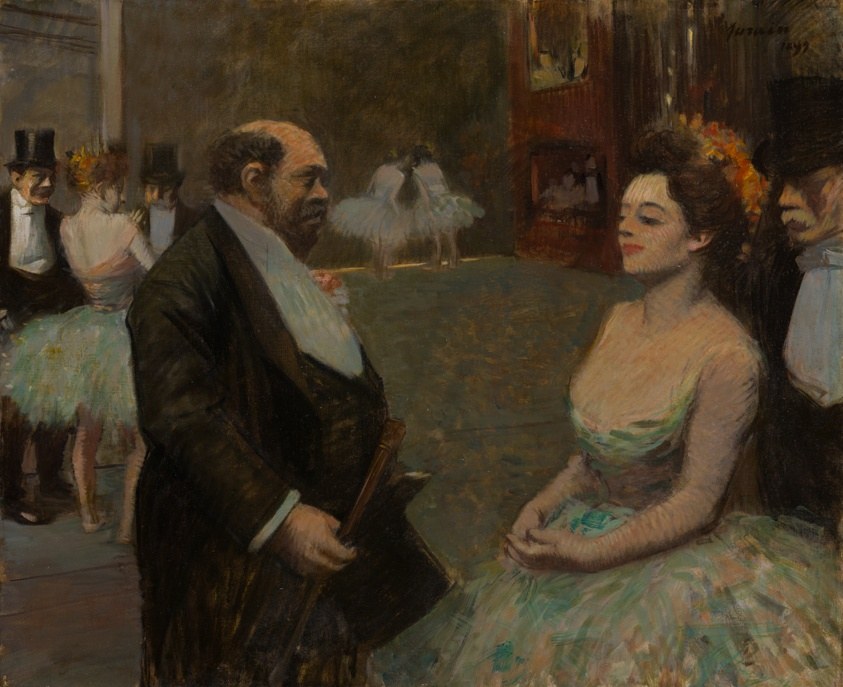
A backstage or wings scene at a theatre during a performance, rendered in Forain's characteristic loose, impressionistic style. In the foreground, a bearded man in evening dress (tailcoat, white shirt front) stands in profile facing right, watching the stage. To his right sits a woman in an elegant pale green gown with a low neckline, her dark hair piled high, gazing toward the stage with a slight smile. Behind and around them, other figures in formal dress occupy the shadowed space—top-hatted gentlemen and women in white and colored gowns—creating a sense of crowded anticipation. The palette is dominated by warm browns and greys in the background, with touches of flesh tone and pale fabric catching the light. The composition suggests a specific moment of watching: the man's posture is attentive, the woman's gaze fixed, both absorbed in something happening just beyond the frame. The setting is clearly the privileged viewing space behind the proscenium, where wealthy patrons and theatre staff observed the action from an intimate vantage.
The dancing
The two central figures are seated or at ease; there is no active dancing here, but rather the absorbed stillness of spectators. The man leans slightly forward, his weight settled, his gaze directed stage-right with professional or appreciative focus. The woman beside him is poised upright, her hands folded in her lap, her expression calm and composed. Neither figure exhibits the tension or movement of performance; instead, they embody the concentrated looking that characterizes theatre attendance from a privileged position. The surrounding figures are similarly posed—watching, waiting—which reinforces that this is a moment of observation rather than action.
The dance depicted
The title *In the Wings* identifies this as a backstage or stage-side scene, and the central couple's fixed gaze toward the stage-left suggests they are watching a performance. The woman's pale, elegant gown and the formal evening dress of the other figures indicates this is a theatre audience or personnel in an urban, cultured setting—likely Paris in the late 19th century. Although no dancers are visible in the composition, the painting documents the social and theatrical context of dance performance: the infrastructure of spectatorship, the segregation of viewing privilege, and the gendered dynamics of theatre attendance. What is being performed on the hidden stage is not shown, but the painting's title and the absorbed watching posture of the figures suggest a ballet or theatrical dance performance is taking place.
How it was made
Oil on canvas, executed in Forain's distinctive late-19th-century style: loose brushwork, atmospheric treatment of light and shadow, and a focus on capturing the momentary quality of modern life. The technique allows for subtle rendering of fabric, skin tone, and the play of theatre light on the figures' faces without sharp definition. The soft focus and warm tonality suggest the actual conditions of viewing a lit stage from the wings—the contrast between the illuminated performers beyond the frame and the shadowed watching figures in the foreground. The painting's size and medium indicate it was made for an educated, urban audience familiar with both theatre and contemporary impressionist practice.
About this work
Jean Louis Forain's *In the Wings* (1899) documents a moment of theatre spectatorship, showing privileged viewers absorbed in a ballet or theatrical dance performance occurring just beyond the canvas edge. Rather than depicting the dancers themselves, Forain captures the social and sensory experience of watching from backstage or in the wings—a vantage point that blends professional theatre personnel and wealthy patrons in a space of shared anticipation. The painting is a study in the culture of late-19th-century Parisian theatre, where the act of watching, the presentation of oneself as a sophisticated spectator, and the gendered dynamics of attendance were as much part of the performance as the dancers on stage. Forain was a prolific illustrator and painter of theatre life, and this work exemplifies his interest in capturing the modern leisure and cultural rituals of fin-de-siècle Paris rather than the conventional heroic or narrative subjects of academic painting.
How to look at it
Attend to what is *not* shown: the painting's compositional strategy is to hide the dancers themselves and instead focus the viewer's eye on the act of watching. Note the direction of the central woman's and man's gazes, which draw the viewer's attention toward the stage-left edge, inviting us to imagine the performance we cannot see. The warm, shadowed tonality of the wings contrasts with the implied brightness of the lit stage beyond, creating a spatial and sensory separation between the watching space and the performance space. The painting invites you to consider the experience of theatre not as the experience of dancers, but as the experience of privileged looking—and to notice how that experience is structured by gender, class, and proximity to the stage.
The artist
Jean Louis Forain (1852–1931) was a French painter, printmaker, and caricaturist who made the theatre and modern urban leisure his primary subject matter. He trained under Jean-Léon Gérôme and exhibited regularly in Paris during the last decades of the 19th century. Forain was celebrated for his ability to capture the spontaneous, observed quality of modern life—particularly the world of theatre, ballet, and café society. His style evolved from academic training toward the looser, more impressionistic handling visible in *In the Wings*. He was prolific in multiple media: oil paintings, watercolors, etchings, and lithographs, and his theatre subjects found a ready audience among educated Parisians who recognized themselves and their leisure world in his compositions.
The period
In 1899, the Paris Opéra and the Opéra Comique were central institutions of high culture, and ballet was a prestige form of entertainment for the urban elite. The late 19th century saw the codification of academic ballet technique and the consolidation of the star system, in which celebrated dancers (particularly women, who dominated the form) became objects of fascination and desire. The contemporary theatre was a space of complex social performance: wealthy patrons displayed their refinement and status through attendance, while backstage and in the wings, a hierarchy of access reinforced class distinctions. Forain's theatre paintings record this world at a moment when modern leisure was reshaping the social fabric of Paris, and when the visual culture of impression and observation was becoming the dominant artistic mode.
Where it lives
The work is held in the Painting and Sculpture of Europe collection at the Art Institute of Chicago, one of the major American museums with significant holdings of late-19th-century European art. It is listed as oil on canvas, dated 1899.
Dance in this work
Questions about this work
Why is there no dancer in this painting about ballet?
Forain made a deliberate choice to exclude the performers and focus instead on the experience of watching from the wings. By hiding the dancers, he emphasizes the social ritual of theatre attendance and the psychology of spectatorship. The viewer becomes aware of their own position as a watcher, positioned outside the frame looking at other people who are looking at something just beyond the frame's edge.
Who are the figures in the painting?
They appear to be a mix of theatre patrons and personnel—people with access to the privileged backstage viewing areas. The central couple, dressed in elegant evening wear, are likely wealthy patrons or possibly staff. Their formal attire and absorbed expressions suggest they are accustomed to this world of theatre and cultural refinement.
What does 'In the Wings' mean?
The phrase refers to the offstage areas adjacent to the stage where actors and dancers wait to enter, but also metaphorically to a position of waiting or being out of sight. Forain uses the term to describe the spatial and social position his figures occupy—they are beside the stage, part of the theatre world but not on it, watching from a vantage point of privilege and proximity.
More dance artwork





