49 works in this view — arrow keys or swipe to move between them.
Dance in Art
Between Acts or the Englishwoman of the New Ballet
Félicien Rops Belgian, 1833-1898
- Medium:
- Heliogravure in black on Japanese paper vellum
- Collection:
- Prints and Drawings
- Source:
- Art Institute of Chicago
- Rights:
- Public domain — free to use, share and adapt.
- Recorded as:
- CC0 (Public Domain)
The work provides crucial evidence for understanding how 19th-century ballet was perceived and consumed off-stage—not as pure art but as a site of voyeurism and commodity exchange. For dance historians, it reveals the gendered assumptions embedded in ballet culture and the distinction between the dancer's public and private roles. The sophisticated technique and satirical framing suggest that debates about the status of ballet, the dancer's body, and art itself were already well-developed by mid-century.
What you are looking at
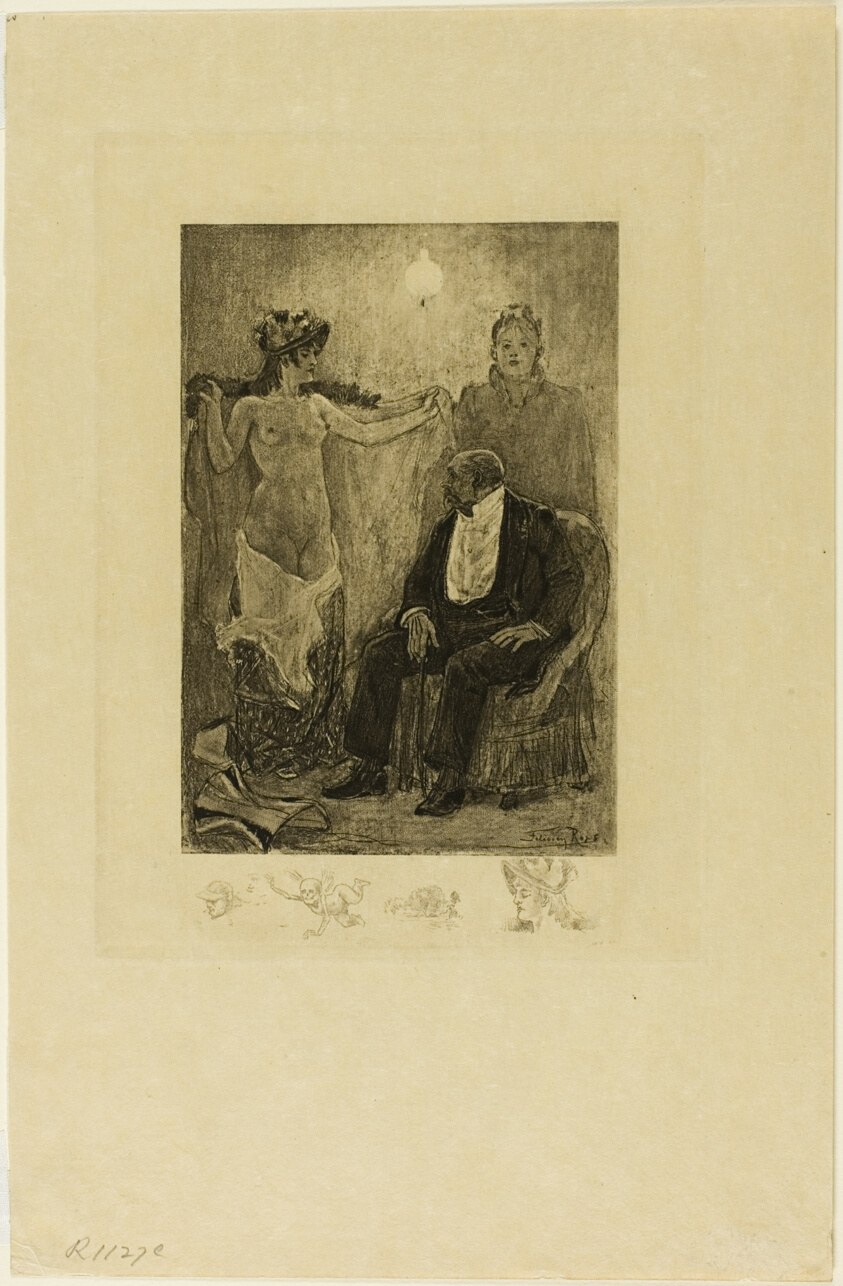
A seated gentleman in dark formal dress observes two female figures in a dimly lit interior. The man, shown in three-quarter profile, wears a black coat with white shirt front and sits with one arm relaxed. Behind him stands a fully nude woman wearing only a decorative headdress and drapery, her body displayed in a classical contrapposto stance. To her right, a clothed female figure in a long dress gestures toward the scene. The setting is rendered in muted tones with shadowy walls and sparse furnishings, creating an atmosphere of theatrical artifice. A pale light source above suggests stage lighting or an interior fixture. The composition suggests a moment of performance or presentation—the nude figure posed for aesthetic contemplation rather than active movement.
The dancing
The nude figure adopts a classical ballet-derived pose with weight centered, one leg slightly forward, arms positioned with the upstage arm extended and the downstage arm curved. Her posture suggests training in academic dance or modeling conventions, with the body aligned in a frontal plane facing the seated observer. The seated man remains still and contemplative, while the clothed figure's gesture—arm extended toward the nude form—emphasizes presentation and spectatorship. No active dance movement is evident; the figures are arranged in a moment of studied stillness rather than locomotion.
The dance depicted
The work depicts not a dance in the active sense but the backstage or dressing-room moment of theatrical ballet culture. The title *Between Acts* and the subtitle *Englishwoman of the New Ballet* suggest a scene from mid-19th-century ballet practice or fantasy. The nude female form represents the ballet dancer as both artistic object and commodity; her classical pose echoes the attitudes and arabesques of Romantic ballet technique, but she is shown not performing on stage but displayed and observed. The setting and dress indicate this is social theatre—the world of ballet as seen by spectators with access to its margins. The 'New Ballet' subtitle may reference contemporary developments in Parisian ballet or satirize the English appropriation of French ballet culture.
How it was made
The work is a heliogravure (photogravure), a photo-based intaglio process that combines photographic precision with the tonal range of etching. The medium allows fine gradation of tone and delicate rendering of texture—visible in the fabric of the woman's dress, the fabric of the nude figure's drapery, and the subtle modeling of flesh. Heliogravure was expensive and produced in limited numbers, circulating among collectors rather than as popular prints. This technique was favored for sophisticated, often scandalous subject matter among fin-de-siècle cognoscenti, and the choice of medium here signals an artwork intended for a knowing audience aware of contemporary debates about art, the body, and performance.
About this work
This is a satirical or observational print depicting the world of mid-19th-century ballet as a site of male spectatorship and female display. Rather than showing a dance on stage, it captures the moment between acts—the dressing room or rehearsal space where the ballet body is revealed as both artistic ideal and social commodity. The work belongs to a tradition of theatre-world imagery that exposes the mechanics of performance and the gender dynamics embedded in dance culture. Félicien Rops was known for probing such intersections between aesthetics, eroticism, and social critique, and this print exemplifies his interest in the theatrical and the transgressive.
How to look at it
Attend first to the composition's geometry: the seated observer frames and anchors the image, while the standing figures form a kind of presentation or display. The nude figure's classical pose—reminiscent of ballet attitudes—is undercut by her presentation as object rather than performer; note how the clothed woman's gesture points toward her as if displaying a work of art. The darkness of the setting and the precision of the heliogravure technique create an atmosphere of intimate, almost clandestine observation. The work asks the viewer to occupy the position of the seated man—to witness, judge, and desire.
The artist
Félicien Rops (1833–1898) was a Belgian Symbolist printmaker and painter known for provocative subjects exploring desire, decadence, and social transgression. He worked across multiple print media—etching, lithography, and photogravure—to circulate works that challenged bourgeois moral conventions. Rops was also a keen observer of Parisian theatre and entertainment culture, frequently depicting actresses, dancers, and the demi-monde. His work was admired by literary and artistic circles but often condemned as obscene; he represents a strand of 19th-century printmaking that used technical sophistication to frame socially marginal or explicit subjects.
The period
The print dates to 1853, a moment when Romantic ballet (featuring works like *Giselle* and *La Sylphide*) was established across Europe, but the nature of ballet employment, training, and the social status of dancers remained contested. The mid-19th century saw rising anxiety about the dancer's body as both artistic and sexual object; the rise of photography and new print media made the body increasingly available for circulation and consumption. The subtitle's reference to 'Englishwoman' and the 'New Ballet' may reflect the period's complex relationship with English culture and the internationalization of ballet practice. The 1850s were also a moment of technical innovation in printmaking, with heliogravure offering new possibilities for reproducing tonal images.
Where it lives
The work is held in the Prints and Drawings collection of the Art Institute of Chicago. Heliogravures by Rops were typically issued in limited editions for collectors and were often bound into portfolios or albums; this single impression has been catalogued as part of the museum's print collection.
Dance in this work
Questions about this work
Is this a scene from an actual ballet?
Likely not. The title *Between Acts* suggests a moment backstage or in a dressing room rather than on stage. It captures the world of ballet as a space of male observation and female display, reflecting contemporary anxieties about the dancer's role and social status rather than depicting a specific choreography.
Why is the central figure nude?
The nudity signals both the classical ideal of the ballet body and its commodification as an object of desire and aesthetic consumption. By showing the dancer undressed and observed by a clothed gentleman, Rops exposes the power dynamics embedded in ballet culture—the distance between the dancer's public idealization and her private vulnerability.
What does 'Englishwoman of the New Ballet' mean?
This may be a satirical reference to English dancers' entry into European ballet, or to new developments in ballet technique and performance in the 1850s. The specificity of 'Englishwoman' suggests the artist is making a social or national comment alongside the theatrical one.
Why use heliogravure for this subject?
Heliogravure was a luxury medium capable of fine tonal effects, used for sophisticated works intended for collectors. Choosing it for this transgressive subject signals that the artist and audience regarded it as serious artistic practice, not popular entertainment—despite (or because of) its controversial content.
More dance artwork





