49 works in this view — arrow keys or swipe to move between them.
Dance in Art
Before the Ballet Class
Georges-William Thornley (French, 1857-1935) after Edgar Degas (French, 1834-1917) printed by Atelier Becquet (French, 19th century) published by Boussod, Valadon, & Company (French, 18th-19th century)
- Medium:
- Lithograph in black on paper
- Collection:
- Prints and Drawings
- Source:
- Art Institute of Chicago
- Rights:
- Public domain — free to use, share and adapt.
- Recorded as:
- CC0 (Public Domain)
This image provides documentary evidence of how ballet was actually taught and practiced in the late 19th century, from the costumes and setting to the pedagogical arrangement of students and instructor. For dancers and historians, it captures a genre—the rehearsal study—that was central to Degas's artistic practice and that helped establish the ballet studio as a subject worthy of fine art attention. The circulation of this print ensured that ballet practice, and the dancers themselves, were visible to audiences far beyond the opera house.
What you are looking at
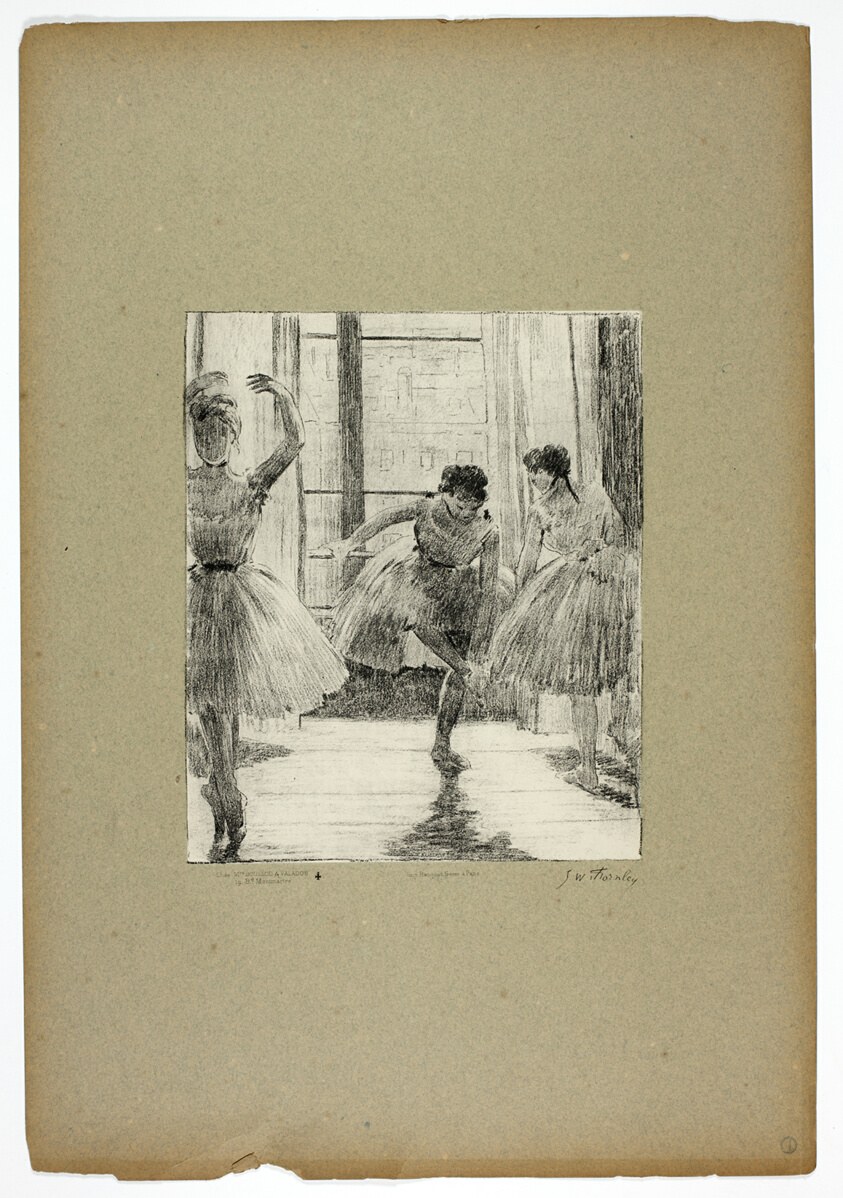
Three young female dancers in a studio or rehearsal space, moments before or during a ballet class. The central figure stands in profile, weight forward on one leg in an active pose, her arms raised and body oriented toward the left. The two flanking figures—one at left, one at right—frame her composition; the leftmost dancer's arm raises overhead while the rightmost observes. All three wear pale, voluminous tutus with fitted bodices, their skirts rendered in fine parallel lines suggesting the tulle's texture and movement. The setting is austere: bare walls with high windows admitting pale light, and what appears to be a ballet barre or studio furniture suggested in the background. The lithographic medium captures the brittleness and immediacy of a moment of instruction or rehearsal, the dancers' postures suggesting attentiveness and readiness.
The dancing
The central dancer's weight distribution, forward and engaged, suggests she is demonstrating or executing an adage or petit allegro phrase. Her raised arms—not in a formal closed fifth or classical frame, but more naturalistic and instructional—indicate an active teaching or learning moment rather than a finished performance. The flanking figures maintain an upright, attentive bearing; their placement suggests they are waiting their turn or observing correction. The artist has captured the dancers' bodies in a state of controlled tension, with elongated necks and lifted spines typical of ballet training, though the poses are less codified than a stage tableau.
The dance depicted
This is a rehearsal scene from classical ballet practice in the late 19th century. The tutu style, the studio setting, and the pedagogical arrangement strongly suggest a French ballet academy or company's daily class routine. The central figure's active, engaged stance and the presence of instruction—indicated by the arrangement of the three dancers—points to a moment within the lesson, likely during a combination or adage work. The image documents how ballet was taught and practiced in this era: in intimate groups, with close observation of demonstrated technique, and with an emphasis on line and carriage. The specific choreography cannot be identified, but the scene's authenticity suggests the artist observed actual rehearsal practice.
How it was made
This is a lithograph, a printmaking technique in which an image is drawn on stone with a greasy crayon and then inked and printed. The catalogue attributes it to Thornley after Degas, indicating that Thornley created this print based on a Degas composition—likely a pastel or drawing. Lithography allowed for broad circulation of fine artworks at relatively modest cost, making it the preferred medium for art reproduction and popular imagery in the late 19th century. The technique's ability to capture fine tonal gradations and spontaneous linear marks suits the intimate, observational character of the scene; we are seeing a studio moment interpreted through two artists' hands, a common practice of the period that extended the reach of celebrated painters' compositions.
About this work
This lithograph presents a pedagogical moment from the ballet studio: three dancers in practice clothes, one actively demonstrating or executing a phrase while the others watch and wait. The work is a reproductive print, created by the engraver Georges-William Thornley working from a composition by Edgar Degas, one of the painter most closely associated with ballet subjects in the 19th century. It documents both a specific dance practice—the daily ballet class—and the apparatus through which that practice was circulated and understood in visual culture. As a print after Degas, it extended access to ballet imagery beyond collectors of unique paintings, making the studio and its rituals visible to a broad middle-class audience interested in art, theater, and modern life. The work sits at the intersection of fine art and popular print culture, and of artistic observation and pedagogical practice.
How to look at it
Observe the central dancer's posture and the direction of her gaze or weight; the artist has frozen a moment of active instruction, not a finished pose. Notice how Thornley's lithographic line conveys the texture and weight of the tutus through parallel hatching, a technique that suggests movement and volume without explicit modeling. Pay attention to the spatial relationships: the three dancers occupy a narrow, compressed space, and the high vantage point (typical of Degas's compositions) makes the studio feel intimate and contained. The rendering of light through the windows, and the stark simplicity of the setting, emphasize the pedagogical nature of the scene—this is not theater, but work.
The artist
Edgar Degas (1834–1917) was a French painter and printmaker who made ballet one of his most sustained and celebrated subjects across five decades. He attended rehearsals, observed dancers in studios and backstage, and developed an unparalleled visual archive of ballet practice, costume, physiology, and social dynamics. His approach was neither celebratory nor romantic; instead, he treated the studio and stage with the same searching realism he applied to laundresses and cafe scenes, capturing awkward postures, moments of instruction, fatigue, and the precise mechanics of training. Georges-William Thornley (1857–1935) was a skilled reproductive engraver and lithographer who worked extensively after Degas's compositions, translating pastels and drawings into prints that extended the artist's reach and secured his reputation beyond Paris. The print was published by Boussod, Valadon & Company, one of the major art publishers and dealers of the period.
The period
The 1880s and 1890s saw ballet in France firmly established as a subject for modernist visual art. Degas's repeated studies of the Paris Opera's dancers coincided with broader interest in representing labor, training, and the female body in art and literature. The ballet studio—backstage, unglamorous, and structured around discipline and hierarchy—became a metaphor for modernity itself: industrialized, hierarchical, and yielding bodies shaped by repetition and instruction. At the same time, reproductive lithography was at its height as a technology for circulating fine art imagery, and works like this one made Degas's radical compositions accessible to middle-class print collectors and audiences who might never see the original pastel. The late 19th century also saw increased interest in dance as a subject for documentary-style imagery, partly driven by new camera technology but also by artists' fascination with capturing motion and transient moments.
Where it lives
This lithograph is held in the Prints and Drawings collection of the Art Institute of Chicago and was acquired as a work on paper within the museum's holdings. It is a reproductive print, created in 1889 by Thornley and published by Boussod, Valadon & Company, a major art publisher of the period. As a reproductive work, it represents the standard practice of the era for extending the circulation and audience of celebrated paintings and drawings.
Dance in this work
Questions about this work
Is this a Degas original?
No. This is a lithograph by Georges-William Thornley created after a Degas composition. Degas likely drew or painted the original (now often housed separately), and Thornley translated it into print form. This was a common and respected practice in the 19th century, and such prints both extended the artist's reputation and provided income to skilled reproductive engravers.
Where is the ballet barre?
The barre—the wooden rail used for warm-up exercises—is suggested rather than clearly depicted in the background. Degas often downplayed the barre in favor of focusing on the dancers' bodies and poses. The studio setting is more impressionistic than documentary.
What is the central dancer doing?
She appears to be executing or demonstrating a step or phrase during a ballet lesson, with one leg working and her arms in an instructional position. The exact choreography cannot be identified, but her engaged posture and the attention of the other dancers suggest an active moment of training rather than a rest position.
Why did Degas paint ballet so much?
Degas was fascinated by the ballet studio as a microcosm of modern life—a place of labor, discipline, hierarchy, and bodily transformation. He was also interested in capturing unusual perspectives and moments of spontaneity, which ballet training provided. His repeated attention to the subject helped establish the dance studio as a worthy subject for fine art.
More dance artwork





