49 works in this view — arrow keys or swipe to move between them.
Dance in Art
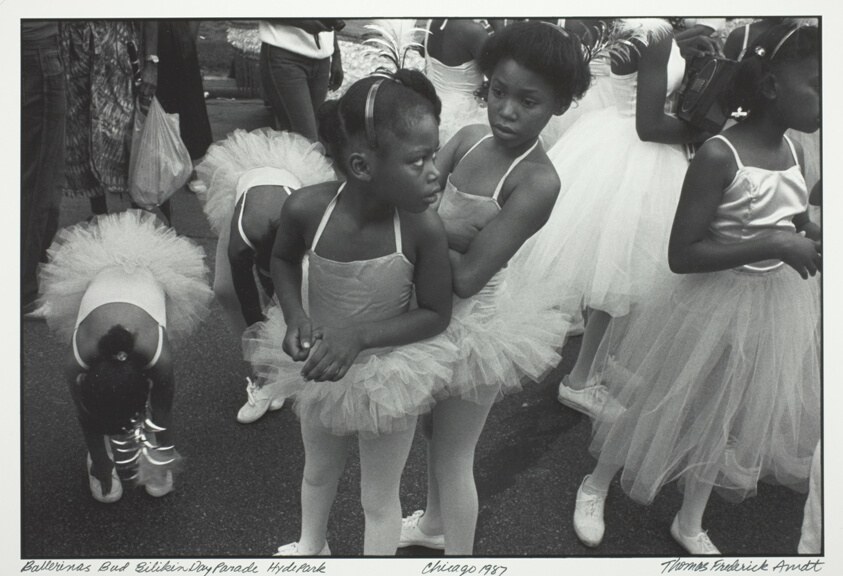
Ballerinas, Bud Bilikin Day Parade, Hyde Park, Chicago
Thomas Frederick Arndt American, born 1944
- Medium:
- Gelatin silver print
- Collection:
- Photography and Media
- Source:
- Art Institute of Chicago
- Rights:
- Rights reserved by the holding institution — do not reuse without permission. Source record ↗
- Recorded as:
- AIC — rights reserved
This photograph is important evidence of classical ballet's presence in African American communities and the work of Black dance educators and families in accessing and maintaining ballet training during the 1980s. It shows ballet dancers not in a concert hall or competition, but in a public parade, suggesting how the art form moved through everyday Black urban life. For dancers and historians, it complicates the narrative of ballet's demographics and geographic reach, and preserves a moment of cultural specificity that studio portraiture or stage photography would not capture.
What you are looking at
A black-and-white photograph captures young Black dancers in white tutus at an outdoor community event, likely the Bud Billiken Day Parade in Hyde Park, Chicago. The image is densely composed, showing multiple figures arranged in depth, with adult supervisors and spectators visible in the background. The nearest dancer, center-left, stands in profile wearing a classic ballet tutu and pointe shoes, her body upright and composed. To her right, another young dancer in similar dress gazes downward with a concentrated expression. A third dancer is visible further back. The setting is clearly urban and festive—a street parade—but the photograph captures a moment of stillness and focus despite the crowd around them. The lighting is natural daylight, casting soft shadows that emphasize the volume of the tutus. The overall effect is documentary: this is a record of a specific cultural moment, not a staged studio photograph.
The dancing
The dancers are young children, probably aged 5–10, standing in ballet posture with weight centered and spines extended. The nearest dancer holds her arms in a relaxed position at her sides or slightly forward, her frame upright in classical ballet alignment. The visible dancers show no active movement—they appear to be pausing, waiting, or preparing, rather than dancing mid-phrase. Their tutus are full and layered, suggesting professional-grade costume. The stillness and composed bearing suggest training, though the outdoor, crowded setting makes extended technical movement impossible. Adult hands are visible at the edges, steadying or supporting the children.
The dance depicted
These are young ballet dancers, almost certainly trained in classical ballet technique, performing or preparing to perform in a public parade. The Bud Billiken Day Parade was a major annual African American community celebration in Chicago, and the presence of tutus and pointe shoes indicates this was an organized performance by a ballet school or dance company. The image shows ballet's presence in African American cultural life in the 1980s, a period when Black classical ballet training and performance were expanding in urban communities, though still uncommon relative to white-dominated professional ballet. The photograph does not capture active dancing but rather the disciplined waiting and presentation that precedes or frames it.
How it was made
This is a gelatin silver print—a photographic negative printed on light-sensitive paper—characteristic of mid-20th-century documentary and fine-art photography. Gelatin silver prints are valued for their tonal range and archival permanence. The medium allowed Thomas Frederick Arndt to capture candid, real-time moments with shallow depth of field and natural light, creating an intimate record of a public event. Black-and-white photography removed color distraction and emphasized gesture, texture (the tutus' layers), and the social composition of the scene. As a print, it would have circulated in galleries, photography exhibitions, and archival collections rather than mass media.
About this work
This photograph documents a moment from the Bud Billiken Day Parade in Chicago in 1987, showing young Black classical ballet dancers waiting or pausing amid a festive crowd. It is a rare visual record of Black children in ballet training in an urban, community context during the 1980s. The work sits at the intersection of dance documentation, social history, and fine-art photography; it preserves not a virtuosic performance but the everyday discipline, presentation, and cultural presence of young dancers in their community. The image matters because it shows ballet—historically coded as white, elite, and European—embedded in African American urban culture and presented as a normal, valued part of children's education and community celebration.
How to look at it
Attend to the posture and focus of the nearest dancer: her composed frame and downward gaze suggest discipline and concentration, not play or spontaneous movement. Notice the layering and volume of the tutus, which required investment in costume and training. Observe how Arndt has positioned the camera to show the dancers within their crowd rather than isolated against a neutral backdrop—this compositional choice emphasizes that these are community members, not distant professionals. The black-and-white medium strips away color and draws attention to gesture, texture, and the social relationship between the dancers and the adults and spectators surrounding them.
The artist
Thomas Frederick Arndt (born 1944) is an American photographer known for documentary and fine-art photography, often focused on social life, community, and vernacular American culture. Working primarily in black-and-white gelatin silver prints, Arndt developed a practice centered on careful observation of public moments and intimate social scenes. His work from the 1980s, such as this image, reflects the documentary photography tradition's interest in authentic, unmediated social life rather than formal portraiture.
The period
In 1987, Black classical ballet was undergoing significant growth in American cities, supported by programs like Dance Theatre of Harlem (founded 1969) and by independent Black-owned ballet schools. The 1980s saw increased visibility of Black dancers in classical ballet, though the profession remained demographically skewed. The Bud Billiken Day Parade (established 1929) was by 1987 a long-standing and widely attended celebration of Black Chicago, and its inclusion of classical ballet reflects the community's embrace of diverse cultural forms. Simultaneously, documentary photography in the 1980s was increasingly engaged with questions of race, community, and the visual representation of African American life.
Where it lives
The work is held by the Art Institute of Chicago in its Photography and Media collection. It is a gelatin silver print from 1987, documented with photographer attribution and historical event information (the Bud Billiken Day Parade, Hyde Park, Chicago).
Dance in this work
Questions about this work
Were these dancers performing ballet or waiting in a parade?
The photograph appears to capture a pause or moment of waiting rather than active dancing. The dancers are standing in ballet posture, upright and composed, rather than in mid-movement. In a parade context, dancers often move briefly, then pause, then move again as the procession proceeds. Arndt has captured a moment of poised stillness—the discipline and presentation—rather than the dance itself.
What was the Bud Billiken Day Parade?
The Bud Billiken Day Parade is an annual celebration of African American culture and community held in Chicago, founded in 1929. By the 1980s it was one of the largest and oldest Black parades in the United States, featuring music, floats, civic organizations, and cultural performers. It served as a major venue for community organizations to present themselves publicly, including dance schools.
Why is this image important for the history of ballet?
Ballet in the United States was historically segregated and presented as a white, European-descended art form. This photograph documents classical ballet training and performance in an African American community context, showing how Black families, educators, and dancers claimed and practiced the form as part of their cultural life. It is evidence of a parallel history of ballet that existed outside the white mainstream institutions often centered in ballet histories.
More dance artwork





