49 works in this view — arrow keys or swipe to move between them.
Dance in Art
Ballet Class
Georges-William Thornley (French, 1857-1935) after Edgar Degas (French, 1834-1917) printed by Atelier Becquet (French, 19th century) published by Boussod, Valadon, & Company (French, 18th-19th century)
- Medium:
- Lithograph on paper
- Collection:
- Prints and Drawings
- Source:
- Art Institute of Chicago
- Rights:
- Public domain — free to use, share and adapt.
- Recorded as:
- CC0 (Public Domain)
Degas invented the visual language for depicting ballet as a working practice. This print, circulated commercially in 1889, reached audiences beyond the opera house and showed dancers not as ethereal performers but as trained athletes conditioning their bodies in unglamorous studios. It remains one of the most influential artistic documents of how ballet was actually taught and rehearsed.
What you are looking at
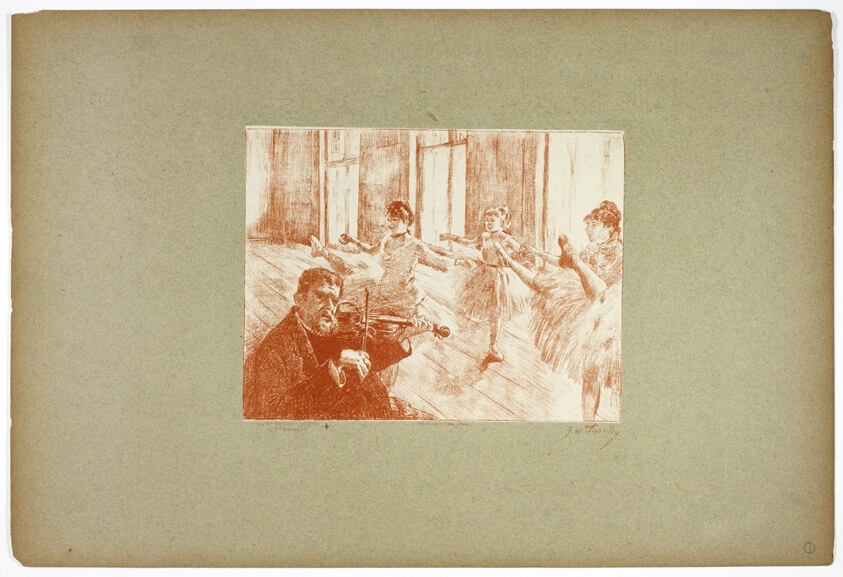
A rehearsal studio scene alive with concentrated activity. A male violinist sits in the left foreground, drawn in bold burnt-orange lines, his instrument raised and bow drawn across the strings. He is the anchor of the composition, positioned low and close to the viewer's eye. Behind and around him, four female dancers in practice clothes move through the studio: one stretches or bends at center-left, another stands upright at center, a third reaches an arm upward at right, and a fourth sits or reclines at far right. The setting is spare—wooden floorboards rendered in parallel hatching, tall windows with pale panes rising behind the figures. The lithograph technique produces a warm monochromatic palette, the figures defined by line weight and hatching rather than tonal modeling. The composition is informal and observational, capturing a moment of active work rather than performance.
The dancing
The dancers display the varied, individual postures of a working rehearsal. One figure leans forward in what appears to be a warm-up stretch; another stands with weight distributed naturally, watching or waiting; a third has lifted an arm in an extended gesture; the fourth is low and grounded. None hold classical ballet's formal closed positions. The bodies are spare and economically drawn, their weight convincingly distributed through the floorboards. The violinist, drawn with heavier line, commands spatial and visual priority—he is the focus, the measure-giver. The scale relationships suggest an intimate, human space rather than a grand stage.
The dance depicted
This is a ballet class or rehearsal, most likely Romantic-era ballet in the 1870s–1880s. The presence of a live violinist indicates professional or semi-professional training at a Paris opera house or academy. The informal variety of poses—some standing, some stretching, some resting—is characteristic of a teaching moment rather than a choreographed sequence. The dancers' light practice dress and bare or soft-shod feet suggest an open studio rather than performance. This is Degas's subject matter at its core: the workaday ballet world, where dancers condition their bodies and wait for instruction, not the spectacle of the stage.
How it was made
This is a lithograph printed by the Atelier Becquet, a commercial studio. Lithography—a planographic printing process in which image and non-image areas sit on the same flat surface—allowed quick reproduction and wide distribution. The warm orange-red ink and the quality of the line, with its gestural sensitivity and capacity for both fine detail and bold accent, are characteristic of 19th-century lithographic printing. This was not a unique artwork but a multiple, likely affordable and accessible to middle-class collectors. The technique suited Degas's drawing style perfectly: his linear emphasis and his preference for describing form through line rather than modeling in tone translate directly to the lithographic plate.
About this work
This is a lithographic print after an Edgar Degas painting or drawing, produced in 1889 and published by the Paris firm Boussod, Valadon & Company. It captures a ballet class in mid-session, with a violinist at work and four dancers in various poses of preparation, stretching, and rest. The work is typical of Degas's lifelong engagement with the Paris Opera ballet—a subject he pursued not for its romantic spectacle but for its material reality: the training regimen, the bodies at work, the unglamorous studio environment. The lithograph format made this intimate studio scene widely available to a 19th-century Paris public. It belongs here because it documents what professional ballet training actually looked like in the 1870s, and because it established a visual vocabulary for showing ballet as labor rather than illusion.
How to look at it
Attend first to the violinist: he is not background but protagonist, the measure and pulse of the room. Notice how Thornley (or Degas before him) has positioned him in the lower left, close to the viewer, commanding attention through line weight and visual solidity. Then follow the dancers' gazes and postures: some are oriented toward the violinist, implicitly listening; others are turned inward, absorbed in their own bodies. The composition is asymmetrical and informal—this is not a balanced academic composition but an observed moment. Look at how the figures overlap and seem to occupy real space, stepping behind one another, receding into the depth of the studio. The windows at the back and the wooden floor establish scale and light without any recourse to atmospheric perspective.
The artist
Edgar Degas (1834–1917) was obsessed with the Paris Opera ballet from the 1860s onward, making thousands of drawings, paintings, and prints of dancers in class, rehearsal, and backstage. He was granted unusual access to rehearsals and the foyer de danse (the dancers' practice room), and he used that privilege to produce an incomparably detailed visual archive of the ballet world. Degas did not work from life in the studio for these later works; instead, he drew from memory and study, composing scenes of observed poses and gestures. Georges-William Thornley (1857–1935) was a printmaker and painter who specialized in reproducing Degas's works in lithography, collaborating closely with him and with dealers to bring these studio scenes into wider circulation.
The period
In the 1870s and 1880s, ballet was undergoing a transition. Romantic ballet—with its emphasis on otherworldly, ethereal female dancers and supernatural scenarios—was giving way to a new aesthetic that prized technical display, male virtuosity, and increasingly, more athletic and naturalistic movement. In Paris, the Paris Opera Ballet remained the most prestigious institution, but it was also a site of labor and commerce, not just art. Simultaneously, lithography was evolving as a fine-art medium: it was no longer merely a commercial printing process but was being adopted by major artists as a vehicle for artistic expression, sold in small editions to collectors. The work was made in 1889, near the end of Degas's life, when his late style had become more interior and psychological—less committed to literal transcription, more interested in memory and impression.
Where it lives
This is a lithographic print from the collection of the Art Institute of Chicago, catalogued in the Prints and Drawings department. It was published by Boussod, Valadon & Company, a major Paris dealer and publisher of the late 19th century, in 1889. The Atelier Becquet was the commercial lithography studio responsible for the technical execution.
Dance in this work
Questions about this work
Did Degas draw this from life in a real ballet class?
Not this specific print. Degas did sketch from life in the Paris Opera's rehearsal rooms, but he worked from these sketches and memory in his studio, composing and recomposing scenes over years. This print is based on a Degas work but was executed by the lithographer Thornley, who was skilled at translating Degas's drawings into the lithographic medium. It is a mediated work, not a direct transcription.
What is the violinist doing?
Providing the music for the class. In professional ballet training of the 19th century, a live musician—usually a violinist or pianist—accompanied the dancers, playing simple melodies that marked the tempo and rhythm of each exercise. The violinist was as essential to ballet training as the ballet master himself.
Why is this a lithograph and not a painting?
Lithography allowed Degas's work to be reproduced and sold widely at a reasonable price. A single painted canvas reaches one patron; a lithograph printed in an edition of 100 or more reaches collectors across Europe. Degas and his dealers used lithography strategically to build his reputation and reach new audiences.
Is this a realistic depiction of a ballet class?
Yes, in its essentials. The poses, the clothing, the studio space, and the presence of a live musician all match what we know of Paris Opera ballet training in the 1870s–1880s from historical records and other Degas works. The composition is selective and artistic, but the details are faithful to observed practice.
More dance artwork





