49 works in this view — arrow keys or swipe to move between them.
Dance in Art
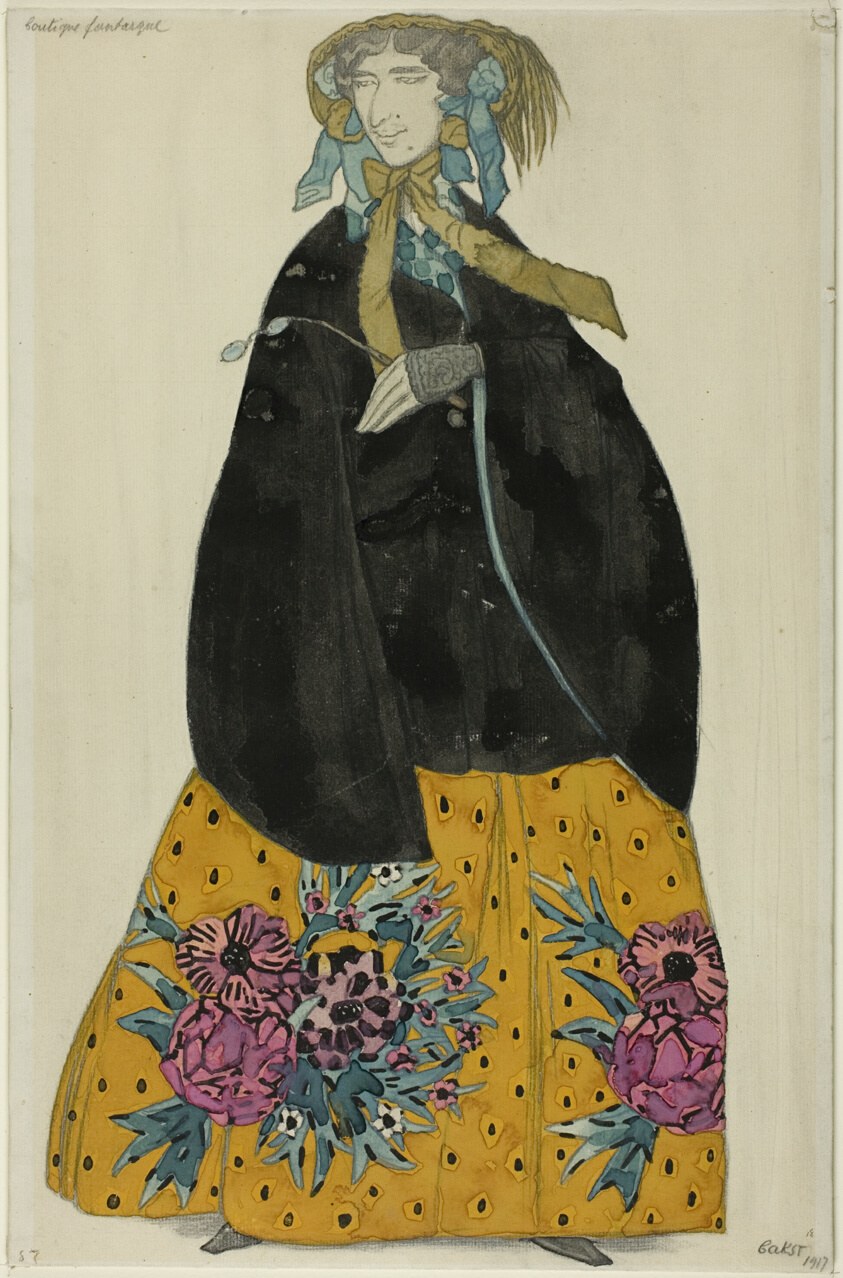
Costume Design for Woman in a Black Coat, for Ballet Boutique Fantasque
Léon Bakst Russian, 1868-1924
- Medium:
- Watercolor and graphite, with touches of gouache, on ivory laid paper, laid down on gray board
- Collection:
- Prints and Drawings
- Source:
- Art Institute of Chicago
- Rights:
- Rights reserved by the holding institution — do not reuse without permission. Source record ↗
- Recorded as:
- AIC — rights reserved
Bakst's designs shaped how the early twentieth-century European avant-garde imagined the body on stage. For historians of dance and costume, these drawings are primary evidence of the actual garments dancers wore and the visual vocabulary of modernist ballet. The work shows how costuming—weight, ornament, color, proportion—communicated character and narrative before a single movement was danced.
What you are looking at
A single female figure stands centrally against a pale ground, shown in three-quarter view facing slightly left. She wears a voluminous black coat that extends to mid-calf, with a notched collar and button front, worn open to reveal a golden-yellow skirt beneath decorated with large dark spots and bunches of pink and mauve flowers rendered in vivid watercolor. A gold-toned shawl or scarf drapes loosely from her shoulders. Her hair is styled in long waves and topped with an elaborate blue and gold bonnet or headdress with trailing ribbons and bows. Her face is rendered with refined, elongated features and a serene expression. A white handkerchief or sleeve shows at her wrist. The pose is static and frontal—this is a costume study, not a moment of dance action—but the figure's stance suggests elegant carriage, with weight settled and posture upright.
The dancing
A single standing figure in a stable, erect pose with no weight transfer, leg flexion, or dynamic movement. The arms hang naturally at the sides. This is a formal costume presentation rather than a captured moment of dancing. The figure's bearing is graceful and dignified, appropriate to theatrical display of a woman's role costume.
The dance depicted
This is a costume design for Ballet Boutique Fantasque, a 1919 Diaghilev ballet created by Léonide Massine with music by Lord Berners. The figure wears the costume of a character woman (likely a vendor or eccentric female character in this satirical pantomime). No dance movement is depicted; the image serves as a costume proposal rather than documentation of choreography. The role would have involved theatrical movement and pantomime within the ballet's narrative, but those qualities cannot be inferred from this static presentation.
How it was made
Watercolor and graphite with touches of gouache on laid paper, laid down on gray board. The technique allows rich color saturation in the skirt's floral ornament and the yellow ground, while the coat's black is built from careful washes. The layering of media creates depth and materiality, particularly in the textile patterns. As a design drawing for a professional ballet company, this object circulated within Diaghilev's organization as a working document and record, far more specialized in audience than a finished artwork for exhibition.
About this work
This is a costume design by Léon Bakst for a female character in the 1919 Ballets Russes production Ballet Boutique Fantasque. The drawing presents a single standing figure in period dress—a voluminous black coat over a dramatically patterned yellow skirt—rendered with Bakst's characteristic command of color and ornament. It is a working design document, not a depiction of dance, but it offers insight into the visual language of early twentieth-century theatrical costuming and into Bakst's role as the Ballets Russes's defining visual artist.
Bakst's costume designs were crucial to the company's success and innovation. They are held as artworks in their own right—valued for their color sense, historical significance, and influence on fashion and stage design. This drawing exemplifies his method: meticulous attention to silhouette, bold patterning, and harmonious color—here, the interaction of black, gold, and pink, grounded in the pale neutral ground that makes them sing.
How to look at it
This is a costume proposal, not a choreographic document. Look at it as you would a fashion illustration or a theater design: attend to the silhouette, the proportions of the coat and skirt, the visual weight and balance created by color and pattern. The black coat creates a vertical frame; the yellow skirt's bold spots and flowers draw the eye downward and outward, expanding the figure's visual presence. The headdress, ornate and asymmetrical with its trailing ribbons, adds height and whimsy. Notice how Bakst uses the pale ground as an active force, making the costume's colors vibrate. The static pose allows the dress itself to be the subject—its construction and ornament speak the character without movement.
The artist
Léon Bakst (1868–1924) was a Russian painter, set and costume designer, and a founding member of the Mir iskusstva (World of Art) movement. From 1909 until his death, he was the chief designer of the Ballets Russes, creating costumes and scenic designs for Diaghilev's most celebrated productions, including Scheherazade (1910), L'Après-midi d'un faune (1912), and The Rite of Spring (1913). His designs combined orientalism, modernist color theory, and historical reference into a visual language that defined early twentieth-century theatrical modernism. He was equally influential on fashion, and his work shaped taste beyond the theater.
The period
Ballet Boutique Fantasque was created in 1919, in the final chapter of the Ballets Russes under Diaghilev's leadership. By this date the company had already revolutionized European dance and visual culture through collaborations with Picasso, Matisse, and other avant-garde artists. Bakst's dominance as designer had begun to wane as Diaghilev turned toward other aesthetics, but this costume demonstrates his continued command of ornamental fantasy and theatrical elegance. The ballet itself was a lighthearted pantomime in the spirit of commedia dell'arte, allowing Bakst to exercise a playful, decorative vocabulary distinct from the orientalism and exoticism of his earlier triumphs.
Where it lives
The drawing is held in the Prints and Drawings collection of the Art Institute of Chicago. It is a working design document from the archives of the Ballets Russes, likely retained by Diaghilev's organization or acquired subsequently by the museum. Such drawings are rare primary documents of theatrical production and costume history.
Dance in this work
Questions about this work
Is this a painting or a drawing?
It is a drawing in mixed media: watercolor and graphite (pencil), with additions of gouache (opaque watercolor), on paper that has been adhered to a backing board. This is a standard technique for theatrical costume designs of the period, combining precision of line with richness of color. The combination of media allowed Bakst to work quickly and expressively while maintaining fine detail.
Who was Léon Bakst?
Bakst was a Russian painter and designer (1868–1924) best known as the chief costume and set designer of the Ballets Russes, Diaghilev's revolutionary company. His designs—combining bold color, historical and exotic reference, and modernist composition—shaped early twentieth-century theater and influenced fashion and fine art. He is considered one of the most important theatrical designers of the era.
What was Ballet Boutique Fantasque?
A 1919 ballet created by Léonide Massine with music by Lord Berners, presented by the Ballets Russes. It was a satirical pantomime depicting the contents of a shop—a lighter, comedic work in contrast to the company's more ambitious modernist ballets. The 'woman in a black coat' was one of several character roles in its narrative.
Why is a costume design included in a gallery of dance in art?
Costume is inseparable from dance. How a body moves, appears, and is perceived on stage depends on the clothes it wears. Bakst's designs were not decoration added after choreography was finished; they were integral to the conception of a role and the visual world of a ballet. These drawings are documents of how dancers embodied character and narrative through the union of movement and costume.
More dance artwork





