49 works in this view — arrow keys or swipe to move between them.
Dance in Art
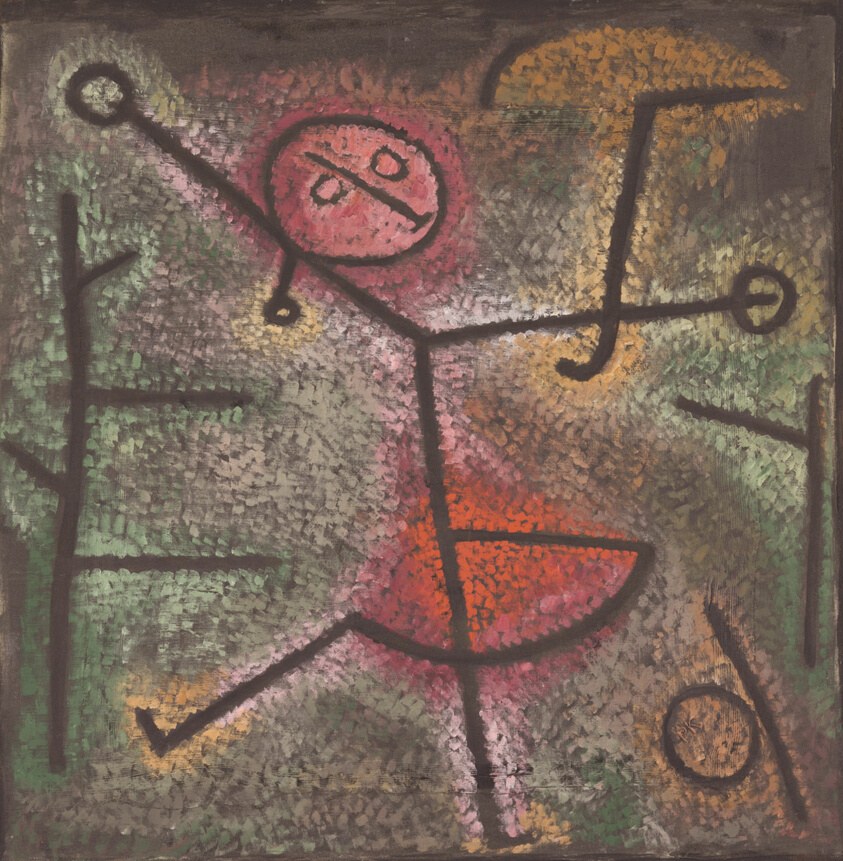
Dancing Girl
Paul Klee German, born Switzerland, 1879–1940
- Medium:
- Oil on cloth
- Collection:
- Modern Art
- Source:
- Art Institute of Chicago
- Rights:
- Rights reserved by the holding institution — do not reuse without permission. Source record ↗
- Recorded as:
- AIC — rights reserved
Klee's *Dancing Girl* exemplifies how modernist artists reimagined dance not as spectacle or social practice but as a vehicle for exploring abstraction, emotional expression, and the liberatory potential of the human body. For dance historians, this work demonstrates how dance entered the vocabulary of twentieth-century visual art as a symbol of freedom, spontaneity, and resistance to academic formalism—concerns shared by both avant-garde painters and experimental choreographers of the period.
What you are looking at
A schematic figure in brilliant pink-red dominates the center of this oil painting, set against a textured ground of ochre, green, and muted earth tones that suggest an interior or abstract space. The figure is rendered in bold black outline with a simple circular head marked by two closed eyes and a horizontal line for a mouth—a primitive or expressionist rendering that strips away anatomical detail. The body consists of a segmented torso in orange-red, with limbs reduced to thin black lines that extend outward in an open, exuberant pose: one arm curves upward in an arc, the other extends to the side, while the legs are splayed in a wide stance. On either side of the figure, dark vertical elements frame the composition—possibly architectural forms or abstract dividers. The background is executed in a dense, crushed-looking texture using muted greens, browns, and yellows, creating visual weight and intimacy that contrasts sharply with the figure's clarity and energy.
The dancing
The single figure occupies an open, almost celebratory stance with both arms raised and legs wide apart—a configuration suggesting freedom of movement and uninhibited gesture. The body is simplified to its essentials: a cylindrical torso, articulated limbs, and a minimal face. There is no suggestion of turnout, alignment, or formal technique; instead, the pose reads as spontaneous, even ecstatic. The figure appears weightless, floating in the compressed space, with no grounding or interaction with other bodies.
The dance depicted
This work does not depict a recognizable dance tradition or style. Instead, it appears to represent the concept or spirit of movement and dance in abstract or expressionist terms. The figure's pose—open, gestural, uncontrained—aligns more with modern expressive movement or the artist's internal vision of dance freedom than with any specific choreographic practice. The simplified, almost childlike rendering suggests an emotional or psychological rather than technical approach to the subject.
How it was made
The work is executed in oil on cloth, a relatively intimate medium that allows for the visible texture and layering visible in the background. The artist has used a reserved palette of earths and muted tones beneath and around the vivid central figure, creating visual contrast through color rather than line alone. The dense, stippled or scumbled texture of the background—achieved through repeated application or manipulation of paint—gives the work a tactile, surface-conscious quality. This technique suggests a modernist engagement with the materiality of paint itself rather than illusionistic representation.
About this work
This is a modernist interpretation of dance, a subject that fascinated Paul Klee throughout his career. Rather than documenting a dancer or a specific dance form, the work uses simplified figuration and expressionist color to convey an interior sense of movement, joy, and bodily freedom. The 1940 date places it in Klee's final years, when his work had become increasingly reductive and spiritual in character, often approaching abstraction while retaining a human or organic core. The painting sits at the intersection of Dada and early Surrealism—movements that valued intuition, play, and the liberation of form from naturalistic constraint—and offers a meditation on dance as a fundamental human impulse rather than a technical achievement.
How to look at it
Attend to the figure's pose and what it conveys: an opening rather than a closing, an outward expansion of limbs that suggests joy or liberation. Notice how the artist has denied the figure any anatomical sophistication—there is no suggestion of trained movement, no evidence of balletic alignment or modern dance technique. Instead, observe how the simplified form and vivid color create emotional immediacy. The contrast between the figure's clarity and the textured, almost muddied background invites you to see the dancer as an emergent or transcendent presence—a spirit of movement appearing from or within the material world. The closed eyes of the figure suggest interiority, even trance: this is dance as inner experience rather than external performance.
The artist
Paul Klee (1879–1940) was a Swiss-German painter, draughtsman, and printmaker whose work bridged Expressionism, Cubism, Dadaism, and Surrealism. Throughout his career, Klee developed a distinctive visual language combining geometric abstraction with organic, often biomorphic forms, frequently informed by music, mathematics, and folklore. He taught at the Bauhaus from 1921 to 1931, where he influenced a generation of artists and designers. His late work, including works from 1940, became increasingly symbolic and introspective, often dealing with themes of mortality, spirituality, and the essence of life itself. Klee's interest in dance was longstanding and appeared in numerous works across his career; for him, dance embodied movement, rhythm, and the transformation of material into spirit.
The period
The 1930s and 1940s were a period of profound upheaval in Europe. The rise of fascism, which branded Klee's work as "degenerate," led to his exile from Germany in 1933. Klee relocated to Switzerland, where he continued to work despite illness in his final years. Simultaneously, modern dance was undergoing radical transformation: the early twentieth-century pioneers of free or interpretive dance—Isadora Duncan, Mary Wigman, and others—had established dance as a medium for personal and political expression distinct from classical ballet. Klee's *Dancing Girl* reflects this cultural moment, in which dance was increasingly seen as a vehicle for individual freedom and emotional authenticity rather than technical virtuosity. The painting's reductive, almost primitivist style also echoes the era's interest in non-Western and folk art traditions as sources of authenticity and vitality.
Where it lives
The work is held in the Modern Art collection of the Art Institute of Chicago. It represents the institution's commitment to documenting the intersection of modernism and human expression across media.
Dance in this work
Questions about this work
Is this a real dancer or a specific dance Klee witnessed?
The title *Dancing Girl* suggests a generic or archetypal figure rather than a portrait of a particular dancer. Klee's practice generally moved away from representation toward abstraction and expression; this figure is best understood as Klee's invented symbol of dance and movement rather than documentation of an actual performance or person.
Why does the figure look so childlike or primitive?
This simplification is deliberate and characteristic of Klee's approach, especially in his late work. By stripping away anatomical detail and academic drawing, Klee aimed to access something more essential or universal about human movement. He was influenced by non-Western and folk art traditions, which he valued for their directness and spiritual power. The simplified form also reflects Dadaist and Surrealist interest in the irrational and anti-academic.
What kind of dance is this, if any?
This is not a representation of a specific dance form—not ballet, folk dance, or even recognizable modern dance. Instead, it is an expression of dance as concept: movement, freedom, and the transformation of the body into pure gesture. It aligns more closely with the spirit of early modern dance, which valued individual expression and emotional authenticity over technical codification.
More dance artwork





