49 works in this view — arrow keys or swipe to move between them.
Dance in Art
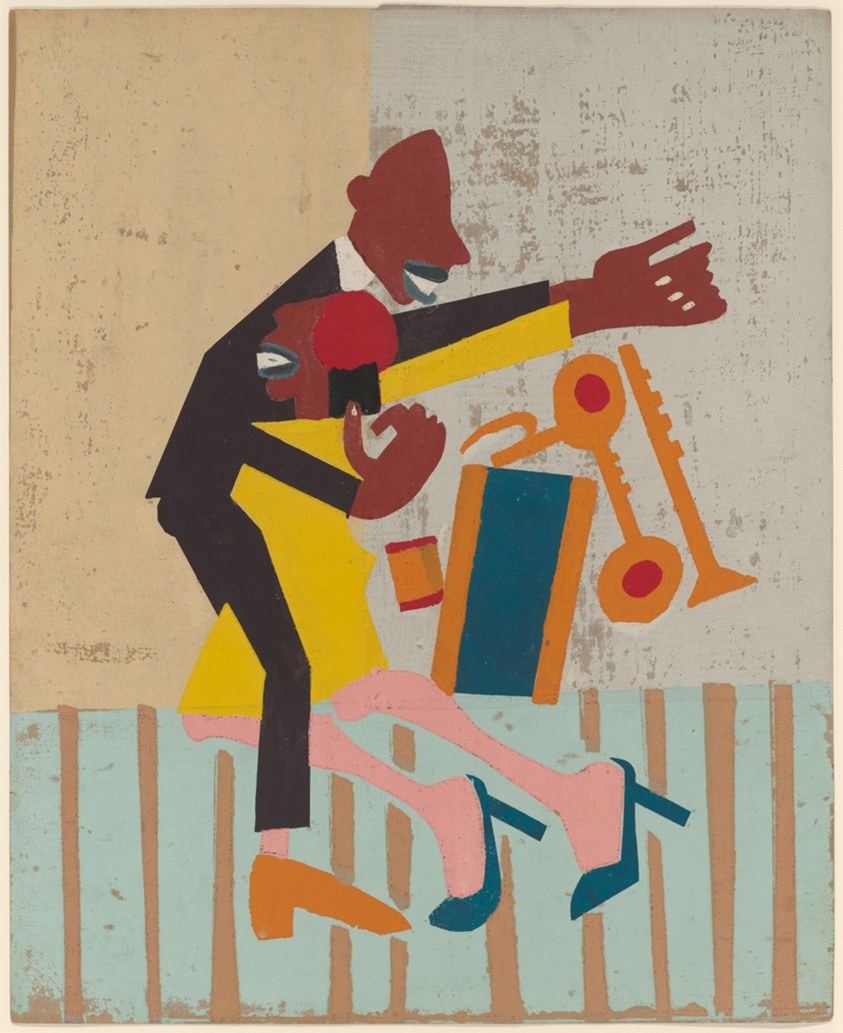
Jitterbugs II
William H. Johnson American, 1901-1970
- Medium:
- Color screenprint on wood-pulp board
- Collection:
- Prints and Drawings
- Source:
- Art Institute of Chicago
- Rights:
- Rights reserved by the holding institution — do not reuse without permission. Source record ↗
- Recorded as:
- AIC — rights reserved
This is one of the few modernist visual artworks that treats African American swing dance and jitterbug as worthy of serious artistic attention during the 1930s, when the form was often dismissed as crude or primitive by white institutions. Johnson's formal innovation—his refusal of naturalistic representation—argues that this dance deserved the same avant-garde treatment as European ballet or folk traditions.
What you are looking at
A dynamic composition showing a couple in vigorous mid-swing, rendered in bold flat color and simplified forms characteristic of modernist screenprint. The male figure, rendered in dark brown-black with a prominent maroon head, leans backward in an exaggerated pose of abandon, his torso at a sharp angle. The female figure, in yellow and pink, has her legs kicked upward and apart in a high kick, her body extended and energetic. A large maroon/red geometric shape suggesting a musical instrument—likely an accordion or similar squeezebox—dominates the right side of the composition in orange and teal. The ground is suggested by a pattern of tan and pale blue vertical stripes. The overall effect is one of explosive joy and movement, with the figures seeming almost to levitate from the rhythmic surface below.
The dancing
The male dancer supports and propels the female dancer in what appears to be an aerially inverted or near-horizontal orientation; her legs are splayed wide and high, suggesting she is being swung or thrown rather than performing a grounded step. His posture shows the muscular tension of a lead absorbing and redirecting energy. The proportions are deliberately distorted—elongated limbs, simplified hands as geometric shapes—which emphasizes motion over anatomical accuracy. The spatial relationship shows the female dancer almost perpendicular to the male, her weight entirely dependent on his support, typical of aerially assisted swing moves.
The dance depicted
This is unambiguously a jitterbug or swing dance scene, the title reinforces this. Jitterbug was the popular American swing vernacular of the 1930s–40s, characterized by aerial moves, high-energy kicks, and the kind of dramatic lead-and-follow dynamic depicted here. The artist has captured the moment of a throw or aerial inversion, where the follower is lifted and rotated, feet off the ground—one of the signature moves of competitive and social swing. The instrument on the right suggests a jazz or swing band context, the music-making world these dancers inhabited.
How it was made
Color screenprint on wood-pulp board is stated in the record. Screenprint's bold graphic quality—flat planes of color, high contrast, limited palette (maroon, yellow, pink, teal, tan, brown-black)—is evident throughout. The technique required separating the design into discrete color layers, which here has produced clean, flat shapes and strong outlines. Wood-pulp board is cheaper and more porous than fine art paper, suggesting this was made for circulation and reproduction rather than as a unique fine art object. The intentionally modernist, almost Constructivist style—geometric abstraction, dynamic diagonals, social subject matter—aligns with 1930s American printmaking and social art movements.
About this work
William H. Johnson's *Jitterbugs II* is a modernist celebration of African American vernacular swing dance, captured at the moment of maximum exuberance and trust between partners. The work belongs to a lineage of American artists in the 1930s–40s who found in jazz and swing dance not frivolous entertainment but vital expression of creativity, physicality, and joy—especially for Black Americans excluded from ballroom institutions. Johnson's style here is deliberately non-naturalistic: the flattened forms, impossible angles, and saturated color move away from documentary realism toward expressive abstraction, making the emotional and physical intensity of the dance itself the subject rather than its surface appearance. The work sits at the intersection of two major American modernisms: the graphic revolution of screenprint and the social revolution of swing.
How to look at it
Look at the moment Johnson chose to freeze: not a ballroom hold or a grounded step, but the moment of flight and inversion, when the follower's weight leaves the ground entirely and control passes completely to the lead. Notice how the impossible angles—the male dancer's backward lean, the female dancer's splayed legs and upward trajectory—are made credible through the distortion of form rather than naturalistic proportion; this is how the artist renders the subjective experience of being swung, the sense of weightlessness and surrender. The musical instrument looming on the right is not background but a co-protagonist: the dance is inseparable from the music that drives it.
The artist
William H. Johnson (1901–1970) was an African American modernist painter and printmaker who spent formative years in Europe (1926–1938) before returning to the United States to engage directly with African American life and culture. He developed a distinctive style that combined lessons from European modernism—flattened perspective, bold color, simplified form—with subjects drawn from Black vernacular life: music, dance, religious practice, and work. Johnson was committed to making art that was both formally innovative and socially rooted. His swing and jitterbug scenes from the mid-to-late 1930s represent a deliberate turn toward subjects that other avant-garde artists ignored.
The period
In 1936, swing was at its cultural apex in urban American dance halls and clubs, but it remained largely invisible to the art world. The Harlem Renaissance had celebrated Black artistic production a decade earlier, but visual artists had rarely treated jazz dance itself as a serious subject. Simultaneously, screenprint and lithography were experiencing a major revival in the United States through the WPA and other Depression-era arts programs, which democratized printmaking and oriented it toward social and political themes. Johnson's embrace of both swing vernacular and modernist formal language positioned him ahead of mainstream art-world recognition of Black culture.
Where it lives
The work is held in the Prints and Drawings collection of the Art Institute of Chicago. It is a color screenprint, a reproductive medium designed for multiple impressions, and likely was one of several prints produced from the same design. The collection represents a major institutional recognition of Johnson's printmaking practice.
Dance in this work
Questions about this work
Is this really a jitterbug? The pose looks too extreme.
Yes. The aerial inversion Johnson depicts—where the follower is lifted and rotated with legs extended—was a signature move in competitive and social swing dance of the 1930s–40s. Jitterbug included aerially assisted throws that could indeed look this dramatic. Johnson was capturing not a static pose but the moment of maximum energy and flight.
Why does the artist distort the bodies so much? Couldn't he draw realistically?
Johnson had trained in European modernism and was deliberately rejecting naturalism in favor of expressive form. The distortion serves multiple purposes: it makes the figures dynamic and hard to ignore, it conveys the subjective sensation of being swung, and it aligns the subject (African American vernacular dance) with the formal language of European avant-garde art. The distortion is a choice, not a limitation.
What is the instrument on the right?
It appears to be an accordion or squeeze-box, a common jazz and swing band instrument. In some swing contexts it accompanied the dance. Johnson's inclusion of it emphasizes that this is not merely physical exercise but music-making and social gathering.
Why is this work in an art museum and not a jazz history collection?
Because Johnson was an avant-garde artist working in the modernist tradition, using screenprint and formal innovation. But the work is also a primary historical document of swing culture and how African Americans experienced and expressed joy and physicality in the 1930s.
More dance artwork





