49 works in this view — arrow keys or swipe to move between them.
Dance in Art
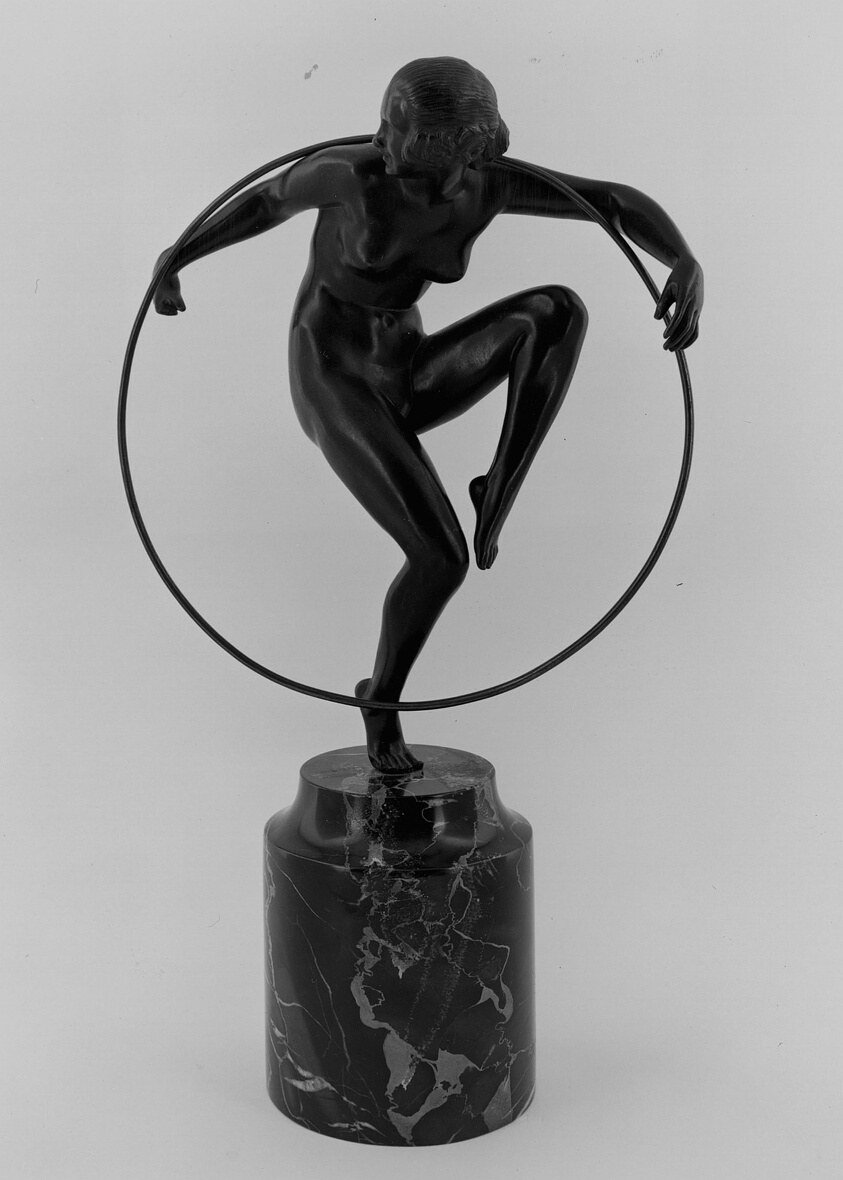
Dancing Woman with Hoop
Marcel Bouraine French, 1886-1948
- Medium:
- Bronze
- Collection:
- Modern Art
- Source:
- Art Institute of Chicago
- Rights:
- Rights reserved by the holding institution — do not reuse without permission. Source record ↗
- Recorded as:
- AIC — rights reserved
Bouraine's sculpture documents a performance tradition—acrobatic and circus arts—that is rarely preserved in visual culture as seriously as theatrical dance. The work insists that virtuosity in movement, whatever its context, is worthy of fine art rendering and permanent materials. It also reveals how early modernists understood the body: not as emotion or story, but as a site of geometric and muscular intelligence.
What you are looking at
A nude female figure, rendered in dark bronze or similar material, is captured in a dynamic moment of movement within a perfect circle—a geometric hoop held at her sides. She is balanced on one leg with the other raised high, her torso twisted and leaning forward, her arms extended to grip the hoop's rim. The figure's musculature is clearly articulated, showing tension and exertion. She stands on a cylindrical base of dark marble or stone with visible veining, which grounds the energetic composition. The photograph is taken against a neutral light ground, emphasizing the sculptural form and the dramatic contrast between the figure's active pose and the static geometry of the hoop.
The dancing
The dancer is in a high arabesque or attitude position, with her weight supported on a straight standing leg while the other leg extends upward behind or to the side at an acute angle. Her torso is flexed forward in a pronounced contrapposto, creating a spiral through her spine. Both arms are extended horizontally or slightly above, gripping the circular form; her shoulders are engaged and drawn back despite the forward lean. The pose reads as mid-movement rather than static—a moment of muscular suspension and balance rather than rest.
The dance depicted
The subject appears to be acrobatic or circus-influenced movement, combining elements of rhythmic gymnastics or rope-work performance with what might be interpretive dance. The hoop is an object of manipulation and support rather than pure theatrical property; the dancer's relationship to it suggests virtuosic control and dynamic interaction. This does not appear to be ballet, modern dance, or any codified theatrical tradition, but rather a performance mode that bridged art and physical feat—typical of early 20th-century avant-garde performance, circus arts, and sculptural interpretation of the body in motion.
How it was made
This is a bronze sculpture, cast and finished to articulate the figure's anatomy with considerable precision. The photograph, a black-and-white studio image on archival paper, documents the three-dimensional work. Bronze casting allowed Bouraine to capture a momentary pose with durability and permitted fine detail in musculature, facial expression, and the interaction between figure and hoop. The polished surface and dramatic lighting emphasize form and shadow, lending the work both monumentality and intimacy—appropriate for an object intended for close viewing in an interior or gallery setting.
About this work
This is a small bronze sculpture by the French Art Deco artist Marcel Bouraine, depicting a female acrobat or dancer in an extraordinary pose of balance and flexibility, locked within a perfect hoop. The work sits at the intersection of figurative sculpture, dance representation, and the early 20th-century fascination with the human body at the limit of its capabilities. It belongs in a dance collection because it documents a real performance mode—circus and vaudeville acrobatics—and because Bouraine chose the precise moment of maximum bodily tension and grace, the instant that dancing is most visible and most suspended. The work celebrates not narrative or emotion but pure kinetic possibility.
How to look at it
Notice first the geometry: the circle encloses the figure without containing her, and her asymmetrical pose breaks the circle's perfection, creating visual tension. Observe the moment Bouraine chose—not the peak of an arc, but the instant of maximum muscular engagement and balance, when the body is fully alert and compressed. The raised leg and forward-leaning torso create a spiral that moves through the figure; this is not a repose but a snapshot of effort. Look at the contrast between the smooth, almost abstract quality of the hoop and the articulated, almost anatomical rendering of the body—the hoop is an object, the body is a living achievement.
The artist
Marcel Bouraine (1886–1948) was a French sculptor specializing in Art Deco figural work, with a particular interest in dancers, acrobats, and female nudes in active poses. He was part of a cohort of interwar sculptors—including Demetre Chiparus—who elevated circus and performance subjects to high art. His work was typically cast in bronze and often featured dynamic asymmetrical poses, clean lines, and an abstraction of form that married neoclassical anatomy to modernist design. Bouraine's sculptures were widely exhibited and collected, and circulated through commercial galleries and salons across Europe and America.
The period
The 1920s saw a genuine avant-garde interest in circus and music-hall performance as sources of authentic movement and visual excitement, distinct from both academic ballet and emerging modern dance. The Russian Ballet's engagement with circus themes, Constructivist appropriations of acrobatics, and the broader cult of the athletic body in interwar design all created a climate in which an acrobat could be a fit subject for fine sculpture. Simultaneously, Art Deco sculptors like Bouraine were translating late-19th-century Salon traditions of dynamic figural work into a more streamlined, geometric mode. This sculpture is the product of that specific moment when high art took circus seriously.
Where it lives
The work is held in the Modern Art collection of the Art Institute of Chicago (source: aic). This photograph is a formal documentation image, likely used for collection records, exhibition materials, or reproduction. It is a professional studio photograph of high quality and standard archival format.
Dance in this work
Questions about this work
Is this the same kind of hoop dance as modern aerial hoop or rhythmic gymnastics?
There is a lineage, but not identity. The modern circus discipline of aerial hoop (and contemporary flow arts) developed from earlier acrobatic and vaudeville traditions that used hoops as props and platforms. This sculpture likely documents a 1910s–1920s acrobatic tradition, quite possibly circus or music-hall work, which emphasized strength, balance, and dramatic posing. The artistic aspiration is similar—using the hoop as both support and graphic element—but the training systems and competitive structures are modern inventions.
Why is Bouraine depicting an acrobat, not a ballet dancer?
By the 1920s, the art world had become fascinated with circus and music-hall performance as sources of authentic, unconstrained movement. Academic ballet was seen as rigid and codified; acrobatics, by contrast, represented raw bodily intelligence and courage. Bouraine's contemporary Demetre Chiparus sculpted dancers in similar acrobatic poses. It was also a practical advantage: the acrobat's extreme poses allowed sculptors to create more dramatic, graphically striking compositions than the conventions of ballet would permit.
Is this a study or a finished work?
This appears to be a finished, saleable sculpture. The bronze is polished and complete, the base is finished marble, and the work has the refined proportions and surface treatment typical of Bouraine's commercial output. Smaller sculptures like this were produced in editions and sold through galleries, making them accessible to middle-class collectors. It is not a maquette or preliminary study.
What does the hoop mean?
The hoop is simultaneously a practical support (the acrobat's prop and platform), a geometric frame (modernist, pure form), and a symbolic boundary—suggesting both containment and the body's capacity to exceed it. The figure breaks the circle's static perfection through her own dynamic energy. It may also reference the circus ring itself, asserting that this performance tradition belongs in galleries as much as under canvas.
More dance artwork





