49 works in this view — arrow keys or swipe to move between them.
Dance in Art
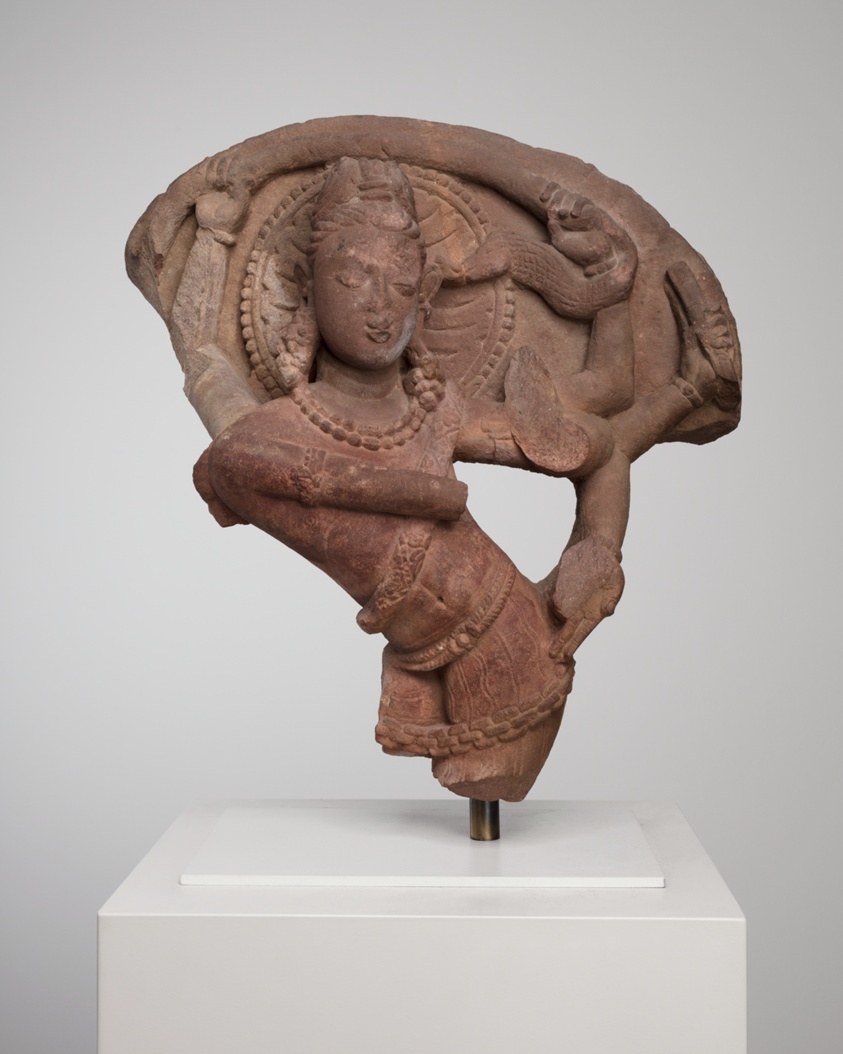
Dancing God Shiva (Natesha)
India Rajasthan
- Medium:
- Sandstone
- Collection:
- Arts of Asia
- Source:
- Art Institute of Chicago
- Rights:
- Public domain — free to use, share and adapt.
- Recorded as:
- CC0 (Public Domain)
For dancers in Indian classical traditions, this image represents the original—the divine template against which all human performance is measured. For art historians of the period, it shows how thoroughly dance was embedded in religious imagination and temple practice. The pose itself appears in texts, in later sculptural traditions, and in every Bharatanatyam performance: understanding Nataraja is understanding the foundational grammar of South Asian dance.
What you are looking at
A sandstone relief sculpture depicts a single figure in dynamic motion, carved in high relief against a neutral background. The figure wears elaborate jewelry and ornaments—a detailed breastplate, arm bracelets, and a decorative collar—rendered with fine linear hatching that suggests metalwork. The body is captured mid-movement: the torso twists, one leg bends sharply at the knee while the other extends, and the arms curve upward in an arcing gesture. The head tilts slightly, adorned with an ornate headdress or crown. The sculptor has used the depth of the relief to create shadow and volume, giving the figure substantial three-dimensionality. The carving shows sophisticated understanding of anatomical structure beneath the ornamental surface.
The dancing
A single dancer dominates the composition, balanced on the balls of the feet in a pose suggesting movement through space. The torso rotates sharply away from the lower body—a hallmark of classical Indian dance technique. The arms are raised and curved, one higher than the other, creating an asymmetrical frame that expresses both grace and dynamic energy. The bent leg creates a triangular negative space, while the extended leg grounds the figure. The head is turned, the gaze directed, giving the figure intention and presence beyond mere static posture. The carving demonstrates knowledge of how a trained body moves through controlled yet expressive gesture.
The dance depicted
This is Shiva Nataraja—the cosmic dancer of Hindu tradition—captured at the moment of the eternal dance (tandava) through which the god simultaneously creates, sustains, and destroys the universe. The sculpture shows the classical iconography: the multi-limbed divinity reduced here to four visible arms in a relief context, positioned in a pose that has no equivalent in Western dance but recurs throughout Indian classical dance forms. The dress—jewelry, ornaments, and royal regalia—marks this as deity rather than human dancer, yet the pose itself codifies movement principles foundational to Bharatanatyam, Kathak, Odissi, and other classical styles. The image records not a performed dance but the archetypal gesture from which all Hindu classical dance derives.
How it was made
This is a carved sandstone relief, a sculptural technique that creates image through subtraction of stone. The medium allowed the artist to work in three dimensions within a shallow depth, using shadow cast by the carved forms to enhance the sense of movement and volume. Sandstone, a regional stone in Rajasthan, is softer than granite and allows fine detail—visible here in the linear ornament and facial features. The technique demands pre-planning: unlike modeling, there is no correction once the stone is removed. The skill required to represent complex twisted body positions and intricate jewelry in a single unified composition reflects high artistic mastery.
About this work
This is a 10th-century Rajasthani sandstone relief of Nataraja, the dancing god Shiva—one of the most recognizable and potent images in Hindu art. The work sits at the intersection of religious sculpture and dance documentation: it records the cosmic gesture that frames all of Indian classical dance while remaining an object of devotion. The relief form allowed the artist to present the divinity in three-quarter view, permitting the viewer to read the twisted torso and curved arms that define the tandava pose. The work belongs in a dance gallery not because it depicts human performers, but because the pose it preserves is the archetypal gesture from which an entire family of dance traditions developed and to which they return as fundamental principle.
How to look at it
Attend to the torso's twist: notice how the shoulders rotate one direction while the hips face another, creating a spiral through the body's center. This is not a static pose but a captured moment of transition—the body is clearly in motion. The asymmetry of the raised arms and the precise positioning of the feet suggest that the sculptor understood the precise biomechanics of the pose. The ornament is not decorative flourish but essential to the meaning: it marks this as Shiva, the cosmic lord, not a human dancer. The relief's slight depth creates shadow that emphasizes the three-dimensionality of the turning torso.
The artist
Unknown. The work is a product of the sculptural tradition of 10th-century Rajasthan, a period of substantial temple building and religious patronage. The Pratihara and Chandella dynasties commissioned elaborate stone temples with extensive sculptural programs. The artist's name is not recorded, as was typical for artisans of this period; the work belongs to a tradition rather than to individual authorship.
The period
The 10th century saw the flourishing of Hindu and Jain temple architecture in northern and central India, particularly in Rajasthan and Madhya Pradesh. This was an era before Islamic conquest altered the region's artistic landscape. Classical Indian dance traditions were codified during this period in texts like the Natyashastra (compiled earlier but influencing practice). Nataraja imagery became increasingly common in sculpture, reflecting both the deity's centrality to Hindu cosmology and the rising status of dance within devotional practice. Temple sculpture served dual purposes: as objects of worship and as repositories of sacred knowledge—including the encoded knowledge of how a body should move.
Where it lives
The work is held in the Arts of Asia collection at the Art Institute of Chicago. The catalogue record dates it to 901 CE, though such dating of medieval stone sculpture involves scholarly judgment and may reflect a range of production within the 10th century. The work is a fragment (note the mounting): it may originally have been part of a larger architectural or temple program, of which context is now lost.
Dance in this work
Questions about this work
Why is this a dance work if it shows a god, not a dancer?
Because the pose itself is dance. In Hindu tradition, Shiva's cosmic dance is not metaphorical—it is the fundamental rhythm that structures existence. The pose shown here is not just illustrated in sculpture; it is performed, studied, and embodied by dancers in traditions like Bharatanatyam. The image preserves the archetypal gesture that dancers learn and repeat, making it a primary source for understanding classical Indian dance.
What are all the arms doing? This figure seems to have four arms.
In the tradition of Hindu iconography, Shiva is typically shown with four arms, each gesturing differently to express different aspects of the cosmic action—creation, protection, destruction, and grace. In a relief context, showing four distinct arms requires careful composition. The multiple arms allow the sculptor to express complex simultaneous meanings in a single image.
How is this pose different from Western dance?
This pose exemplifies principles central to Indian classical dance: the tribhanga (three-bend), where the body twists at the knee, hip, and shoulder simultaneously; the shift of weight onto the balls of the feet; and the use of the torso's rotation rather than the legs' extension to create spatial interest. Western ballet developed its own vocabulary; Indian classical dance works from this foundational geometry of the turned and twisted body.
Is this a historical record of how people actually danced in 901?
Partly. The pose records a codified gesture that was performed then and is still performed now. However, this is the sacred, archetypal version—the ideal form. Human dancers would have worn different clothing, danced in temples rather than as cosmic forces, and inhabited the pose within performance sequences. The sculpture gives us the shape; texts and later dance traditions give us context for how it moved.
More dance artwork





