49 works in this view — arrow keys or swipe to move between them.
Dance in Art
Dancers, New York
Roy DeCarava American, 1919–2009
- Medium:
- Gelatin silver print
- Collection:
- Photography and Media
- Source:
- Art Institute of Chicago
- Rights:
- Rights reserved by the holding institution — do not reuse without permission. Source record ↗
- Recorded as:
- AIC — rights reserved
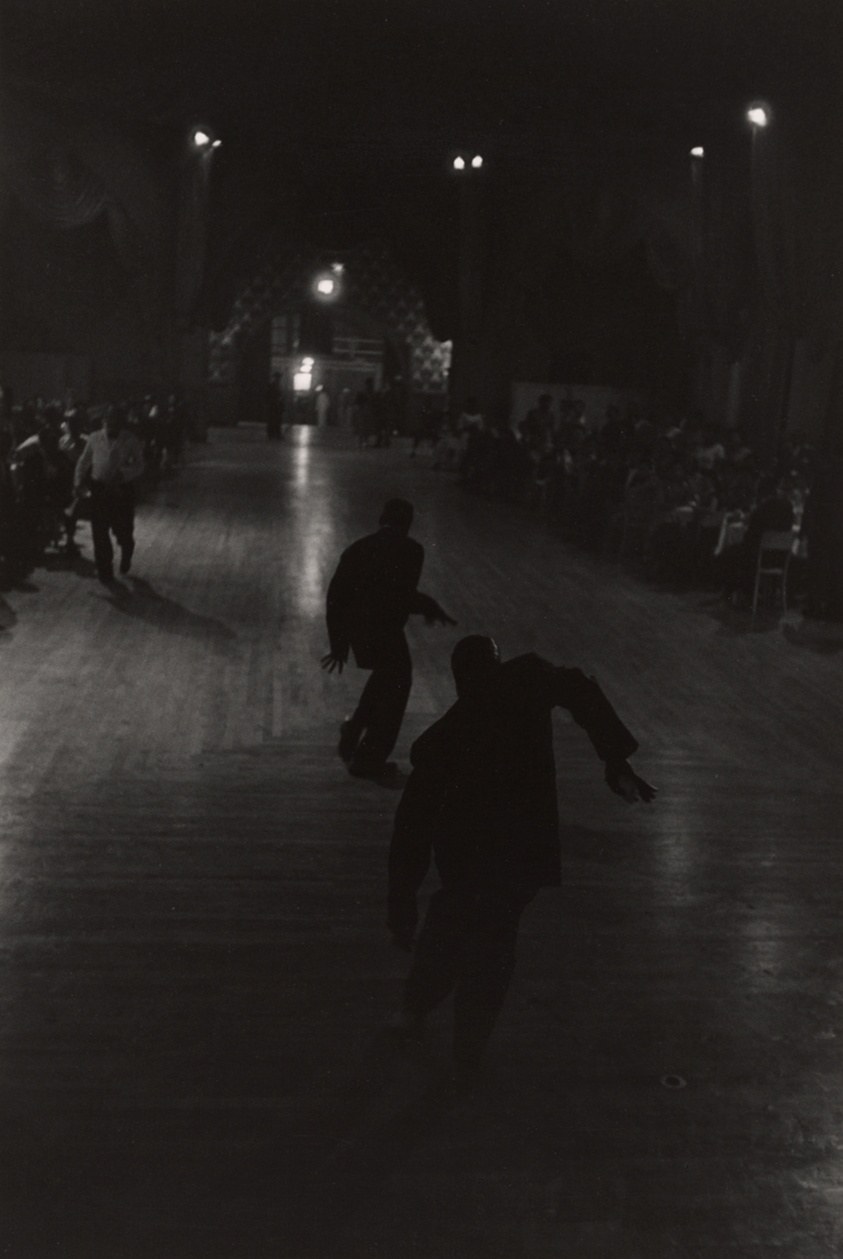
This photograph documents a form of dance—street-based, vernacular, social, belonging to African American urban culture—that was rarely treated as a subject worthy of serious artistic attention at the time. DeCarava's framing elevates the dancing bodies and the street itself to gallery status, insisting that community movement is art. The image is also a record of how people actually moved in the 1950s, unposed and in their own space.
What you are looking at
A nighttime street scene in New York, captured in high-contrast black and white. Two figures in dark suits dominate the foreground, moving across a wet pavement that reflects the overhead street lights. The man in closest focus strides forward with arms slightly outstretched, while a second figure in similar dress moves behind and to the side. The setting is urban and austere: street lamps glow overhead, their light pooling on the rain-slicked ground. In the background, shadowy figures line both sides of the street—pedestrians, onlookers, or residents creating a sense of community observation. The composition is deliberately grainy and atmospheric, with minimal lighting that isolates the central figures against pools of luminescence and deep shadow. The mood is one of movement through public space, captured with the immediacy of street photography.
The dancing
Both figures in the foreground are men in formal dark suits moving with forward momentum across the wet street. The nearest dancer strides with arms held at shoulder height and slightly forward, his posture open and expansive; the second figure behind him echoes the forward motion with similar arm positioning. Neither figure displays the closed frame or rigid posture of ballroom dance; instead, both move with a loose, weight-centered stride that belongs to vernacular or social dance. The positioning suggests contact or partnership, but the image captures them in a moment of traveling movement rather than a held partner position.
The dance depicted
The figures appear to be dancing a form of African American vernacular street dance, most likely from the mid-twentieth-century social dance tradition. The forward stride, the relaxed but intentional arm carriage, and the wet street as the stage suggest a style drawn from social blues, swing, or early street funk—dances rooted in African American communities and performed in public space. Without clearer detail of footwork, shoes, or a more defined hold, the exact style cannot be determined with confidence. The presence of onlookers and the public setting suggests this was community dance, the kind DeCarava documented throughout his work: movement that belonged to everyday life rather than the stage.
How it was made
This is a gelatin silver print, the dominant photographic medium of the mid-twentieth century. DeCarava was a master of this process, using it to render tonal subtlety and dramatic chiaroscuro in low light. The grainy texture, the pools of street-lamp light, and the near-silhouetting of figures are not accidents but achieved through careful exposure and darkroom technique. The photographic medium allowed DeCarava to document street life and vernacular culture with an immediacy and authenticity unavailable to painting or drawing, and to circulate those images through exhibitions and publications aimed at art audiences, not only documentary journalism.
About this work
This 1956 photograph captures two men dancing on a wet New York street at night, their figures illuminated by overhead lamps and reflected in the pavement. DeCarava's composition isolates the dancers' movement from the watching crowd, emphasizing the moment of forward motion and the grace of their carriage. The work belongs to a sustained body of DeCarava's practice documenting African American life, culture, and expressive movement in urban America—a practice that treated vernacular street dance and social dancing not as documentary curiosities but as art worthy of the formal attention usually reserved for concert stages. The image stands as evidence of how mid-twentieth-century African American communities danced in public space, and of how an artist trained in the fine-art tradition chose to direct his camera toward community movement and joy.
How to look at it
Attend to the isolation of the two dancers in the foreground: DeCarava's composition pushes the watching crowd into shadow, making the dancers' movement the primary subject. Notice the moment of suspension captured—neither the beginning nor the completion of a gesture, but the middle of traveling movement, with both figures in stride. The lighting is architectural: observe how the street lamps create a stage, directing the viewer's eye and creating a theatrical space on the pavement itself. The wet ground is not incidental; it reflects light and creates a surface that makes the dancers' movement visible, visible in the way a stage floor does.
The artist
Roy DeCarava (1919–2009) was an African American photographer, painter, and printmaker who spent his career documenting African American life and culture in Harlem and across New York. He trained as a painter and printmaker at City College and the Harlem Studio of Arts, then turned to photography in the mid-1940s as a tool for reaching a wider audience. DeCarava was deeply committed to representing Black life and expressive culture with dignity and aesthetic sophistication, refusing the documentary or sociological register in favor of an approach that treated his subjects as artists and his communities as sources of beauty. His collaborations with writer Langston Hughes, including the landmark photobook *The Sweet Flypaper of Life* (1955), established him as a major voice in American photography. DeCarava received a Guggenheim Fellowship in 1952, one of the first awarded to an African American photographer.
The period
In the 1950s, African American vernacular dance—swing, social blues, street forms—was a vital part of urban community life but largely invisible in the fine-art world and in mainstream cultural institutions. Concert dance was dominated by European classical ballet and emerging modern dance, most of whose practitioners and gatekeepers were white. The street dances of Harlem and other Black neighborhoods were dismissed as folk culture or entertainment, not art. Simultaneously, mid-century street photography was establishing itself as a serious artistic medium, particularly through the work of photographers like Henri Cartier-Bresson and the emerging American tradition of photographers like Walker Evans. DeCarava's work in this period represents a crucial intersection: he deployed the formal and aesthetic resources of fine-art photography to insist that Black community life, including vernacular dance, was worthy of artistic attention and belonged in galleries.
Where it lives
The photograph is held by the Art Institute of Chicago in its Photography and Media collection. It is a single gelatin silver print, a fine-art photograph created for exhibition and publication, not documentary journalism.
Dance in this work
Questions about this work
What kind of dance is this?
The photograph shows what appears to be African American vernacular street or social dance, likely from a tradition of social blues, swing, or early street-based movement. Without clearer view of footwork or shoes, the specific style cannot be determined. The context—a wet public street, informal dress, the presence of onlookers—suggests community dance rather than staged performance.
Who were the dancers?
The catalogue record does not identify the dancers. DeCarava's practice often involved photographing people in his community without formal identification; the focus was on the movement and the moment, not on naming individuals. The dancers were likely community members dancing in their own space.
Why did DeCarava photograph dance?
Dance was central to DeCarava's vision of African American expressive culture and community life. He saw vernacular dance not as entertainment or folk practice, but as art—a form of beauty and creativity that deserved the same aesthetic attention as concert forms. Photographing street dancers asserted their dignity and insisted that community movement belonged in galleries.
What does the wet street mean?
The wet pavement may reflect actual weather conditions on the night of the photograph, but it also functions as a stage. The reflection of light on the wet surface makes the dancers' movement visible and creates a theatrical quality. It grounds the dance in real, ordinary space—the street as a stage for community movement.
More dance artwork





