49 works in this view — arrow keys or swipe to move between them.
Dance in Art
Snake Dance
Hermon Atkins MacNeil (American, 1866–1947)
- Medium:
- Bronze
- Collection:
- Arts of the Americas
- Source:
- Art Institute of Chicago
- Rights:
- Rights reserved by the holding institution — do not reuse without permission. Source record ↗
- Recorded as:
- AIC — rights reserved
This sculpture records a moment when American artists began to treat Indigenous ceremonial movement as a serious subject worthy of monumental form, rather than as ethnographic curiosity or entertainment. It demonstrates how serpent ceremonial dance—a sacred practice—was translated into the aesthetic register of Romantic sculpture and neoclassical idealism, raising questions about appropriation, interpretation, and how dominant art institutions understood non-Western dance. For historians of American Indian performance, it is a primary visual document of how these ceremonies appeared to and were understood by non-Native audiences of the period.
What you are looking at
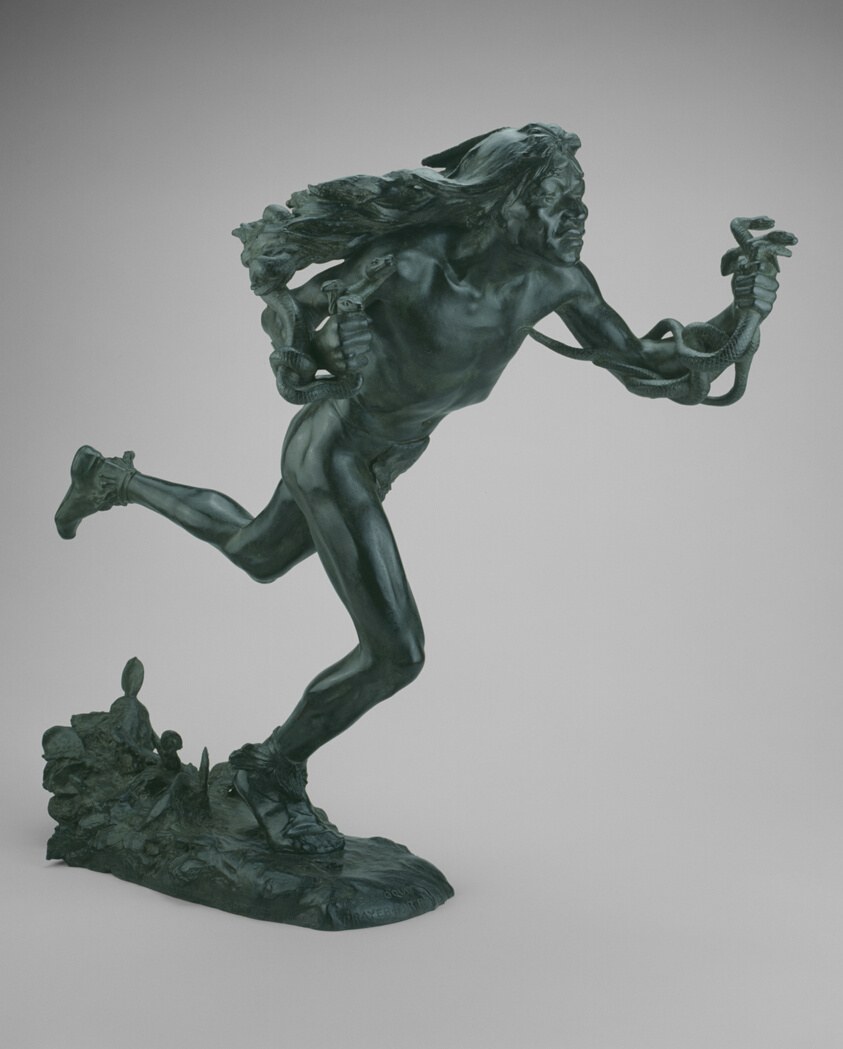
A bronze sculpture of a male figure in dynamic, airborne motion, captured mid-leap with one leg extended and the other bent beneath him. His torso twists dramatically, with his head thrown back and long hair streaming behind. He holds a serpent or snake-form object in each raised hand, the creatures coiling upward and outward. His musculature is rendered with classical precision, and he wears what appears to be a brief loincloth or ceremonial covering. The figure springs from a textured base suggesting earth or stone, rendered with naturalistic detail. The bronze has developed a rich green patina. The sculpture is lit against a neutral background that emphasizes the figure's powerful, suspended moment—neither fully in contact with the ground nor at rest.
The dancing
A single male figure dominates the composition, frozen at the apex of an explosive upward jump. The weight is concentrated in the moment of ascent, with one leg driving upward and the other tucking beneath the body. The arms are raised and spread, each grasping a serpent that extends the line of the gesture beyond the body. The torso arches backward, creating an extreme curve from the extended leg through the raised arms. The head is tilted back, the face in profile, the expression one of intensity or ecstasy. The entire pose suggests a moment of maximum elevation and energy expenditure.
The dance depicted
This work is titled "Snake Dance" and most likely depicts a Hopi or broader Southwestern Native American serpent ceremony, a sacred dance form performed in the American Southwest. The serpents held aloft are the key iconographic element. While this is a European-trained sculptor's interpretation rather than documentation of the actual ceremony, the suspended, ecstatic pose and the prominence of the snake forms suggest the artist is referencing the spiritual and physical intensity of Indigenous ceremonial practice. The dynamic, almost balletic treatment reflects early 20th-century artistic fascination with non-Western performance and ritual movement.
How it was made
This is a bronze sculpture, as stated in the record. The casting allows for precise anatomical detail and the capture of a momentary pose in a permanent material. The green patina indicates this is an aged cast, likely a foundry piece. Bronze sculpture of this scale and ambition was a major public art form in the American Gilded Age, intended for monumental settings and accessible to general audiences. The technique allowed MacNeil to freeze a moment of movement in three dimensions, visible from multiple viewpoints—essential for conveying the power and spirituality the artist associated with this subject.
About this work
"Snake Dance" is a bronze sculpture created in 1896 by American sculptor Hermon Atkins MacNeil, depicting a male figure in an ecstatic leap, clutching serpents in both raised hands. The work sits at the intersection of theatrical movement, Indigenous ceremonial practice, and classical sculptural tradition. It represents the Gilded Age fascination with the American West and with non-European peoples, filtered through the aesthetic language of Greco-Roman heroic sculpture and Romantic dynamism. The figure's suspended, almost balletic pose suggests the artist understood the dance as a moment of spiritual or physical transcendence. The work remains a significant document of how Native American sacred practices were visualized and reimagined in American fine art at the turn of the century.
How to look at it
Focus on the moment MacNeil chose: not the beginning or end of the leap, but the instant of maximum elevation and maximum extension, when the dancer's energy is most fully expressed. Notice how the backward arch of the torso and the raised arms create an enormous vertical sweep, making the figure appear to occupy more space than its proportions would suggest. The serpents are not incidental props but structural elements of the composition—they extend the line of the gesture and link the human body to animal power. The intensity of the facial expression and the muscular tension throughout suggest the artist read the dance as a moment of spiritual as well as physical extremity. This is Romantic sculpture applying its language of sublime exertion to a non-European ceremonial subject.
The artist
Hermon Atkins MacNeil (1866–1947) was one of the leading American sculptors of the Gilded Age and early 20th century. He was trained at the École des Beaux-Arts in Paris and became known for monumental public sculptures and figurative work. MacNeil developed a sustained interest in the American West and in Native American subjects, creating multiple works based on Plains and Southwestern peoples. His approach was influenced by both classical sculptural traditions and the turn-of-the-century fascination with "primitivism" and non-academic artistic traditions. He was a prolific public sculptor whose works appear in many American cities.
The period
In 1896, American sculpture was dominated by the Beaux-Arts tradition, which emphasized anatomical precision, dramatic gesture, and the elevation of contemporary or "exotic" subjects into the language of classical heroism. This was also the era of the Indian Wars' conclusion and the reservation system's consolidation. American artists of the period were intensely interested in documenting or interpreting Indigenous cultures, often before (from their perspective) they disappeared—a project colored by paternalism, romanticism, and genuine intellectual curiosity. The Hopi Snake Dance had become known to Eastern American audiences and was increasingly documented, photographed, and discussed in artistic and anthropological circles. MacNeil's interest in the subject reflects broader patterns in American visual culture of the period.
Where it lives
The work is held by the Art Institute of Chicago in the Arts of the Americas collection, indicating its recognition as a significant example of American sculpture and as a document of early 20th-century artistic engagement with American Indian subjects. The collection treats it as a work of American fine art rather than ethnographic material.
Dance in this work
Questions about this work
What is the Snake Dance?
The Snake Dance (or Snake Ceremony) is a sacred ceremonial practice of the Hopi people and other Southwestern tribes, historically performed as part of agricultural fertility and rain-bringing rituals. It involves trained dancers who handle live snakes as part of the ceremony. The practice has been documented, photographed, and interpreted by non-Native observers since the late 19th century, and remains an important part of Hopi religious life, though access for outside observers is now restricted.
Is this sculpture based on direct observation?
MacNeil likely encountered descriptions, photographs, or possibly witnessed performances of the Snake Dance, which had become relatively well-known in American cultural circles by the 1890s. However, this is a fine art interpretation rather than an ethnographic documentation. The highly classical, Romantic aesthetic—the idealized musculature, the balletic suspension, the emotional intensity—reflects the artist's training and artistic vision as much as it reflects the actual ceremony.
Why are serpents important in this sculpture?
The serpents are the defining element of the Snake Dance ceremony and anchor the work's subject matter and meaning. In the sculpture, they extend upward from the dancer's hands, visually linking human and animal power. They also create visual and thematic connections to broader mythological traditions—the serpent as a symbol of earth, fertility, danger, and spiritual power—making the work legible to a classical European-educated audience.
When was this cast made?
The work is dated 1896, but without further documentation, it is impossible to determine whether this particular bronze is an original cast from that period or a later foundry casting. Bronze sculptures often exist in multiple casts made at different times.
More dance artwork





