49 works in this view — arrow keys or swipe to move between them.
Dance in Art
Dancing Brush
Toshiko Takaezu (American, 1922–2011) Princeton, New Jersey
- Medium:
- Stoneware and glazes
- Collection:
- Arts of the Americas
- Source:
- Art Institute of Chicago
- Rights:
- Rights reserved by the holding institution — do not reuse without permission. Source record ↗
- Recorded as:
- AIC — rights reserved
Takaezu was a major American ceramic artist of the late twentieth century, one of the most important figures in the studio pottery movement. Her integration of gestural abstraction with vessel form was revolutionary in the 1960s and 1970s, and works like this one demonstrate how dance vocabulary—extension, balance, the articulation of the human figure—became central to modernist ceramics. For historians of dance in visual culture, this work exemplifies how the vocabulary of movement transcended the stage and became a universal language for twentieth-century artists.
What you are looking at
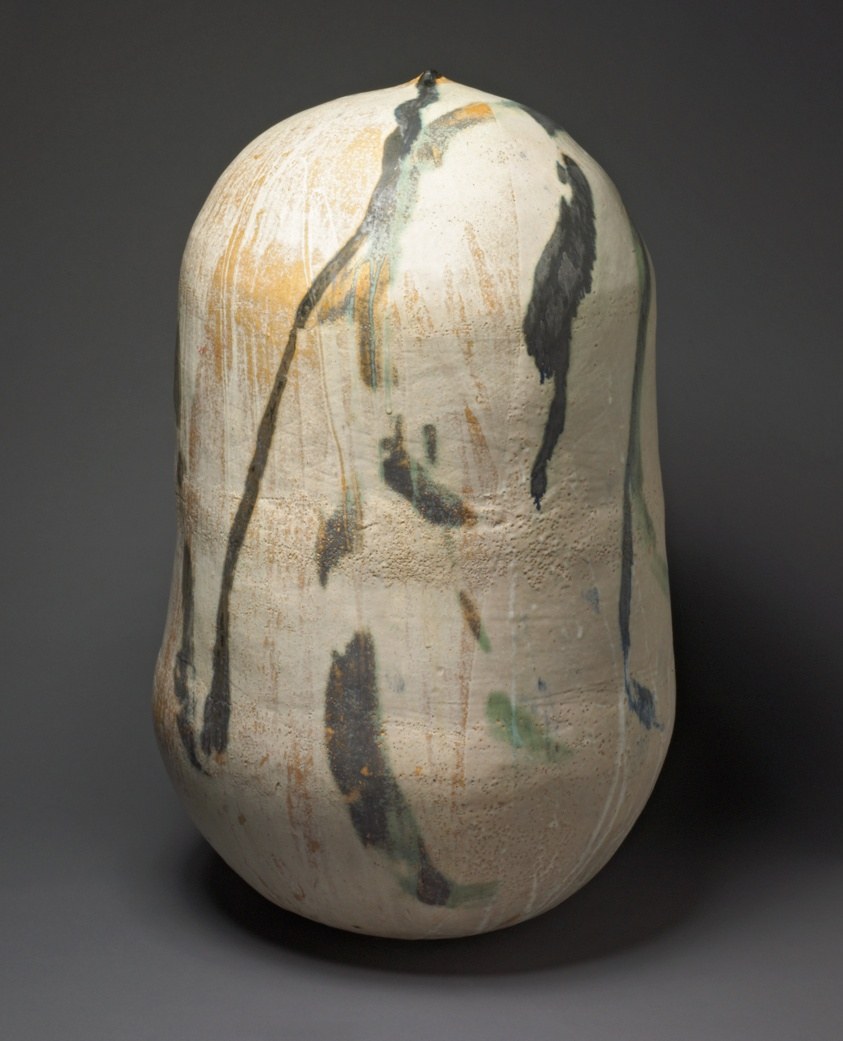
A ceramic vessel of rounded, bulbous form dominates the composition—a stoneware form suggesting a gourd or seed pod. The surface is pale cream with warm ochre striations running vertically, and across it moves a figure painted in dark charcoal and black glazes. The figure appears mid-gesture, arms raised and curved, the body twisting in a sinuous line that follows the contours of the pot itself. The pose suggests movement arrested—a dancer caught in extension, the arms flowing upward in a gesture both controlled and expressive. The painting is gestural and assured, applied with a painter's freedom rather than the precision of drawing. There is no setting beyond the vessel itself; the figure exists in the round, inhabiting the three-dimensional space of the ceramic form and inviting the viewer to turn the object to follow the motion.
The dancing
A single figure, rendered in profile and frontal aspect simultaneously (following the curved surface), with arms raised in an elegant arc above the head. The torso twists, suggesting a pivot or turn of the hips. The posture reads as extension and lift—the weight appears engaged through the core, the arms reaching but not rigid. The figure's proportions are stylized rather than naturalistic, elongated and fluid, which emphasizes the quality of motion over anatomical precision. No feet or legs are clearly articulated, allowing focus to remain on the upper body and the expressive line of the gesture.
The dance depicted
The work does not depict a specific recognizable dance technique or genre. Instead, it captures an abstracted moment of human movement—a gesture that could belong to modern or contemporary dance, or to no particular tradition at all. The title *Dancing Brush* suggests that the act of making the work is itself a kind of dance, and that the figure painted on the vessel is an expression of the artist's gestural freedom. The raised arms and twisting torso evoke a vocabulary of extension and release common to twentieth-century modern dance, but without the costume, setting, or codified form that would anchor it to a specific style. This is movement as pure expression, mediated through the artist's hand.
How it was made
Stoneware with applied glazes, hand-painted. The vessel form is thrown or hand-built ceramic, and the figure is painted onto the unfired or bisque surface using iron oxide, cobalt, or similar ceramic pigments before a final firing. The technique allows the glaze to fuse with the clay body, creating a permanent image. The painterly approach—loose, gestural, with visible brushwork—distinguishes this from the precision of printed or drawn imagery. The three-dimensional form of the vessel means the image is not fixed to a single viewpoint; it unfolds as the object is rotated, a fundamental difference from works on flat surfaces. This object was made for viewing in the hand and in the round, suggesting an intimate, tactile engagement with the work.
About this work
This ceramic vessel by Takaezu combines the ancient tradition of pottery with modernist gesture and twentieth-century dance vocabulary. The stoneware form itself—compact, organic, almost biological—becomes a stage for a single painted figure in an attitude of movement. The work bridges the gap between vessel and sculpture, between craft and fine art, between the repetitive and meditative act of pottery and the spontaneous expression of the brushed gesture. It belongs in a gallery about dance not because it documents or illustrates a particular dance practice, but because it uses the language of the human body in motion to explore the relationship between making, moving, and form. The work suggests that dance and painting are not separate disciplines but expressions of a unified impulse toward gesture and rhythm.
How to look at it
Turn the vessel slowly to follow the figure as it moves around the form. Notice how the painted figure changes in aspect as the curvature of the pot shifts your viewpoint—what appeared as a profile becomes frontal, then profile again. Attend to the quality of the brushwork: the marks are loose and confident, not labored. The figure is not anatomically complete; legs and feet dissolve into the surface. This incompleteness is essential: it forces you to complete the gesture in your mind's eye, making you an active participant in the act of viewing. The ochre striations in the clay ground pull your eye vertically, while the figure's horizontal gesture resists that pull—a quiet formal tension at work.
The artist
Toshiko Takaezu (1922–2011) was an American ceramicist and sculptor of Japanese descent, trained in Hawaii and at the Cleveland Institute of Art. She pioneered a distinctly modernist approach to pottery, rejecting purely functional or decorative traditions in favor of vessels as autonomous sculptural forms. Her work is characterized by bold gestural surfaces, often incorporating painted or incised imagery, and an interest in the dialogue between form and surface. She taught at Princeton University for many years and was deeply influential in American studio ceramics. Her practice synthesized Japanese ceramic traditions with American abstract art and the broader modernist emphasis on the artist's gesture.
The period
This work dates to 1990, late in Takaezu's career, during a period when contemporary dance had moved decisively away from narrative representation and toward abstraction, minimalism, and the primacy of the body itself. In visual art, gestural abstraction and the legacy of Abstract Expressionism remained influential, though often in dialogue with craft traditions and non-Western aesthetics. The 1980s and 1990s saw increasing critical attention to dance as a conceptual and formal practice rather than entertainment, and growing recognition of the connections between dance vocabulary and visual art. Takaezu's work participated in this larger conversation about gesture, embodiment, and the relationship between the maker's hand and the finished object.
Where it lives
The work is held in the Arts of the Americas collection at the Art Institute of Chicago. It is a ceramic vessel, meant to be handled and viewed in the round, though it functions as a sculpture rather than a functional object. The museum's classification suggests an understanding of modern ceramics as fine art rather than decorative craft.
Dance in this work
Questions about this work
Is this a functional pot?
No. While it is made of ceramic in the form of a vessel, it is a sculpture designed for aesthetic contemplation rather than use. The glazed surface and the painted figure are integral to the artistic statement. Takaezu made vessels that questioned the boundary between functional object and autonomous sculpture.
What dance is being depicted?
No specific dance or technique. The work uses the vocabulary of human movement—extended arms, a twisting torso—as a formal language. The title *Dancing Brush* suggests that the gesture belongs as much to the act of painting as to any codified dance form. This is modernist abstraction using the body as subject.
Why is the figure incomplete?
The artist has chosen to show only the upper torso and arms, allowing the figure to dissolve into the surface of the pot. This incompleteness is not a limitation but a choice: it creates a sense of movement arrested mid-gesture, and it forces viewers to complete the image in imagination. It also acknowledges the three-dimensional form of the object, which cannot contain a complete figure in a conventional sense.
How is this made?
The stoneware vessel was thrown or hand-built, then painted with ceramic glazes before firing. The technique allows the image to become permanent, fused with the clay body. The loose, gestural quality of the brushwork is visible in the finished piece, giving it an immediacy that contrasts with more controlled ceramic decorating techniques.
More dance artwork





