49 works in this view — arrow keys or swipe to move between them.
Dance in Art
At the Moulin Rouge
Henri de Toulouse-Lautrec (French, 1864–1901)
- Medium:
- Oil on canvas
- Collection:
- Painting and Sculpture of Europe
- Source:
- Art Institute of Chicago
- Rights:
- Public domain — free to use, share and adapt.
- Recorded as:
- CC0 (Public Domain)
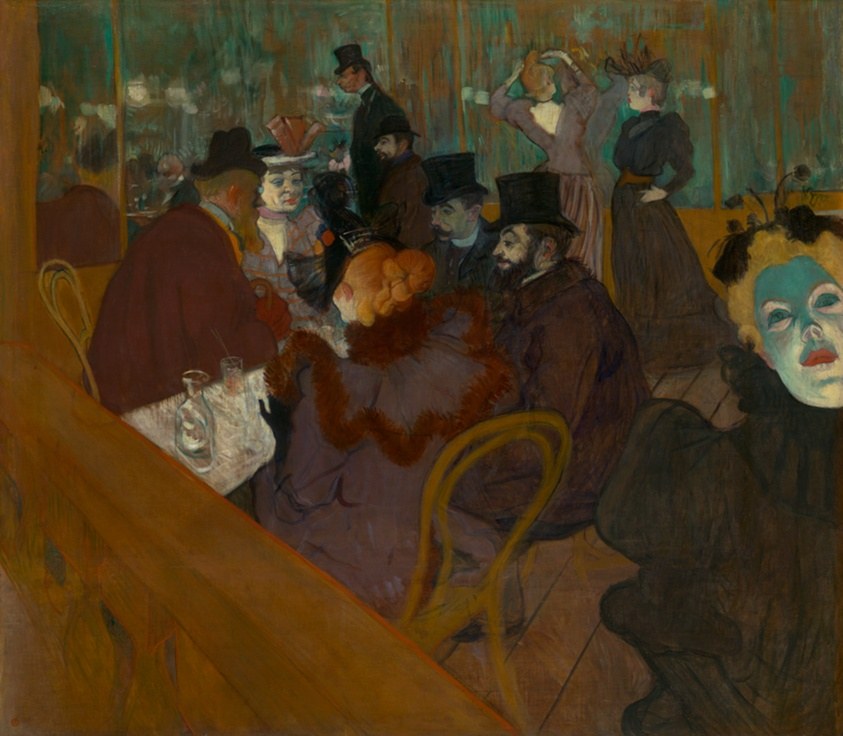
For dance historians, this work is crucial evidence of how the Moulin Rouge operated as a social institution, not merely a performance venue. It captures the real social dynamics—the mix of performers, clients, and onlookers—that made the cabaret a symbol of modern leisure and a site of anxiety about gender, class, and public behaviour. The painting's psychological intensity and the unsettling directness of the central figure's gaze complicates any simple reading of cabaret culture as mere entertainment.
What you are looking at
This painting depicts the interior of the Moulin Rouge cabaret in Paris, captured in a moment of social congregation rather than formal performance. The composition is crowded and intimate, with figures arranged in loose groups across a warm-toned interior lit by yellowish light. In the foreground, a woman in a striking orange-red feathered boa or garment sits prominently, her pale face turned toward the viewer with an almost mask-like expression. Around her cluster fashionably dressed Parisians in dark coats and hats—the men bearded and formally attired, the women in elaborate bonnets and wraps. The background shows additional figures, some standing, others seated, with a sense of movement and social interaction throughout. The palette is dominated by ochres, oranges, browns, and greens, creating a smoky, intimate atmosphere. The brushwork is loose and expressive, with figures suggested rather than minutely rendered, capturing the energy and slight chaos of the venue.
The dancing
The bodies throughout are relatively static and posed rather than actively dancing. Figures stand or sit in conversational clusters, leaning toward one another in social engagement. The central woman's posture is particularly striking—upright, frontally oriented, her gaze direct and unsettling. There is little evidence of choreographed movement or partnered dance hold; instead, the gestures are those of socialising, turning the head, adjusting clothing, and casual interaction. The arms are generally at rest or used for social gesturing rather than extended in dance frame.
The dance depicted
This is not a depiction of active dance, but rather of the social world of the Moulin Rouge as a space where entertainment and courtship occurred. The venue was famous for the can-can, a high-energy, high-kicking group dance performed by professional dancers, yet this painting captures the audience and social milieu rather than a performance. The scene documents the cabaret as a site of modern urban leisure and social mixing, where the boundary between performer and spectator was fluid. Toulouse-Lautrec was documenting the space itself as a dance environment—a place defined by performance culture—rather than recording a specific dance in motion.
How it was made
This is oil on canvas, a medium that allowed Toulouse-Lautrec to build atmosphere and psychological intensity through loose, gestural brushwork and a restricted but suggestive palette. The technique is economical: figures are often indicated by line and colour rather than fully modelled, and the composition relies on the viewer's eye to complete forms and relationships. Oil allowed him to layer transparent glazes and heavy impasto, creating the hazy, intimate lighting characteristic of indoor gaslight. The method produces a work suitable for exhibition and acquisition by collectors, marking a shift from the earlier tradition of cabaret imagery as popular prints.
About this work
Toulouse-Lautrec's *At the Moulin Rouge* (1892) is one of the canonical images of fin-de-siècle Paris nightlife, depicting the interior social world of the most famous cabaret of the era. Rather than representing a choreographed performance, the painting captures the audience, the crowd, and the distinctive social space that made the Moulin Rouge legendary. The work is fundamental to understanding how dance venues functioned as sites of modern urban culture, mixing classes, genders, and social roles in an atmosphere of entertainment and transgression. This is a painting about the culture of dance and spectacle rather than about the dancers themselves—it shows us what it meant to go to the Moulin Rouge, and why the experience fascinated Parisian and European society.
How to look at it
Attend first to the central figure: her isolation within the crowd, her direct gaze, the artificial colour of her complexion. This frontality and psychological intensity is unusual in crowd scenes and creates an unsettling quality. Notice how Toulouse-Lautrec uses the yellow-toned light to knit the figures together into an atmospheric whole, yet keeps them psychologically distant from one another. Look at how the composition pulls your eye forward into the space—you are positioned as if seated in the venue, observing. The loose handling of paint and the suppression of detail in the background figures creates a hierarchy of attention, with the foreground figures emerging from the murk of the crowd.
The artist
Henri de Toulouse-Lautrec (1864–1901) was a Post-Impressionist painter obsessed with the entertainment districts of Paris, particularly Montmartre. Born into an aristocratic family but physically disabled and socially isolated, he found community and subject matter in cabarets, music halls, and brothels. He was a regular at the Moulin Rouge from its opening in 1889 and created numerous paintings, prints, and drawings of its performers and patrons. His work combined the flat compositional innovations of Japanese prints and the loose brushwork of Impressionism with a keen eye for psychological character and social type. He worked across multiple media—oil, lithography, pastels—and his images of cabaret life became iconic representations of Belle Époque Paris.
The period
The Moulin Rouge opened in 1889 and became the symbol of Paris's new mass entertainment culture and the emerging consumer leisure industry. The 1890s saw the rise of popular dance forms—the can-can, quadrille, and various social dances—performed for paying audiences in specially designed venues. Toulouse-Lautrec was working during the peak of the cabaret's cultural power, when it represented modernity, transgression, and the possibility of social mixing. In art, this was the moment when popular entertainment began to be taken seriously as a subject for high art; the Post-Impressionists and their followers treated café and cabaret scenes with the same formal ambition previously reserved for history painting or portraiture.
Where it lives
This painting is held by the Art Institute of Chicago as part of its collection of European painting and sculpture. The work is one of Toulouse-Lautrec's largest and most ambitious cabaret interiors, created during the height of his engagement with Montmartre subject matter.
Dance in this work
Questions about this work
Is anyone dancing in this painting?
No. This is a painting of the social world of the Moulin Rouge—the audience, the clientele, the atmosphere—rather than a depiction of the can-can dancers themselves. Toulouse-Lautrec was interested in capturing the experience of being in the cabaret as a space and a social phenomenon, not in documenting a specific choreographed performance.
Who is the woman in the orange feathers in the foreground?
Toulouse-Lautrec did not title this painting with identifying names, and interpretations of her identity have varied. She may be a performer, a client, or a figure representing the composite social type of the Moulin Rouge crowd. Her direct, unsettling gaze and artificial appearance suggest she may be a performer taking a break, observing the room.
What was the Moulin Rouge known for?
The Moulin Rouge, which opened in 1889, was Paris's most famous cabaret, renowned for the high-kicking can-can performed by professional dancers and for attracting a mixed clientele of all social classes. It became a symbol of modern urban leisure, transgression, and the new mass entertainment industry of the late 19th century.
Why did Toulouse-Lautrec paint cabaret scenes?
Toulouse-Lautrec was fascinated by the social dynamics and visual drama of entertainment venues. As a disabled man who felt alienated from aristocratic society, he found acceptance and community in the Moulin Rouge and similar spaces. He documented these worlds with psychological insight and formal ambition, treating cabaret life as a worthy subject for serious art.
More dance artwork





