49 works in this view — arrow keys or swipe to move between them.
Dance in Art
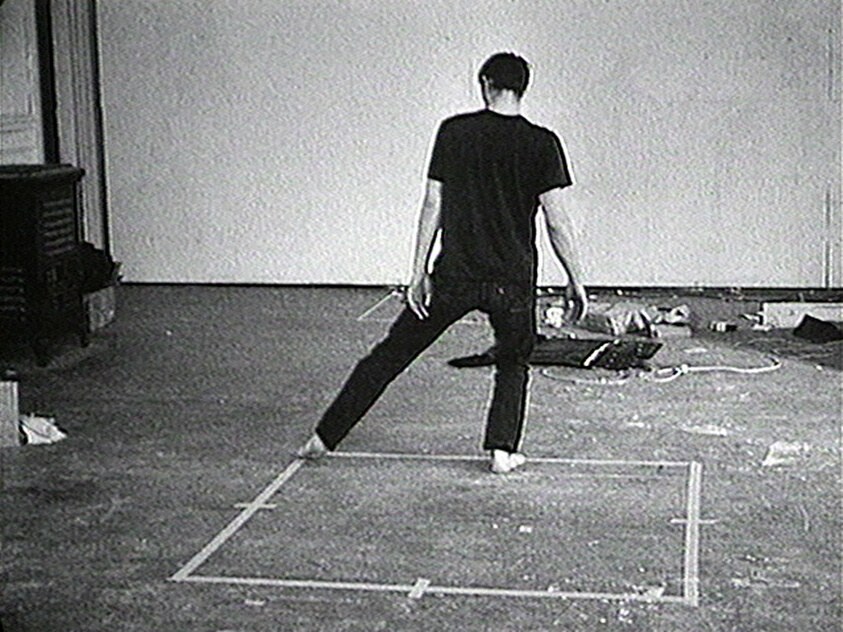
Dance or Exercise on the Perimeter of a Square (Square Dance)
Bruce Nauman American, born 1941
- Medium:
- 16mm black-and-white film transferred to digital video disc, sound; 8:20 min.
- Collection:
- Contemporary Art
- Source:
- Art Institute of Chicago
- Rights:
- Rights reserved by the holding institution — do not reuse without permission. Source record ↗
- Recorded as:
- AIC — rights reserved
Nauman's video works were among the first to treat the body and ordinary movement as sufficient content for a serious artwork, without music, narrative, or conventional virtuosity. This shifted thinking about what dance could be documented as, and influenced a generation of performance and movement artists who saw conceptual rigor and bodily presence as compatible. For historians of contemporary dance and video art, this is essential evidence of the late-1960s collapse of boundaries between disciplines.
What you are looking at
A solitary figure in black clothing stands in a spare, institutional interior, filmed from behind in black-and-white video. The dancer occupies the center of the frame, straddling the geometric lines of a white square marked on the ground—the perimeter suggested by tape or chalk. The space is nearly empty: concrete or linoleum flooring, bare white walls, and minimal fixtures (what appears to be ventilation on the left side). The lighting is flat and forensic. The dancer's posture is emphatic: legs spread wide, one extended forward in a lunge or stride, arms at the sides, body weight shifted asymmetrically. The composition suggests neither grace nor ornament but rather a deliberate, almost mechanical engagement with the floor plane and the square's boundary.
The dancing
One dancer, filmed in profile-to-back view, executes a wide-legged stance with the torso upright and one leg thrust forward into what reads as either a deep lunge or a directional step. The arms hang at the sides or are held in a neutral, undecorative position. The weight distribution is uneven and grounded; there is no lift or turnout. The body reads as investigative rather than expressive—the dancer is testing or marking the space, not performing emotion or virtuosity.
The dance depicted
This is an early work of conceptual movement practice, not dance in any traditional genre sense. Nauman's work sits at the boundary between dance, performance art, and sculptural investigation of the body in space. The 'square dance' is a systematic exploration of how a body occupies and moves within a geometric constraint—the perimeter of the square becomes both the subject and the boundary. It relates to the procedural, task-based movement investigations of postmodern dance (Judson Dance Theater-era practices) but is more austere and documentary in tone. The video medium allows repetition and frame-by-frame study of the movement.
How it was made
This is a 16mm black-and-white film transferred to digital video, a significant technical choice. Film stock of the period was grainy and high-contrast, which Nauman's monochrome approach amplifies—this removes all distraction from the body and floor. The transfer to video preserves the work's reproducibility and archive status while extending its exhibition life. The documentary flatness of video (no art direction, no special lighting) matches the conceptual rigor: the medium does not beautify or interpret, it records. The 8:20 duration suggests repeated passes or sustained observation, not a discrete choreographic phrase.
About this work
This is a foundational work in body art and conceptual performance practice. Nauman, born in 1941, began making films and videos in the late 1960s as he was leaving painting; this 1968 work belongs to a series in which the artist used his own body and simple architectural constraints (walls, corners, corridors, floor lines) as both subject and material. The work has no narrative, no music, no virtuosity—instead it interrogates how movement inhabits space, how the body becomes a sculptural and spatial tool. It belongs in a gallery of dance not because it is dance, but because it redefined what dancing could mean: not a performance of trained skill but a systematic, almost phenomenological investigation of bodily movement as material. For dancers and historians, this marks a crucial moment when contemporary visual art and experimental movement practice merged.
How to look at it
Watch for the deliberateness of each step and stance. Nauman is not moving 'freely' or 'expressively'—every gesture appears to be a test of how the body can relate to the square's boundary. Notice the weight: it is always shifted, never centered or balanced in a classical sense. The camera remains fixed; the body moves relative to the frame and the floor line. The duration (8+ minutes) matters—this is not a moment but an endurance, a sustained interrogation. Pay attention to whether the movement repeats, varies, or develops; this tells you whether Nauman is exploring the square or the body's capacity to move.
The artist
Bruce Nauman is an American conceptual and performance artist born in Fort Wayne, Indiana. He studied mathematics and physics before turning to art in the 1960s; he left painting around 1966–67 and began making films, videos, and live performances using his own body and the space around it as the primary material. His early video works (1967–72) are landmark documents of body art and postmodern performance practice. Nauman has remained central to contemporary art, exploring language, space, surveillance, and bodily experience through video, sculpture, installation, and performance. His practice has consistently refused conventional beauty or skill-display in favor of conceptual and phenomenological rigor.
The period
In 1968, postmodern dance was established at Judson Dance Theater (founded 1962) and in the practices of Yvonne Rainer, Lucinda Childs, and others who rejected spectacle and virtuosity in favor of pedestrian movement, task-based choreography, and conceptual clarity. Simultaneously, visual artists—particularly Nauman, Vito Acconci, and others—began using their bodies on film and video as material for conceptual investigation. The late 1960s saw video technology becoming accessible to artists outside broadcast and saw a fundamental questioning of what constituted art, dance, and performance. Nauman's work emerges in this ferment but stands apart by its severity: where Judson-era dancers often found joy in democratizing movement, Nauman treats the body as a neutral, almost austere investigative tool.
Where it lives
The work is held in the Contemporary Art collection at the Art Institute of Chicago. It belongs to the archival and documentary layer of institutional collections—a video artwork intended for preservation, study, and repeated screening, not a unique object. The transfer to digital video disc is a conservation choice typical of late-20th-century media art.
Dance in this work
Questions about this work
Is this actually dance?
It depends on your definition. Nauman is a visual artist, not a trained dancer, and he is not performing choreography. But he is moving his body intentionally in space, and the video documents that movement as its primary content. This work is central to histories of performance art and expanded dance, where the boundary between 'dance' and 'movement investigation' became porous in the 1960s–70s. Many contemporary dancers and choreographers cite Nauman's work as influential.
Why is there a square on the floor?
The square is both subject and constraint. Nauman was interested in how the body responds to geometric and spatial limits. The square—its edges, its perimeter, its interior—becomes a structure the body must navigate or test. This is typical of his practice: he often used simple architectural or spatial constraints (corridors, walls, corners) as frameworks for movement investigation.
Why black and white and why so plain?
The austere visual style matches the conceptual approach: there is nothing to distract from the body and its relationship to the floor and the square. Nauman rejected the aesthetic conventions of both dance (costume, lighting design, music) and gallery art (composition, beauty, decoration). The flatness is intentional and radical.
How long is the whole video and what happens?
The work is 8 minutes 20 seconds. Within that duration, the dancer repeats, varies, and develops movements within and around the square's perimeter. The title suggests it is an exercise or study, not a finished choreography. Viewing the entire duration is important; a single still does not convey the work's rhythm or logic.
More dance artwork





