49 works in this view — arrow keys or swipe to move between them.
Dance in Art
Tanabata Dance
Torii Kiyonobu I Japanese, 1664-1729
- Medium:
- Woodblock print; sumizuri-e
- Collection:
- Arts of Asia
- Source:
- Art Institute of Chicago
- Rights:
- Public domain — free to use, share and adapt.
- Recorded as:
- CC0 (Public Domain)
This is one of the earliest printed images of named Japanese dance practice, made by a master of the form at a moment when woodblock printing was just becoming the primary medium for theatrical documentation. It shows how early Edo-period artists understood and represented dance: as a vehicle for displaying costume, ornament, and formal beauty rather than movement analysis. For historians of East Asian dance and of Edo popular culture, it is a primary document of how festival dance functioned and how it was circulated as an image.
What you are looking at
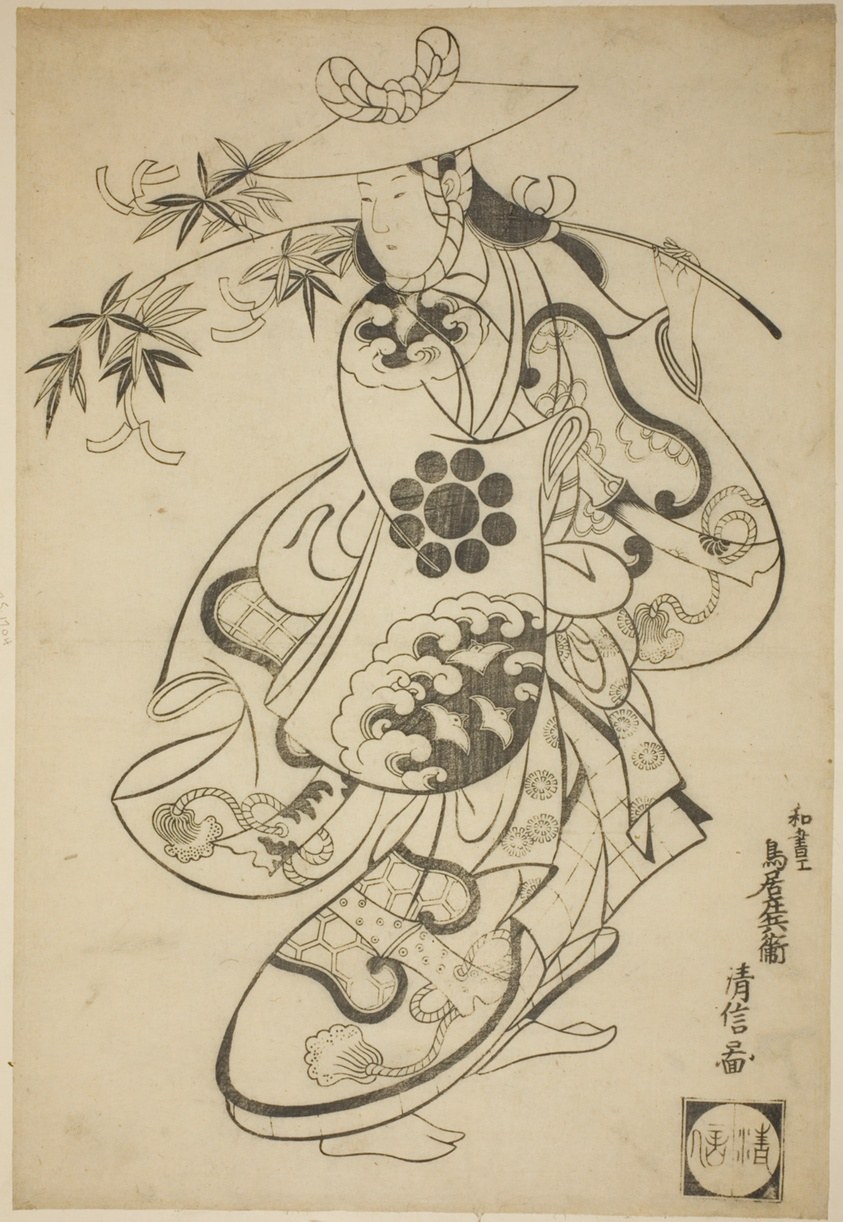
A single figure in elaborate Japanese court dress dominates this woodblock print, shown in a dynamic, floating pose against a plain background. The dancer wears a richly patterned garment with layered sleeves in a pale cream or white ground decorated with intricate geometric and floral motifs—honeycomb patterns, shell designs, and stylized cloud forms rendered in black ink. A long outer robe with bold decorative elements flows around the figure. The dancer holds a wide, pointed hat (a Tanabata festival accessory) above the head with one hand while grasping what appears to be a bamboo branch or ornament in the other. The face is rendered with delicate lines showing a serene, frontal expression. Above the figure floats a second ornamental object—curled ribbons or paper streamers characteristic of Tanabata decoration. The composition is purely frontal and decorative, with no spatial ground line; the figure appears to hover or float within the picture plane.
The dancing
The body is shown in an elevated, weightless pose—neither standing nor in motion across ground space, but suspended. The left arm is raised to hold or adjust the hat above the head, the right arm extends lower to grasp the bamboo sprig. The posture is upright and formal rather than athletic; the weight appears to distribute evenly through the figure's center rather than shifting side to side. There is no evidence of footwork or the dynamic, grounded movement that characterizes most theatrical dance forms.
The dance depicted
This image almost certainly documents Tanabata odori, a seasonal celebration dance performed during the Tanabata festival (seventh day of the seventh lunar month). The Tanabata festival celebrates the legendary meeting of two stars, Orihime and Hikoboshi, represented in Japanese tradition as separated lovers. Dances performed at this festival were courtly or semi-courtly entertainments, often performed by women or by actors in female roles. The figure holds the characteristic props—the bamboo branches and decorative streamers—that identify this as Tanabata-specific practice rather than a generalized dance form. The pose suggests the formal, presentational manner of early Edo-period dance: an elegant display of costume and ornament rather than virtuosity of movement.
How it was made
This is a sumizuri-e (black-ink woodblock print), a format used for the most widely circulated theatrical imagery of the Edo period. The technique relies on a single wood block carved in relief and printed in black ink only, which made production rapid and inexpensive. Sumizuri-e prints were mass-produced for popular consumption—sold at theater districts and to collectors of theatrical imagery. The line work shows the characteristic clarity and precision of carved woodblock: strong, confident outlines defining the figure and its ornaments, with areas of solid black for shadow and pattern. This technical economy means the image prioritizes recognizable silhouette and costume detail over modeling or spatial recession.
About this work
This is a print record of Tanabata festival dance as performed in late-17th-century Japan, made by Torii Kiyonobu I, a foundational figure in the production of woodblock theater prints. The image celebrates costume, ornament, and the formal presentation of the body rather than the dynamics of movement. It sits at the origin of Japanese theatrical print culture—Kiyonobu was among the first artists to develop the visual language for representing Kabuki and festival performance. The work documents a specific occasion and a specific dance type that has largely disappeared from living practice, preserved only in prints and written records.
How to look at it
Attend to the costume rather than the pose: the garment is the subject, its patterns and layers carefully delineated to display wealth and artistry. Notice the stillness and formality of the body—this is not a captured moment mid-movement, but a presentational pose, much like a fashion plate or an actor's publicity portrait. The floating, weightless quality is not meant to suggest levitation but rather to remove the figure from everyday space and present it as a decorative object. The accessory—the hat and bamboo branch—are as important as the dancer, marking the occasion and the role being performed.
The artist
Torii Kiyonobu I (1664–1729) was a painter and printmaker who founded the Torii school, which became the dominant workshop for Kabuki theater imagery in the Edo period. He is credited with establishing the pictorial conventions for representing Kabuki actors in prints: the bold outlines, the emphasis on costume and silhouette, and the theatrical poses that would define the genre for generations. Kiyonobu worked primarily in sumizuri-e and hand-colored prints (urushi-e), producing actor portraits, full-stage scenes, and named dances. His work circulated widely and influenced all subsequent Japanese theater print traditions.
The period
The late 17th century in Japan saw the codification of Kabuki as a professional entertainment form and the rapid expansion of print culture in urban centers. Woodblock printing, newly refined and commercially viable, became the primary medium for circulating images of actors and performances to audiences who could not attend theaters. Theater prints served as publicity, souvenirs, and collectibles, much as playbills and photographs do today. Simultaneously, seasonal festival dances like Tanabata odori continued as court and semi-court traditions alongside the rising popularity of Kabuki; prints of these dances document a moment when older performance forms were being visually recorded and circulated to a mass audience for perhaps the first time.
Where it lives
This work is held in the Arts of Asia collection at the Art Institute of Chicago. It is a woodblock print, a commodity object of the Edo period, originally produced in quantity and intended for popular consumption. The fact of its survival in an institutional collection suggests both the historical recognition of Kiyonobu's importance and the relative rarity of such prints in good condition.
Dance in this work
Questions about this work
What is Tanabata dance?
Tanabata odori was a seasonal celebration dance performed during the Tanabata festival, an Edo-period observance of the legendary meeting of two separated stars. It was typically performed at court or in semi-formal settings, often by women or female-role specialists. The dance incorporated characteristic props—bamboo branches and decorative paper streamers—that linked it to the festival's romantic narrative.
Who was Torii Kiyonobu I and why does he matter?
Kiyonobu (1664–1729) founded the Torii school of woodblock printmakers, which became dominant in Edo-period theater imagery. He is credited with inventing or codifying the visual language for representing Kabuki actors: the bold black outlines, the emphasis on silhouette and costume, and the theatrical poses that define the genre. His prints established the conventions that all later Japanese theater prints would follow.
What is sumizuri-e?
Sumizuri-e (black-ink printing) is a woodblock print technique using only black ink on a single block. It was the fastest and cheapest method of producing prints, allowing images to be made quickly and sold cheaply to a mass audience. The technique's economy forced artists to prioritize clear, strong outlines and high-contrast design—strengths that became aesthetic virtues of the medium.
Why does the figure look like it's floating?
The weightless, floating pose was a convention of early theater prints: it removes the figure from everyday space and presents it as a formal, decorative image—more like a costume plate than a captured moment. This style emphasizes the ornament and the role being performed rather than the naturalism or athleticism of movement.
More dance artwork





