49 works in this view — arrow keys or swipe to move between them.
Dance in Art
The Harugoma Dance
Torii Kiyomitsu I Japanese, 1735-1785
- Medium:
- Color woodblock print; o-oban yoko-e, benizuri-e
- Collection:
- Arts of Asia
- Source:
- Art Institute of Chicago
- Rights:
- Public domain — free to use, share and adapt.
- Recorded as:
- CC0 (Public Domain)
This print provides rare visual evidence of how classical Japanese dance was actually performed and understood in the 18th century, documented by an artist with direct access to theater and performance worlds. For dancers and historians, it offers concrete detail about body position, costume, spatial arrangement, and the integration of dance into seasonal celebration that written sources alone do not convey. Kiyomitsu's status as a designer for the Kabuki theater means this image likely reflects practices he observed directly.
What you are looking at
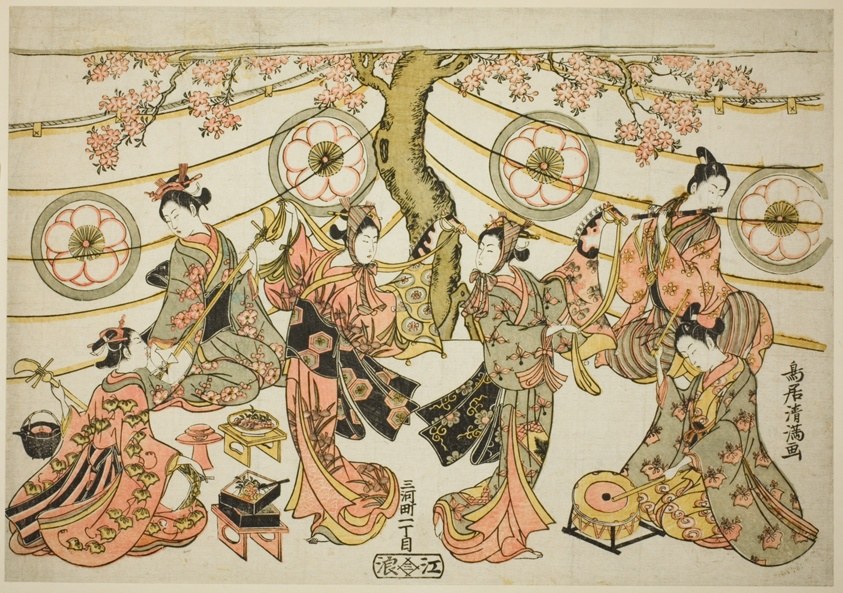
Five figures in elaborate kimonos gather beneath a flowering cherry tree, its delicate blossoms rendered in soft pink and coral above. The composition is divided horizontally by wooden architectural elements—possibly a garden pavilion or performance stage—that frame the action. Three circular fans or possibly drum heads appear in the upper register, decorated with pale pink and gold. The figures are arranged in a loose, animated grouping rather than a formal line: some gesture expansively, others hold their bodies in elegant counterbalance. A small child or attendant in dark garments appears among them. In the foreground, low furniture and vessels suggest a garden setting or outdoor entertainment space. The palette is restrained—blacks for hair and accents, golds for details, reds and pinks for fabrics and flowers—against the pale paper ground. The overall effect is of refined leisure and performance captured in a moment of choreographed grace.
The dancing
The dancers display varied but coordinated body positions suggesting ensemble movement rather than partnered holds. One figure on the left inclines deeply forward from the waist, arms held expressively in front and to the sides. A central figure stands nearly upright with arms raised and splayed. Another turns, her torso rotated while her lower body remains grounded, creating the torsional effect characteristic of classical Japanese dance. The figures' weight appears centered and grounded rather than lifted or airborne. The flowing, heavy kimonos constrain movement to the upper body, hips, and head, with no evidence of footwork or leg extension. The spacing between dancers is intimate but not symmetrical.
The dance depicted
This depicts what the title identifies as Harugoma, a spring celebration dance in the classical Japanese tradition. Harugoma (meaning "spring spinning top") was an auspicious festive dance performed during Edo period celebrations, particularly at New Year and spring festivals. The cherry blossoms and the paired fans or drum-like circular forms in the composition reinforce the spring festival context. The movement vocabulary visible here—the turned torso, the expressive arm gestures, the weight centered in the lower body despite the elaborate costume—is consistent with Buyō (classical Japanese dance-theater). The multiplicity of participants and the outdoor garden setting suggest this was a social or celebratory performance rather than a court formality, though the precision of dress and pose indicates professional or highly trained execution.
How it was made
This is a benizuri-e (red-printed picture), a technique that applied hand-coloring over woodblock-printed outlines. The woodblock medium allowed for the crisp, assured line work visible in the kimonos' patterns and the figures' contours, while the benizuri process—overpainting with red and other pigments—created the soft gradations in the cherry blossoms and fabric coloring. This technique was economical compared to full color woodblock printing (brocade pictures or nishiki-e), making it accessible to a broader market. The delicate register divisions and the compositional control suggest a work made for urban consumers in Edo-period Japan, circulating among merchants, artisans, and entertainers interested in current performance and fashion.
About this work
This is a 1761 woodblock print by Torii Kiyomitsu I depicting the Harugoma dance, a spring festival performance from classical Japanese tradition. The print captures five performers in elaborate kimonos gathered beneath a flowering cherry tree, their bodies arranged in expressive, coordinated gesture without the symmetry of formal court dance. The benizuri-e technique—woodblock printing with hand-applied color—gives the work its distinctive character: strong linear clarity in the costume details paired with soft, watercolor-like effects in the blossoms and fabrics. Kiyomitsu worked in the mid-18th century when Edo-period woodblock prints were beginning to document contemporary performance practices and fashion with increasing sophistication. The Harugoma dance itself, tied to spring celebration and renewal, appears here in the context of urban entertainment culture—the work is as much a record of what fashionable Edo audiences wore and watched as it is a document of the dance itself.
How to look at it
Attend first to the variety of arm and torso positions among the five figures: rather than a unison line or rigid formation, the composition shows dancers in different moments or different roles within the ensemble, which tells us something about how Harugoma was choreographed. Notice how the heavy fabric of the kimonos constrains and shapes the movement—the artist emphasizes the torsion and lift of the upper body while the lower body remains stable and grounded. The placement of the cherry tree overhead and the circular fans above creates a frame that suggests an outdoor performance space or garden setting, not a formal theater stage. The slight awkwardness in some of the poses—one figure leaning quite far forward, another with arms held in a somewhat strained position—suggests the artist prioritized fidelity to observed movement over idealized elegance.
The artist
Torii Kiyomitsu I (1735–1785) was a printmaker and painter working during the height of the Edo period, born into the Torii lineage of artists deeply connected to Kabuki and performance culture. The Torii family had designed theater signage, sets, and actor portraits for generations; Kiyomitsu inherited both technical sophistication and insider access to performers and performance practice. He specialized in benizuri-e and later nishiki-e (full-color woodblock prints), and his works frequently depicted actors, dance, and theater subjects. His position as both artist and theater insider made him unusually well-positioned to document movement and costume with anatomical and sartorial accuracy.
The period
In 1761 Japan was in the mature Edo period, approximately 130 years into the Tokugawa shogunate's rule. Kabuki and classical dance forms like Buyō had become central to urban entertainment culture, especially in Edo (Tokyo). Woodblock printing was experiencing rapid technical innovation and increasing commercialization: the benizuri-e technique of this work was an economical stepping stone toward the full-color nishiki-e prints that would dominate the market by the 1770s. Spring festival dances and auspicious performances like Harugoma remained important cultural practices, tied both to agricultural cycles and to courtship and social ritual. The print's documentation of contemporary fashion—the specific patterns and colors of kimonos—suggests it was created for consumption by the same urban audiences who attended the performances it depicts.
Where it lives
The print is held in the Arts of Asia collection at the Art Institute of Chicago. This provenance aligns with the work's status as a significant example of mid-18th-century Japanese woodblock printing and performance documentation, preserved within one of North America's major collections of Asian art.
Dance in this work
Questions about this work
What is Harugoma and why was it danced?
Harugoma (spring spinning top) was an auspicious celebration dance performed during spring festivals and New Year festivities in Edo-period Japan. The dance was associated with renewal, fertility, and good fortune. Its performance in gardens and at public entertainments made it a familiar spectacle to urban audiences, documented here by an artist with direct ties to the theater world.
Why are there circular fans or drums floating above the dancers?
These are likely musical accompaniment elements or props integral to the performance. In Japanese classical dance, music and percussion are fundamental to choreography, and their placement in the composition above the figures suggests they are as much part of the 'event' as the dancers themselves. They also serve a compositional function, framing and structuring the visual field.
How does the heavy costume affect what we see of the dance?
The elaborate kimono completely obscures the legs and constrains hip movement, meaning all visible dance vocabulary is generated from the torso, arms, and head. This tells us that classical Japanese dance, as performed in this tradition, prioritized upper-body expression, torsion, and hand and arm gesture—a very different movement logic from Western theatrical dance that emphasizes footwork and lower-body extension.
Why was this printed using benizuri-e rather than full-color woodblock?
Benizuri-e was faster and cheaper to produce than full-color nishiki-e printing, making it economical for commercial circulation. The technique was ideal for works meant to reach a broad urban audience—entertainers, merchants, fashion-conscious patrons—who wanted current documentation of performance and costume without the cost of the most lavish printing processes.
More dance artwork





