49 works in this view — arrow keys or swipe to move between them.
Dance in Art
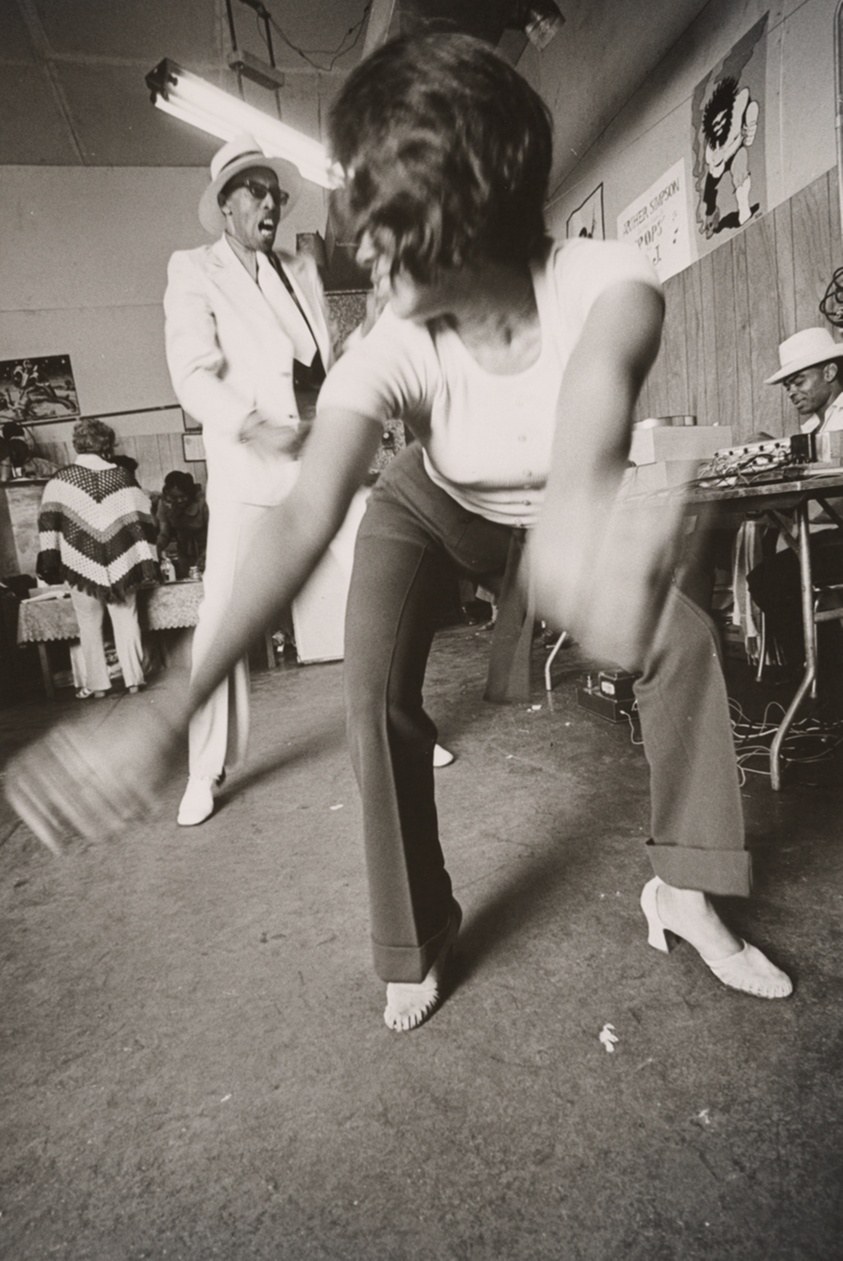
Untitled, from the series "The Garage" (1970-80)
Valeria “Mikki” Ferrill American, born 1937
- Medium:
- Gelatin silver print
- Collection:
- Photography and Media
- Source:
- Art Institute of Chicago
- Rights:
- Rights reserved by the holding institution — do not reuse without permission. Source record ↗
- Recorded as:
- AIC — rights reserved
This photograph is essential evidence of experimental dance practice in the early 1970s, a period when American artists were radically questioning what dance could be and where it could happen. It documents dancers working outside concert institutions, in artist-run spaces, at a moment when such work was systematically excluded from official dance history. The image captures the physical vocabulary and embodied risk of that moment—the shirtless torso, the twisted spine, the reaching gesture—which tells us as much about how experimental dancers understood their bodies as any theoretical text.
What you are looking at
A black-and-white photograph captures an indoor dance scene, shot from a low angle that emphasizes the dancers' bodies. In the foreground, a shirtless male dancer in light-colored pants is captured mid-movement, his torso twisted and arms extended in an expressive gesture. His weight appears shifted, suggesting dynamic motion. Behind him, a female dancer in a white sleeveless top and light pants moves with her back partially to camera. The setting is sparse—a concrete floor, industrial ceiling with fluorescent lighting, and walls decorated with posters and what appears to be performance documentation. On the right side, a man in a white suit and hat stands observing, and a second figure in similar dress can be seen further back. The scene has the quality of a rehearsal or informal performance space, captured with documentary directness.
The dancing
The primary dancer shows a torqued, off-center weight distribution with a open-armed, reaching quality to his movement—elbows bent, shoulders rotated, the body caught in transition rather than a held position. The female dancer's frame is similarly loose and exploratory. Neither dancer displays the turnout, alignment, or formal carriage of classical technique. The movement vocabulary appears improvisational and grounded, with emphasis on twisting, rotation, and weight transfer through the torso rather than linear spatial progression.
The dance depicted
This photograph documents what appears to be freestyle or improvisational contemporary movement, possibly within an experimental or avant-garde performance context. The absence of formal balletic or partner-dance positioning, combined with the shirtless male torso and the exploratory arm vocabulary, suggests modern dance or street-derived movement forms. The documentary framing and informal studio setting point to a rehearsal or experimental showing rather than a staged production. Without identifying marks or clear stylistic convention, the specific dance form cannot be named with certainty, but the movement quality aligns with 1970s experimental and post-modern dance practices.
How it was made
This is a gelatin silver print—a direct photographic medium that captures a precise moment with documentary clarity. The low camera angle, grainy texture typical of period silver gelatin work, and the emphasis on capturing unposed movement suggest the photographer chose a position and timing that foreground the dancers' physical intensity rather than their visual composition. The black-and-white format eliminates color distraction and emphasizes form, weight, and spatial relationships. As part of a series titled 'The Garage,' the work appears to be part of sustained documentation rather than a single commissioned performance.
About this work
This photograph documents experimental dance or improvisation in an informal, industrial setting, likely from a rehearsal or artist-run performance space. The 1972 date places it within the era of post-modern and avant-garde dance practice in the United States, when artists were deliberately moving away from concert-hall formality and institutional structures. The image records not a polished performance but the working body—the moment of discovery and risk-taking that characterizes experimental practice. 'The Garage' series, from which this print comes, appears to have been a sustained documentary project capturing dance in non-traditional venues and contexts, making visible the infrastructure and spaces of experimental performance that institutional records often omit.
How to look at it
Attend to the dancer's torso—the twist, the off-center weight, the reaching quality that suggests momentum and vulnerability rather than control. Notice the absence of any framing device (no barre, no formal stage, no corps de ballet). The low camera angle forces the viewer to look up at the dancers, collapsing the distance between observer and performer in a way that emphasizes physical presence. The casual dress and industrial setting are not obstacles to 'real' dance but are integral to what is being documented: movement created outside formal training systems and institutions.
The artist
Valeria 'Mikki' Ferrill (American, born 1937) is a photographer whose 'Garage' series documents experimental performance and movement in informal spaces. The series suggests a sustained engagement with artists working outside traditional institutions, capturing rehearsal and performance in what appears to be a converted industrial or garage space. Her choice to photograph from close range, at low angles, and with documentary directness indicates an interest in the body itself—its effort, weight, and spatial intention—rather than in framing dancers as aesthetic objects.
The period
In 1972, American experimental dance was at a critical threshold. The Judson Dance Theater (active 1962–1964) had already challenged concert-dance conventions; Alvin Ailey's American Dance Theater (founded 1958) was expanding the definition of American dance to include Caribbean, African, and jazz vocabularies; and artists like Merce Cunningham and Twyla Tharp were questioning the relationship between dance and music. Simultaneously, artist-run spaces and non-institutional performance were proliferating. Ferrill's 'Garage' series situates itself in this landscape of informal, exploratory practice—documenting dancers who were deliberately stepping outside concert institutions to invent new movement forms and contexts. The low-angle photography and emphasis on the working body reflects broader mid-century art practices that valued documentation of process over the finished product.
Where it lives
The photograph is held by the Art Institute of Chicago in the Photography and Media collection. It is part of Ferrill's 'Garage' series, dated 1970–1980, suggesting a sustained documentary project spanning at least a decade. The series is now part of an institutional collection, but the work itself documents practices and spaces that existed deliberately outside such institutions.
Dance in this work
Questions about this work
Is this ballet or contemporary dance?
Neither in the formal sense. The movement vocabulary—twisted torso, reaching arms, grounded weight, absence of turnout—does not belong to classical ballet or post-modern concert dance as typically defined. It appears to be experimental or improvisational movement, possibly drawing on multiple sources. The photographer's interest was in capturing dancers working in non-traditional spaces, outside concert-dance institutions.
What is 'The Garage'?
A documentary photography series by Valeria Ferrill spanning 1970–1980, capturing performance and movement in what appears to be a converted garage or warehouse space. The series documents experimental artists working outside institutional venues, making visible the informal spaces and communities in which experimental dance was being made.
Why photograph from such a low angle?
The low angle emphasizes the dancers' bodies and the effort of movement. It eliminates the distance between viewer and performer, forcing the eye to encounter the dancers' weight, musculature, and spatial negotiation directly. This compositional choice reflects a documentary interest in the body as it works, rather than in dancers as aesthetic objects framed for distant viewing.
More dance artwork





