49 works in this view — arrow keys or swipe to move between them.
Dance in Art
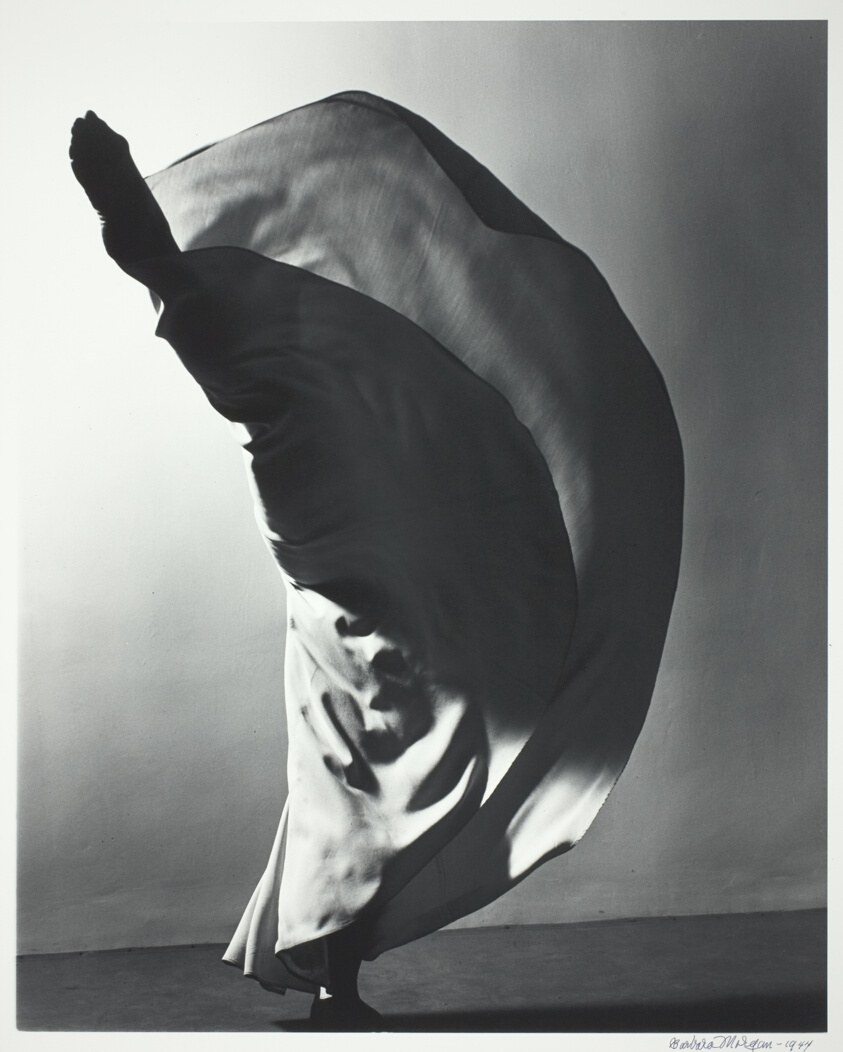
Valerie Bettis-Desperate Heart
Barbara Morgan American, 1900-1992
- Medium:
- Gelatin silver print
- Collection:
- Photography and Media
- Source:
- Art Institute of Chicago
- Rights:
- Rights reserved by the holding institution — do not reuse without permission. Source record ↗
- Recorded as:
- AIC — rights reserved
This image shows modern dance at a moment when the form was still fighting to establish itself as legitimate art—when an extreme pose like this *meant* something emotionally and was not merely decorative. For dancers and historians, it documents both Bettis's physical vocabulary and the photographic practice of Morgan, one of the few women photographers who achieved canonical status in 20th-century American art. The work also captures the particular American modernism of the 1940s, in which emotional extremity and physical risk were inseparable from artistic seriousness.
What you are looking at
A solitary figure photographed against a plain backdrop, captured mid-movement in a dramatically arched backward bend. The dancer's body forms a near-semicircular shape, with the head dropped back and one leg extended upward in a sharp angle, the other supporting the torso in an extreme contortion. A light, translucent fabric—possibly chiffon or silk—sweeps across the frame, caught in motion and creating sweeping diagonal lines that echo and amplify the body's curve. The photograph is rendered in high-contrast black and white, with strong sidelighting that casts the figure into dramatic silhouette while illuminating the fabric's movement. The setting is minimal and abstract: a plain floor and neutral background allow the body and cloth to dominate entirely. This is a moment of extreme physical vulnerability and extension, the kind of pose that reads as emotional extremity—fitting for a work titled *Desperate Heart*.
The dancing
A single dancer, photographed in profile or three-quarter view, executing an extreme backward arch—what in modern dance vocabulary would be described as a full-spine extension or dramatic backbend. The weight appears to be supported primarily by one leg, while the other leg extends upward and backward, the torso hollowed and the head thrown back in a gesture of abandon or surrender. The arms are less clearly articulated in shadow, but the overall frame suggests a release of control rather than a contained or supported hold. This is virtuosic flexibility and dramatic expression, not balletic technique or partnership.
The dance depicted
This is modern concert dance, captured in what appears to be a studio or stage setting. The extreme flexibility and emotional intensity of the pose suggest the work of an expressionist or primitive modern dance artist, likely American concert dance of the 1940s. Valerie Bettis was a prominent modern dancer and choreographer known for emotional, often anguished movement vocabulary—this image captures exactly the kind of raw physical expression her work demanded. The pose is not borrowed from ballet or any social dance tradition; it is a creature of modern dance's liberation of the body and its alignment of extreme physical positions with emotional or psychological states. The title *Desperate Heart* anchors the formal extremity to an emotional reading.
How it was made
This is a gelatin silver print, a photograph made from a photographic negative. The high contrast and dramatic lighting are characteristic of the photographic printing and studio lighting practice of the 1940s. Barbara Morgan was a pioneering dance photographer whose practice involved close collaboration with modern dancers; she typically worked in a studio with controlled lighting and often used the camera to isolate dancers against plain backgrounds, allowing the body itself to become the entire visual content. The print process allows for tonal control and contrast that emphasizes form; Morgan's choice of a plain backdrop and sidelighting heightens the sculptural quality of the pose. Photographs such as this circulated in dance magazines, exhibition catalogs, and arts publications, reaching dancers, choreographers, and educated audiences interested in modern dance.
About this work
Barbara Morgan's photograph of Valerie Bettis freezes a single moment of extreme physical and emotional expressivity—a backward arch so complete it borders on contortion, wrapped in moving fabric that amplifies the gesture. Bettis was a central figure in American modern dance, known for a vocabulary that married virtuosic flexibility with raw emotional delivery; this image is a perfect distillation of that practice. The photograph itself is an artwork: Morgan's composition, lighting, and printing choices transform a dance moment into a sculpture of human form and feeling. The work belongs in any history of how photography and modern dance intersected in mid-20th-century America, and of how photographers (especially women photographers) documented and shaped the visual culture of concert dance.
How to look at it
Look at the way Morgan has composed the frame: the dancer fills nearly the entire photograph, with no context, no stage, no other bodies. This forces you to read the pose as pure form and pure emotion—there is nowhere to look but at the body's extremity and the fabric's motion. The lighting casts the dancer in silhouette, flattening the form slightly, which paradoxically makes the curve of the spine and the extension of the limbs read even more dramatically. The moment Morgan chose is one of maximum extension and maximum vulnerability; this is not a pose of strength or control, but of surrender. Notice too how the translucent fabric becomes part of the gesture, doubling and amplifying the body's movement—Morgan understood that dancers don't move alone.
The artist
Barbara Morgan (1900–1992) was an American photographer and painter whose primary subject from the 1930s onward was modern dance. She trained as a painter but shifted her focus to photography after witnessing Martha Graham perform in 1938; she subsequently became the unofficial photographer of the American modern dance establishment, creating a vast archive of images of Graham, Merce Cunningham, Alvin Ailey, and other major figures. Her photographs combine a modernist sensibility—stark compositions, dramatic contrast, the body as pure form—with a deep understanding of dance movement and meaning. She worked primarily in black-and-white gelatin silver printing and was instrumental in elevating dance photography from documentation to fine art. Her work appeared in major exhibitions and publications and helped define how the American public understood modern dance visually.
The period
By 1944, American modern dance had matured into a vigorous and self-conscious art form, led by Graham and others who had explicitly rejected both classical ballet and folk or social dance as their model. The mid-1940s saw a flowering of emotional expressionism in modern dance, often tied to psychological or social content. Bettis herself was part of a generation of dancers (born in the 1910s and 1920s) who inherited Graham's technique and emotional intensity but developed their own vocabularies; her work was often more openly erotic, anguished, or physically extreme than Graham's. Photographically, this was also a period when serious artists and critics were beginning to recognize dance photography as an independent art form—not merely documentation but a creative medium in its own right. Morgan's practice was crucial to this recognition.
Where it lives
The photograph is held in the Photography and Media collection of the Art Institute of Chicago. It is a gelatin silver print, catalogued with accession information held by the institution.
Dance in this work
Questions about this work
Who was Valerie Bettis?
Valerie Bettis (1919–1982) was an American modern dancer and choreographer known for an intensely emotional and physically extreme movement vocabulary. She trained with Martha Graham and Hanya Holm, was a founding member of the Bettis-de Mille Dance Company, and created over 60 dances during her career. Her work often engaged with psychological and erotic themes and was notable for its lack of conventional restraint.
What is Barbara Morgan known for?
Barbara Morgan was one of the first and most important photographers of American modern dance. She photographed nearly every major modern dancer of the mid-20th century and published several influential books of dance photographs. Her work elevated dance photography to the status of fine art and helped establish the visual language through which modern dance was understood and disseminated.
What dance style is this?
This is American concert modern dance, the art form pioneered by Martha Graham and others in the 1930s and 1940s. It is characterized by an expressive vocabulary that draws on the full range of human movement—including extreme flexibilities, contractions, falls, and emotional extremity—and aligns physical form with psychological or emotional content. It is distinct from ballet, jazz, and social dance traditions.
Why photograph dance at all?
Dance is ephemeral and exists only in performance or rehearsal; photography freezes a moment and makes it permanent. For modern dance artists seeking legitimacy and visibility in the 1930s–1950s, photographs in magazines and books were essential to reaching audiences and establishing a canon. Morgan's photographs also transformed dance into visual art that could hang in galleries and museums, enlarging its cultural claims.
More dance artwork





