49 works in this view — arrow keys or swipe to move between them.
Dance in Art
Josephine Baker
Robert Brady (American, 1928–1986; permanent resident of Mexico, from 1961) Cuernavaca, Mexico
- Medium:
- Wool and cotton; tapestry weave
- Collection:
- Textiles
- Source:
- Art Institute of Chicago
- Rights:
- Rights reserved by the holding institution — do not reuse without permission. Source record ↗
- Recorded as:
- AIC — rights reserved
Josephine Baker was a transformative figure in twentieth-century dance and performance; her visibility in Paris challenged racial boundaries and redefined what audiences expected from entertainment and spectacle. This tapestry, created decades after Baker's greatest fame but during a period of revival and reassessment, testifies to her enduring visual and cultural power. For historians and dancers, the work shows how the dancing body—particularly a Black female body—became modern, iconic, and worthy of being translated into fine art textiles.
What you are looking at
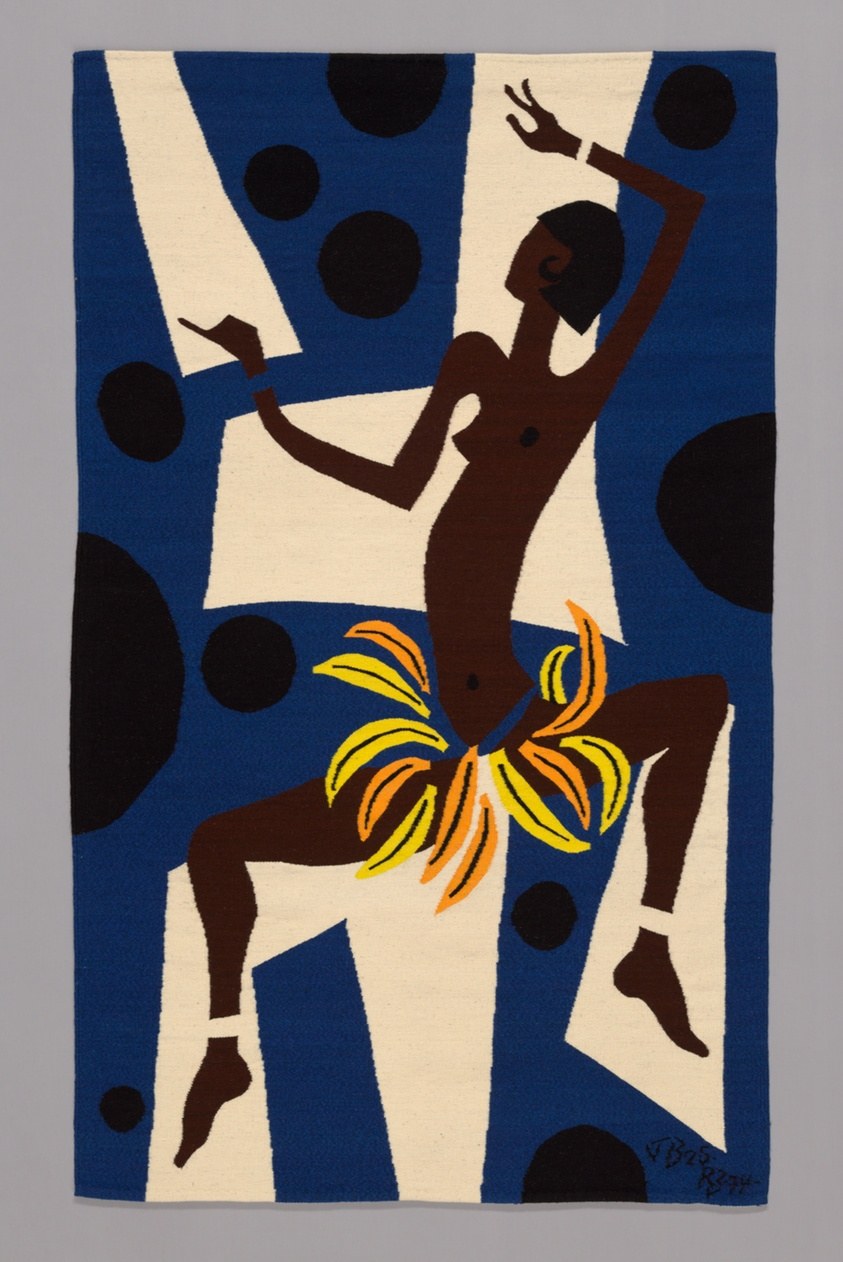
A figure in dark brown silhouette dances against a bold geometric ground of deep blue and cream stripes, punctuated by large black circles. The dancer's body is captured mid-leap or mid-gesture, with one arm raised dynamically overhead and the other extended outward, legs bent in an athletic stride. At the hip level, a striking burst of yellow and orange radiates outward like stylized bananas or feathered plumes—a signature element of 1920s entertainment costume. The composition is vertically oriented, with the figure centered and monumental against the patterned background. The stripes suggest movement or energy; the black circles float across the composition like stage lights or decorative motifs. The work reads as a portrait of exuberant, high-energy performance captured in the moment of maximum expression.
The dancing
The dancer is rendered as a single powerful silhouette in profile-frontal view, with clear anatomical articulation despite the flatness of the form. The raised arm reaches upward and back with fingers splayed, while the lower arm extends forward, creating a dynamic diagonal line through the torso. The legs are bent and splayed in a wide, grounded stance that suggests both stability and momentum—the weight appears to be in mid-transfer. The costume element at the hips (the banana burst) is prominent and decorative rather than functional, integrated into the overall gestural composition. The proportions are modern and stylized; this is not a naturalistic anatomy but an artist's interpretation of bodily expression.
The dance depicted
This is a portrait of Josephine Baker, the American-born French entertainer who became an international star in Paris during the 1920s Jazz Age. Baker famously danced in the 'Danse Sauvage' and other revue numbers at venues like the Théâtre des Champs-Élysées, often performing in a costume featuring a skirt of bananas—the very element depicted here. The gesture and energy in this work suggest high-energy popular dance of the jazz and cabaret tradition, though the abstraction and monumentality of the figure transcends any single step or technique. The work celebrates her kinetic virtuosity and the theatrical spectacle of her performances rather than documenting a specific choreography.
How it was made
This is a tapestry woven in wool and cotton, executed in the tapestry weave technique—a labor-intensive process in which colored threads are woven by hand across a loom to create the image. The flat, bold areas of solid color (brown, blue, cream, black, yellow, orange) and the clean edges between them are characteristic of tapestry work, which excels at graphic, high-contrast designs. Tapestry as a medium implies both artistic ambition (it is the medium of fine art and display) and a specific audience: the finished work would hang on a wall and be seen in domestic, institutional, or gallery contexts. The technique's constraint to flat color and bold forms aligns with the modernist and Art Deco aesthetics of the early twentieth century, suggesting this work participates in the translation of modernist design into textile arts.
About this work
This is a wool and cotton tapestry portrait of Josephine Baker, the transformative entertainer of the Jazz Age, created by American artist Robert Brady in 1974. The work captures Baker's iconic silhouette mid-performance, her body a bold brown form against a syncopated ground of blue, cream, and black, crowned with the famous yellow-and-orange banana motif that defined her stage costume. Brady, who spent much of his career in Mexico, brings a modernist sensibility to the subject: the figure is flattened and monumental, the composition geometric and rhythmic, the effect celebratory rather than documentary. The tapestry is both a portrait of an individual and an homage to the visual and kinetic energy of 1920s entertainment culture. This work belongs in any gallery of dance because it documents not a dance technique but the figure of the dancer as cultural icon—the way a performer's image, costume, and body become inseparable from modernist visual art.
How to look at it
Attend to the moment of maximum extension and lift captured by the artist—the raised arm, the splayed stance, the sense of propulsion. Notice how Brady uses the geometric background (the stripes and circles) not as a neutral stage but as a rhythmic field that reinforces the figure's energy; the composition is as much about pattern and movement in the ground as in the body itself. The monumental scale of the figure against the intimate medium of tapestry creates a dissonance: this is a grand public gesture rendered in a domestic, handmade form. Finally, observe how the banana costume element is abstracted into pure color and form—it is recognized instantly but is also thoroughly modernist, suggesting that Baker's body was always as much image and symbol as it was a dancing instrument.
The artist
Robert Brady (1928–1986) was an American painter, sculptor, and tapestry designer who became a permanent resident of Mexico from 1961 onward. He was known for bold, graphic modernist work informed by both European abstraction and Mexican folk and decorative traditions. Brady worked extensively in textiles and created designs for tapestries woven by master artisans, combining his interest in color, pattern, and figuration. His work often depicted performers, musicians, and dancers, celebrating the human figure and popular culture through a modernist formal language. The Josephine Baker tapestry exemplifies his approach: a historical cultural figure transformed into a design of geometric rigor and chromatic intensity.
The period
The 1920s–1930s, when Baker achieved her greatest fame in Paris, was a moment of profound cultural ferment: the Jazz Age, the Harlem Renaissance, the emergence of modernism in visual art, and significant racial and gender upheaval. Baker's performances were controversial and celebrated in equal measure; she became a symbol of modernity, racial transgression, and female artistic authority. By the 1970s, when Brady created this work, Baker was being reassessed and celebrated as a civil rights activist and cultural pioneer. The tapestry's 1974 date places it in an era of renewed interest in African American cultural history, Pop Art's embrace of popular imagery, and the continuation of modernist formal experimentation in textiles and design.
Where it lives
The work is held in the Textiles collection of the Art Institute of Chicago. It is catalogued as a tapestry, a classification that positions it as a fine art textile rather than a decorative or commercial product, reflecting the mid-twentieth-century elevation of fiber arts to gallery status.
Dance in this work
Questions about this work
Who was Josephine Baker?
Josephine Baker (1906–1975) was an American-born French entertainer, dancer, and singer who became an international star in Paris during the 1920s. She was known for her high-energy performances in jazz revues, her iconic banana skirt costume, and her later activism in the Civil Rights Movement. She became a French citizen in 1937 and lived much of her life in France.
Why the bananas?
The banana skirt (or banana costume) was part of Baker's stage costume in the 'Danse Sauvage' and other popular numbers. It was a theatrical element that made her performances visually distinctive and memorable. The costume has been both celebrated as iconic and critiqued as perpetuating racial stereotypes; it is historically inseparable from Baker's image but should be understood in context.
What is tapestry weave?
Tapestry weave is a hand-weaving technique in which colored threads are interlaced to create an image, typically on a vertical loom. Unlike other weaving techniques, the colored threads are not continuous across the width; instead, they are woven only in their designated color areas, creating bold, high-contrast designs. This technique produces a durable, displayable textile suitable for wall hanging and is often used for fine art.
Why create a tapestry of Baker in 1974?
By the 1970s, Baker was being reassessed as a pioneering artist and civil rights activist. Creating a monumental tapestry of her silhouette was a way of honoring her legacy and translating her iconic status into fine art. Brady's choice of tapestry—a traditional, artisanal medium—may suggest a desire to create something enduring and dignified from her image.
More dance artwork





